Loading...
Gadget by The Blog Doctor.

Showing posts with label Tarneit. Show all posts

Thursday, April 2, 2009

The Manera

Our friends, and neighbours, David and Glenda Horne, own a boat. the Manera that is moored at Yaringa Marina on Westernport Bay.

Yesterday we travelled to join them on the boat.

This post is quite long, so if you just want to view the photos follow this link.

The map below shows the location of the Marina (the place mark at the top). The map can be operated like a normal Google Map, but it is probably better to click on the View Larger Map link at the bottom. If you choose the Satellite option and zoom in as far as possible the place mark is pointing at the Manera.


View Larger Map


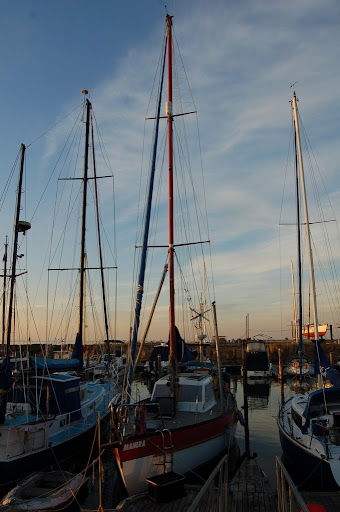
We arrived after dark, boarded, and walked down the fore deck shown in the photo.


After a convivial supper in the Manera's spacious main cabin we retired for the night.


Thursday morning dawned bright and fine ...
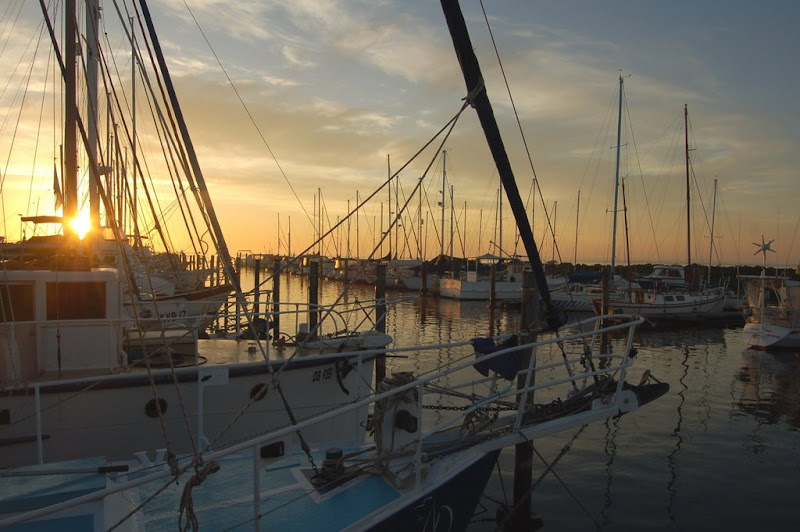


... giving us a clearer view of the boat.


Unfortunately, I didn't take many pictures of the interior, but the photos on this link clearly show that there is plenty of room down below, in a Swanson 42.


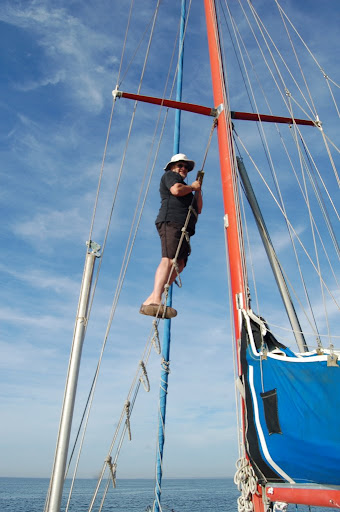
After checking over the boat, which included the rigging as can be seen in the photograph, David and Glenda manoeuvred the yacht from its tight berth into the main channel of the marina. This required some magic with ropes and at the helm.


Incidentally, that ladder that David is standing on, is called the ratlines, pronounced "ratlns".


According to Glenda, the sight of David on the ratlines is a rarity, as it is she who usually climbs the higher areas of the boat.


With Glenda at the helm we gently motored out of the marina. Westernport is very tidal, and we could only access the deeper water via channels. Sailing times are not determined by the whim of the captain, but by the requirements of the tide. We left at 9:20 am to ensure that our boat, with a draft of 1.8 metres could negotiate the two shallow places in the channel. David and Glenda discovered this once when sailing, getting firmly stuck on one of the shallow places. Although they spent a worrying couple of hours, they learned important information about the characteristics of the Manera on that occasion. The tide was still receding when they stuck fast, and after a while the boat rapidly tilted over to a 45 degree angle. Some boats do not recover well from such a predicament, but happily as the tide started rising, some hours later, the boat quickly righted itself.

When we finally cleared the channel, after about one nautical mile, David and his friend Jim, raised the sails. The Manera has a cutter rig, meaning that it has one mast, a mainsail, and can have two headsails set. We sailed with only the mainsail and one headsail.

I will try to use technical, nautical terms so the diagram below might be of help in deciphering my descriptions.


1 main sail


2 jib


3 spinnaker


4 hull


5 centre board


6 rudder


7 skeg


8 mast


9 spreader


10 shroud


11 main sheet


12 boom


13 mast


14 boom


15 backstay


16 forestay


17 vang


Another useful reference is this Wikipedia article.

The mainsail is raised using a rope called the main halyard.

The headsail is furled (wound) around the forestay, which is a piece of standing rigging which keeps a mast from falling backwards. It is attached to the top of the mast, at one end and to the bow of the boat at the other.

Before we left the marina, David had attached two ropes, called the headsail sheets, to the free corner of the headsail, the clew. These sheets were run through pulleys back to the cockpit, where the helm is located. David pulled the leeward sheet using a winch to set the headsail into position.

For a while the wind was too light for the sails to provide forward motion, though the water though the tide was moving us, slowly, in reference to the bottom of the bay. After a few minutes Glenda gave over the helm to Jim, a friend who lives on his boat at the marina. Jim is an experienced sailor, having participated in the >Sydney-Hobart race.

David and Glenda have also has experience in blue water sailing. They purchased the Manera in Brisbane and sailed the boat back to Victoria, with the help of Jim and a few other friends. They have also sailed her to from Western Port to Wilson's Promontory.

After Jim had sailed the boat for a while I took over the helm. This task is not quite as easy as it seems, as there are a range of issues to be considered.

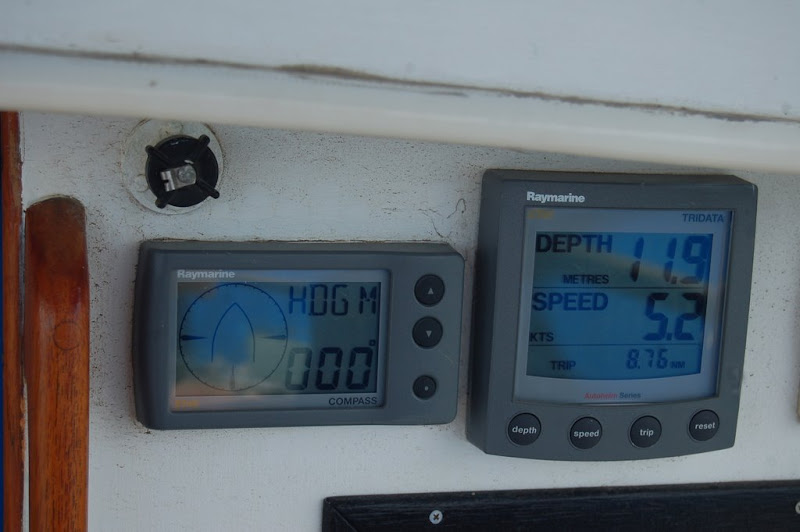
An appropriate heading has to be determined. It is not always possible to go directly to the destination - the wind might be blowing from an inappropriate quarter, and shallow water has to be avoided. One method of keeping on the chosen heading is to pick out a landmark in the right direction and sail towards it. There are also instruments available to assist in maintaining the heading. The Manera has three of them, the compass at the helm, and electronic compass as shown at left in the photo below ...


... and the chart plotter, below.


The chart plotter provides a great deal of information. The black oval shape near the bottom of the screen is the location of the boat. The heading can be seen (on the right) as 357 degrees (this photograph was taken while we were returning to the marina). The green line shows the heading graphically and the blue line with arrow is the direction of the tide. The boat's speed of 7.4 nautical miles is a combination of speed through water and the tide. The white areas signify deeper water, the shallow blue areas should be avoided.

The depth of the water can be monitored in two ways. The first is via the depth meter next to the electronic compass the second is by using the chart plotter.

The third issue to be monitored was brought home to me when Jim cautioned me to watch the wind direction which was heading around aft, and which could cause an unintentional gybe. The definition of a gybe (or jibe) below is taken from this site.

A jibe or gybe is a sailing maneuver where a sailing vessel turns its stern through the wind, such that the wind direction changes from one side of the boat to the other. ... In this maneuver the mainsail will cross the center of the boat while the jib (foresail) is pulled to the other side of the boat.


As a result of Jim's comment I adjusted the heading a little to port (the left). An instrument is available to determine the direction of the wind, relative to the boat. It is shown to the right of the clock in the photo below.


The photograph was taken on our return trip, when we were using the motor rather than the sails. At the time of the photograph, the wind was coming from about 15 degrees to starboard. When I took over the helm the ideal direction of the wind was 120 degrees on the port side. After Jim's warning I carefully watched the wind direction.

As well as heading, depth of water and wind direction, the person at the helm must regularly scan the water for other vessels.

About 10 or 15 minutes after I took over the helm we started to approach the shallower water (as indicated by the chart plotter) and a change of heading was required. As we were reaching, in fact close to a broad reach, the appropriate manoeuvre was a gybe (described above).

Jim adjusted the main sheet to make sure that the boom did not come across too fast. Then David loosened the starboard headsail sheet (from the winch) and after I turned the helm to starboard, Jim pulled in the port headsail sheet, until the sail was positioned and drawing air on the port side. While all of this was going on, the main automatically changed from starboard to port.

We sailed for a while toward Lysart's pier and then gybed back to port.

We then sailed on passing French Island to port and the Mornington Peninsula to starboard, with me at the helm ...


and, Frankie ...
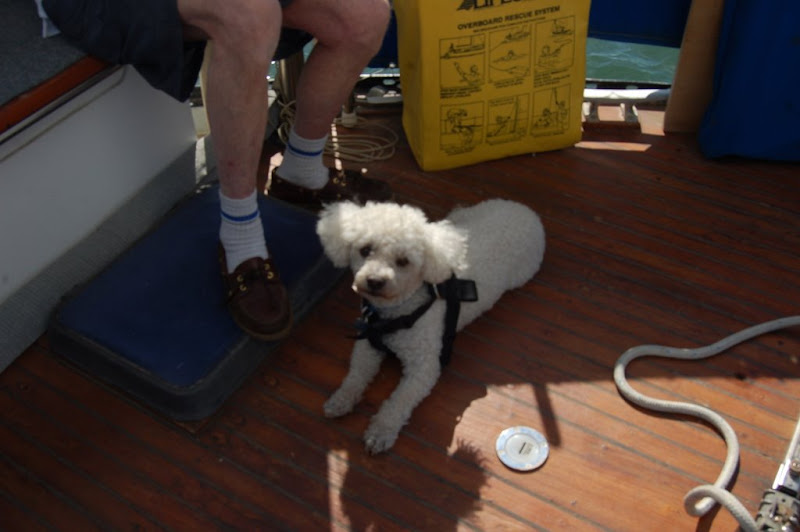


... Glenda ...


... Margaret ...
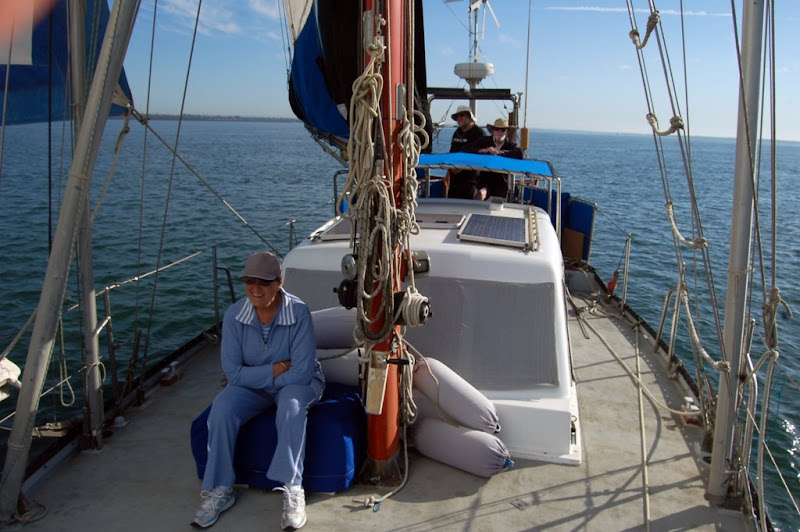


... Jim ...
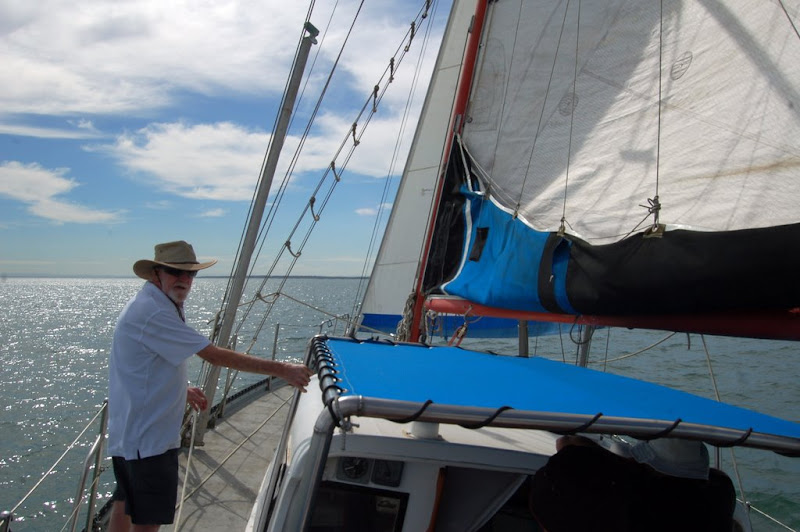


... and David ...
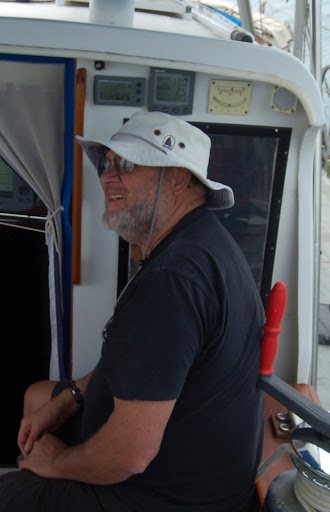


... chilling.

A mile of so east of Cowes, on Philip Island, we noticed one of the Bass Straight oil platforms moored near the shore. A few hundred metres off Cowes we decided that we had travelled far enough to the south and decided to turn start our return to the marina. This time the appropriate turn was a tack. This involves turning the boat through the wind. It is important to have plenty of speed before performing a tack, as part of the way through the procedure, the boat looses power as it is pointing directly into the wind.

I turned the helm hard to starboard, and David and Jim started to move the headsail from port to starboard. Just after we had passed the half way point, they held the headsail in only part of the way across to get wind into it as quickly as possible so we could complete the turn as quickly. Then they secured the sail to its new position on the port side. Naturally the mainsail moved across automatically.

We took a heading reasonably close to the wind (close hauled), with the sails trimmed in fairly tightly. This was to avoid excessive rolling as Glenda was below preparing lunch - hot crossed buns and watermelon.

While we were sailing between Mornington Peninsula and French Island, we heard a radio communication with the ship Iron Monarch. Looking around we could see the ship a couple of miles aft. It was travelling much faster than we were and relatively soon it caught up to us and passed us. We kept out of its way, which was fairly easy as it had to stay in the channel.

Soon after we noticed that we were on a potential collision course with a trimaran. We watched the boat closely. We had the right of way as we were on starboard tack and he was on port tack, but not all sailors take notice of the rules. Happily the trimaran sailor did know the rules as he changed direction to pass aft of us.

The wind was coming from the direction we needed to go, so we were sailing close hauled, close to the wind, but not making much headway as the wind was dying. Consequently, we took down the sails and started motoring. There are not many landmarks in the northern section of Westernport, which would make for difficulties in finding the channel to the marina, if it were not for the fact that it was clearly marked on the chart plotter.

I was still at the helm, when David and Jim started a conversation about araldite. I suspected that it was about me, which was confirmed when they explained that someone who does not easily give up the helm is called Captain Alaldite. This has become my nickname according to David.

Six hours after leaving we arrived back at the marina. After a peaceful few hours on deck, a pleasant dinner, Margaret and I headed home into the sunset ...
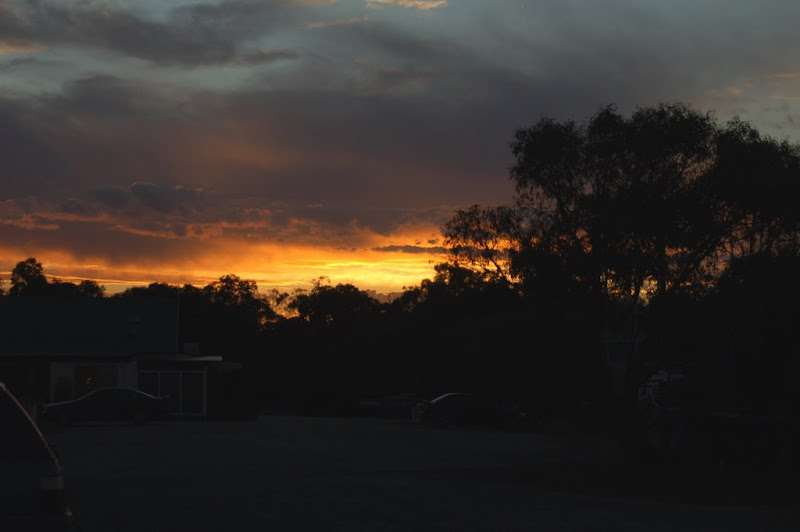


... while Glenda and David stayed another couple of days on the yacht.


Tuesday, March 3, 2009

Mystery Picture

What do you think this is a picture of?


To check your answer click to read the rest of the post.


Water running into our new water tank.

Rare indeed in Melbourne!

Saturday, February 21, 2009

The Birthday Paradox

Recently two of my friends (and neighbours) in the village noticed that they shared a birthday. They expressed surprise at this revelation because it seems improbable. Actually it is likely that a relatively small group of people will have two members with the same birthday. For instance, with groups of 25 people, two will have birthdays on the same day of the year in 56% of cases; with groups of 60 the likelihood increases to more than 99%. These apparently unlikely facts can be demonstrated by some simple maths.

The simplest way to start this is to investigate the likelihood that people do not have the same birthday. The probability t hat two people do not have the same birthday is 364 / 365 , as there is only one chance in 365 that one person's birthday will coincide with another's). The probability that a third person's birthday will differ from the other two is 363 / 365; a fourth person's 362 / 365; a fifth person's 361 / 365; ans so on to the fraction for the 25th person which is 341 / 365. This gives us 24 fractions that have to be multiplied together to reach the probability that all 25 birthdays are different. This gives a percentage of 43.13%. Given that there are only two alternatives, either no birthdays match or two (or more) do match. Therefore the probability that there will be a match is 100 - 43.13 = 56.87%

I calculated these percentages in a spreadsheet. The formulas that I used are shown in the picture below. (Naturally, just enter them in row 3 and fill down.)


For a larger and clearer version click on this link.
I also charted the spreadsheet. The probabilities can be read off the chart below:


For a larger and clearer version click on this link.

So what to make of my friends' birthday coincidence. There are eleven people living in our street. If we just consider this group the birthday coincidence is relatively unlikely at 14% though not at all impossible. If you consider the wider village with almost 150 people it is virtually a certainty that two people will have the same birthday. Although I haven't checked, I expect that there is likely to be at least one other birthday coincidence.

Thursday, May 15, 2008

New House

Well we have finally settled into our new house

Click on the photo below to see the full photographic set.

House


Here is a slide show of the pictures:


Our details are:
Address: 54/250 Thames Blvd Tarneit, 3029
Phone: 87342354
Mobile: 0412212755
Email: stespe@premiertarneit.co.au or stespe1@gmail.com

Monday, January 28, 2008

Australia Day Celebration 08

At Tarneit Skies Retirement Village, we had an Australia Day celebration. It was organised by Pat Hickey with a large group of assistants.

About 145 people attended showing that the residents of the Village supported the celebration enthusiastically.

My photos can be found at this link

To whet your appetite here is a slide show of the pictures:


As can be seen from the pictures, tables had been set up for all those attending.

The celebration was started by a stirring rendition of the National Anthem.

The first activity was the thong and gumboot throw. Women threw a thong (foot variety) men threw a "gumboot" (small variety). The aim was to land the object in a bucket. None of the men were successful, but two women succeeded: Pam Radford and Judy Barned.

The video below shows a small part of the thong and gumboot throw. Click on the play button to view it.


Meat and chicken platters were provided and residents bought plates of salad and desert. Consequently the buffet table was heavily laden with luscious food. We all ate our fill (and a bit more for some of us).

The steady hum of conversation around the tables showed that everyone was having a great time and it sometimes gave Pat a challenge to be heard as he made his announcements.

Pat had provided a "show bag" of activities for each person attending which contained a wide range of interesting items. These included gap fill exercises for Banjo Patterson's poem Clancy of the Overflow and a quiz. See this link for electronic version of some of the activities.

Pat had organised a large number of prizes for the raffle and many people received an extra surprise when their ticket was drawn from the box.

Although there was a residents' meeting in the Community Centre in June 2007, this was the first activity in the Centre since it has become habitable.

We all had a great time, and for me as a new resident, it was fantastic to be able to attend such a great party and then walk home!

Thursday, January 17, 2008

Mystery Trip

Today we went on a Mystery Bus Trip organised by Tarneit Skies.

The trip was free, all that we had to pay for was morning tea and lunch.
There was considerable discussion about our destination as we drove out of The Village, including Bendigo, Ballarat and the Mornington Peninsular. It soon became obvious that we were headed north as we travelled north along Derrimut Rd. Margaret and I had planned to investigate the section of Derrimut Rd north of Dohertys Rd and here was our chance.

Our driver was careful to keep our destination secret as long as possible as he travelled along secondary roads that many of us had never seen before. This reminded me of the book Zen and the Art of Motorcycle Maintenance which involves travel across the US only on secondary roads, as they are far more interesting.

The map below shows the route we took.
Zoom in and out by clicking on the plus or minus signs, or by double clicking on a location. Move the map by clicking on an arrow key or by clicking and dragging with the mouse. Click on each of the place holders for details.

View Larger Map

We had morning tea at Woodend - tea or coffee and Scones, Jam and Cream.

At Kyneton we visited Kyneton Fine China which produces fine china pieces that were hand painted. We watched one of the proprietors painting one of the pieces. Every one was impressed with the quality and some of our number bought items.

Lunch was at the Kyneton RSL. We arrived 20 minutes early for pre-dinner drinks and of cause the pokies. Some of our group came out well ahead when they left the gaming room. No names no pack drill.

Most of us chose from the Specials Board, with the Risotto and Fish and Chips particular favourites.

I expected that we would head back home after lunch, but instead we drove west from Kyneton and ended up at the Chocolate Mill, which imports Belgian chocolate and makes chocolates by hand.

We then returned home after a very happy day.

It is great to go on a trip like this, where the driving and navigation are someone else's problem, and where it is possible to have a drink at lunchtime without concern for safely driving home.

Wednesday, July 11, 2007

The move to Tarneit

As I described in the Tarneit Skies post we are going to move to a Retirement Village. This involves many processes. We have recently been given a probable move in date by Tarneit. It looks likely that we will move in during the last week of November. As a result we have started the house selling process. This will be a long and detailed process. More posts to come on our experiences.

Tuesday, July 10, 2007

Tarneit Skies

More than a year ago Margaret and I decided to downsize. We are quite capable of maintaining our house and garden for another ten years or more, but we can't really see the point. The house is a little too big for us and is now 50 years old, so it has few modern touches. As well keeping our garden alive during last summer's El-Nino was a nightmare that we don't want to face again. Neither of us are avid gardeners, we just want the yard to look neat and cared for but don't particularly enjoy working in the garden. All the same, at the right time of the year the garden looks pretty good, as shown by the photo. Click on it to see a larger view.

If we are going to downsize it doesn't make much sense to find an anonymous flat in the suburbs, it seems to us to make more sense to live in a community. We also intend to spend much of our retirement traveling (hence the name of this blog). Already we have booked three holidays totalling 8 weeks in 2008. For details see the Travel Plans post. We therefore want a home base that is secure when we are away. Often on holidays we think (separately) about the security of our home - ie has anyone burgled or trashed it? We also want to be close to facilities such as a pool, gym, restaurant, library, theatre and to self improvement and study groups such as a well resourced craft group.

We found all of these requirements at a retirement village called Tarneit Skies which is in Tarneit near Werribee. There is a gym, pool, restaurant, library and small theatre less than a minutes walk from our prospective front door. As well it becomes a "gated community" at night which is when a house is most at risk.

Many people suggest that we are too young for this step with the idea that Retirement Villages are for old people. There are three problems with this idea. Firstly, it assumes that older people are not interesting, which we have found not to be true - see my post Valuing Old Folks. Secondly, we will not forget all of our current friends and relatives, and thirdly most of the current residents that we have met do not seem to be "old" to us.

We are now in the business end of this life transition which I will outline in more posts to come.