I like the title given to this video:
Someone Should Have Told This Girl That This Can't Be Done
Showing posts with label Sport. Show all posts
Showing posts with label Sport. Show all posts
Sunday, September 4, 2011


Thursday, April 2, 2009
The Manera
Our friends, and neighbours, David and Glenda Horne, own a boat. the Manera that is moored at Yaringa Marina on Westernport Bay.
Yesterday we travelled to join them on the boat.
This post is quite long, so if you just want to view the photos follow this link.
The map below shows the location of the Marina (the place mark at the top). The map can be operated like a normal Google Map, but it is probably better to click on the View Larger Map link at the bottom. If you choose the Satellite option and zoom in as far as possible the place mark is pointing at the Manera.
View Larger Map
Thursday morning dawned bright and fine ...
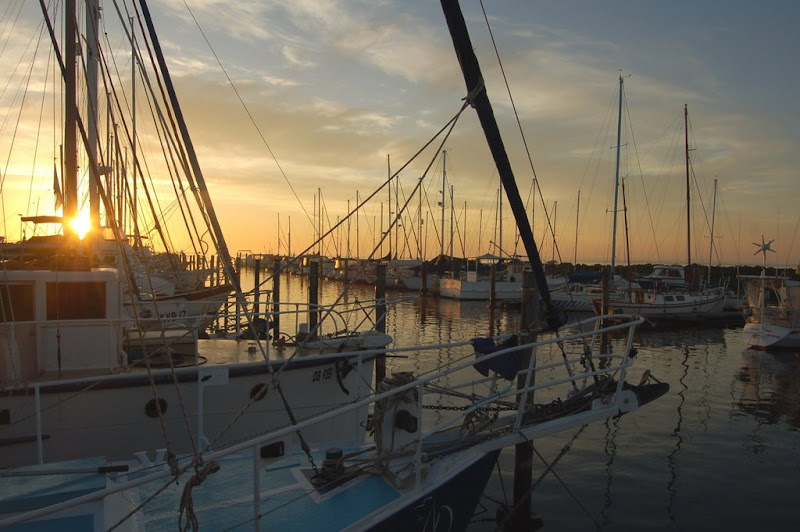
Unfortunately, I didn't take many pictures of the interior, but the photos on this link clearly show that there is plenty of room down below, in a Swanson 42.
With Glenda at the helm we gently motored out of the marina. Westernport is very tidal, and we could only access the deeper water via channels. Sailing times are not determined by the whim of the captain, but by the requirements of the tide. We left at 9:20 am to ensure that our boat, with a draft of 1.8 metres could negotiate the two shallow places in the channel. David and Glenda discovered this once when sailing, getting firmly stuck on one of the shallow places. Although they spent a worrying couple of hours, they learned important information about the characteristics of the Manera on that occasion. The tide was still receding when they stuck fast, and after a while the boat rapidly tilted over to a 45 degree angle. Some boats do not recover well from such a predicament, but happily as the tide started rising, some hours later, the boat quickly righted itself.
When we finally cleared the channel, after about one nautical mile, David and his friend Jim, raised the sails. The Manera has a cutter rig, meaning that it has one mast, a mainsail, and can have two headsails set. We sailed with only the mainsail and one headsail.
I will try to use technical, nautical terms so the diagram below might be of help in deciphering my descriptions.
Another useful reference is this Wikipedia article.
The mainsail is raised using a rope called the main halyard.
The headsail is furled (wound) around the forestay, which is a piece of standing rigging which keeps a mast from falling backwards. It is attached to the top of the mast, at one end and to the bow of the boat at the other.
Before we left the marina, David had attached two ropes, called the headsail sheets, to the free corner of the headsail, the clew. These sheets were run through pulleys back to the cockpit, where the helm is located. David pulled the leeward sheet using a winch to set the headsail into position.
For a while the wind was too light for the sails to provide forward motion, though the water though the tide was moving us, slowly, in reference to the bottom of the bay. After a few minutes Glenda gave over the helm to Jim, a friend who lives on his boat at the marina. Jim is an experienced sailor, having participated in the >Sydney-Hobart race.
David and Glenda have also has experience in blue water sailing. They purchased the Manera in Brisbane and sailed the boat back to Victoria, with the help of Jim and a few other friends. They have also sailed her to from Western Port to Wilson's Promontory.
After Jim had sailed the boat for a while I took over the helm. This task is not quite as easy as it seems, as there are a range of issues to be considered.
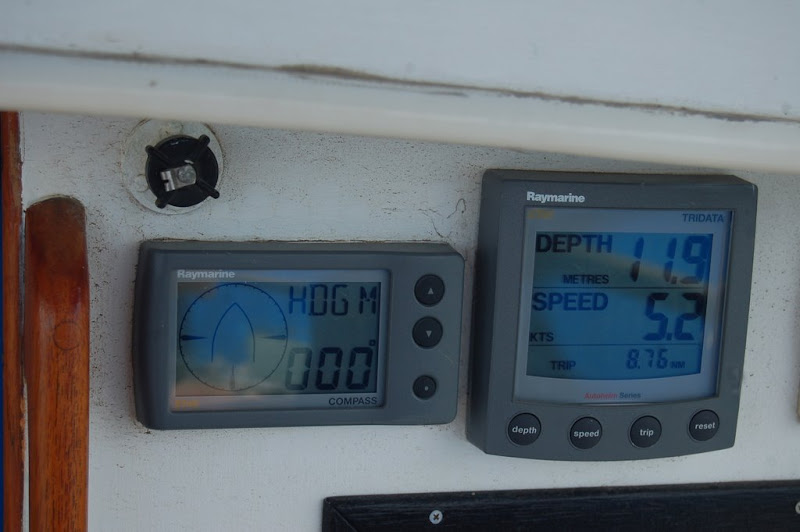
An appropriate heading has to be determined. It is not always possible to go directly to the destination - the wind might be blowing from an inappropriate quarter, and shallow water has to be avoided. One method of keeping on the chosen heading is to pick out a landmark in the right direction and sail towards it. There are also instruments available to assist in maintaining the heading. The Manera has three of them, the compass at the helm, and electronic compass as shown at left in the photo below ...
... and the chart plotter, below.

The chart plotter provides a great deal of information. The black oval shape near the bottom of the screen is the location of the boat. The heading can be seen (on the right) as 357 degrees (this photograph was taken while we were returning to the marina). The green line shows the heading graphically and the blue line with arrow is the direction of the tide. The boat's speed of 7.4 nautical miles is a combination of speed through water and the tide. The white areas signify deeper water, the shallow blue areas should be avoided.
The depth of the water can be monitored in two ways. The first is via the depth meter next to the electronic compass the second is by using the chart plotter.
The third issue to be monitored was brought home to me when Jim cautioned me to watch the wind direction which was heading around aft, and which could cause an unintentional gybe. The definition of a gybe (or jibe) below is taken from this site.
As a result of Jim's comment I adjusted the heading a little to port (the left). An instrument is available to determine the direction of the wind, relative to the boat. It is shown to the right of the clock in the photo below.

The photograph was taken on our return trip, when we were using the motor rather than the sails. At the time of the photograph, the wind was coming from about 15 degrees to starboard. When I took over the helm the ideal direction of the wind was 120 degrees on the port side. After Jim's warning I carefully watched the wind direction.
As well as heading, depth of water and wind direction, the person at the helm must regularly scan the water for other vessels.
About 10 or 15 minutes after I took over the helm we started to approach the shallower water (as indicated by the chart plotter) and a change of heading was required. As we were reaching, in fact close to a broad reach, the appropriate manoeuvre was a gybe (described above).
Jim adjusted the main sheet to make sure that the boom did not come across too fast. Then David loosened the starboard headsail sheet (from the winch) and after I turned the helm to starboard, Jim pulled in the port headsail sheet, until the sail was positioned and drawing air on the port side. While all of this was going on, the main automatically changed from starboard to port.
We sailed for a while toward Lysart's pier and then gybed back to port.
We then sailed on passing French Island to port and the Mornington Peninsula to starboard, with me at the helm ...

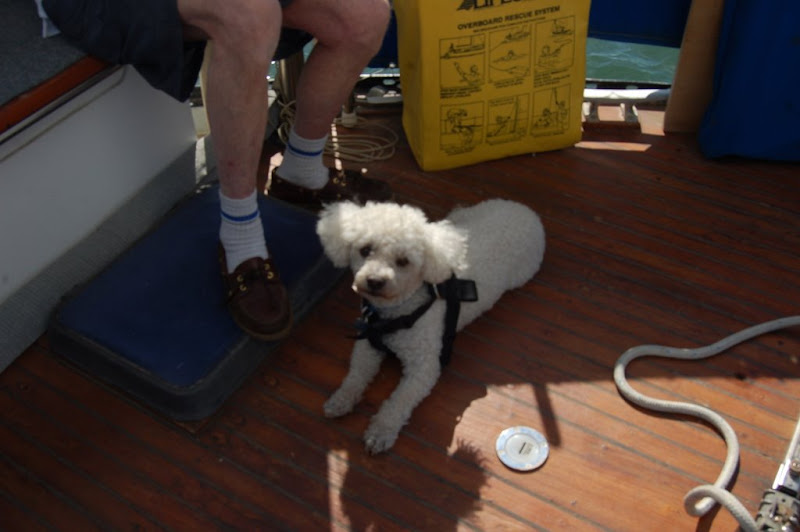
and, Frankie ...
... Glenda ...

... Margaret ...
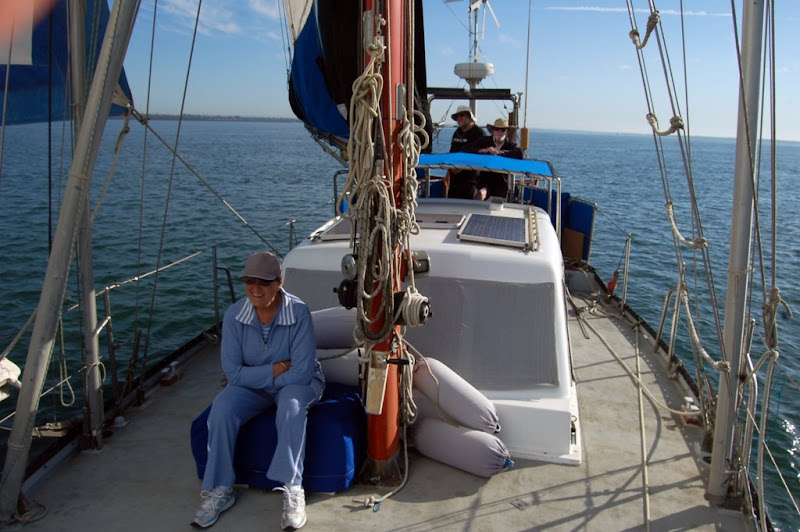
... Jim ...
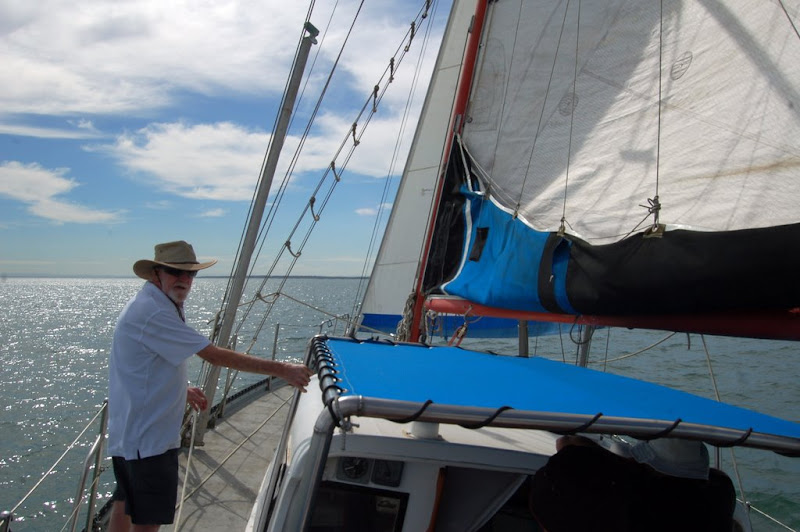
... and David ...
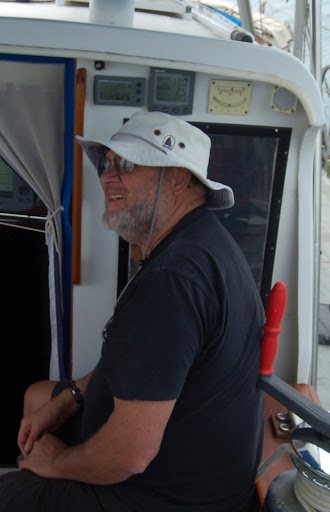
... chilling.
A mile of so east of Cowes, on Philip Island, we noticed one of the Bass Straight oil platforms moored near the shore. A few hundred metres off Cowes we decided that we had travelled far enough to the south and decided to turn start our return to the marina. This time the appropriate turn was a tack. This involves turning the boat through the wind. It is important to have plenty of speed before performing a tack, as part of the way through the procedure, the boat looses power as it is pointing directly into the wind.
I turned the helm hard to starboard, and David and Jim started to move the headsail from port to starboard. Just after we had passed the half way point, they held the headsail in only part of the way across to get wind into it as quickly as possible so we could complete the turn as quickly. Then they secured the sail to its new position on the port side. Naturally the mainsail moved across automatically.
We took a heading reasonably close to the wind (close hauled), with the sails trimmed in fairly tightly. This was to avoid excessive rolling as Glenda was below preparing lunch - hot crossed buns and watermelon.
While we were sailing between Mornington Peninsula and French Island, we heard a radio communication with the ship Iron Monarch. Looking around we could see the ship a couple of miles aft. It was travelling much faster than we were and relatively soon it caught up to us and passed us. We kept out of its way, which was fairly easy as it had to stay in the channel.
Soon after we noticed that we were on a potential collision course with a trimaran. We watched the boat closely. We had the right of way as we were on starboard tack and he was on port tack, but not all sailors take notice of the rules. Happily the trimaran sailor did know the rules as he changed direction to pass aft of us.
The wind was coming from the direction we needed to go, so we were sailing close hauled, close to the wind, but not making much headway as the wind was dying. Consequently, we took down the sails and started motoring. There are not many landmarks in the northern section of Westernport, which would make for difficulties in finding the channel to the marina, if it were not for the fact that it was clearly marked on the chart plotter.
I was still at the helm, when David and Jim started a conversation about araldite. I suspected that it was about me, which was confirmed when they explained that someone who does not easily give up the helm is called Captain Alaldite. This has become my nickname according to David.
Six hours after leaving we arrived back at the marina. After a peaceful few hours on deck, a pleasant dinner, Margaret and I headed home into the sunset ...
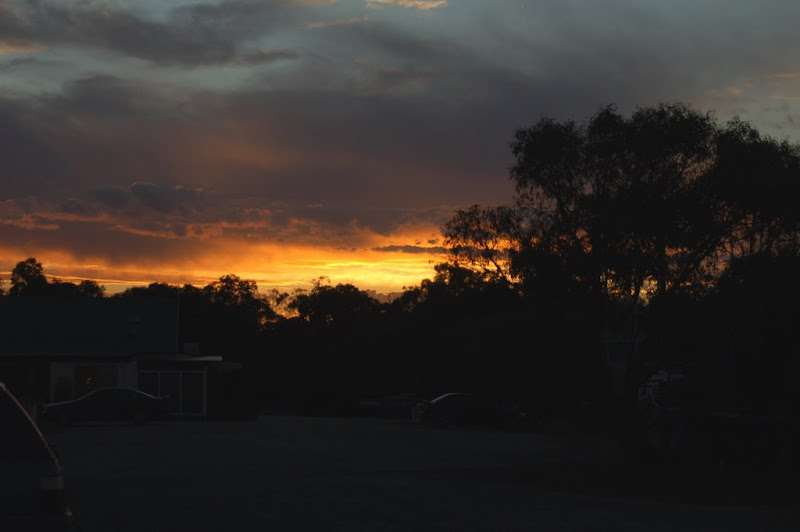
... while Glenda and David stayed another couple of days on the yacht.
Yesterday we travelled to join them on the boat.
This post is quite long, so if you just want to view the photos follow this link.
The map below shows the location of the Marina (the place mark at the top). The map can be operated like a normal Google Map, but it is probably better to click on the View Larger Map link at the bottom. If you choose the Satellite option and zoom in as far as possible the place mark is pointing at the Manera.
View Larger Map
 | We arrived after dark, boarded, and walked down the fore deck shown in the photo.
|
Thursday morning dawned bright and fine ...
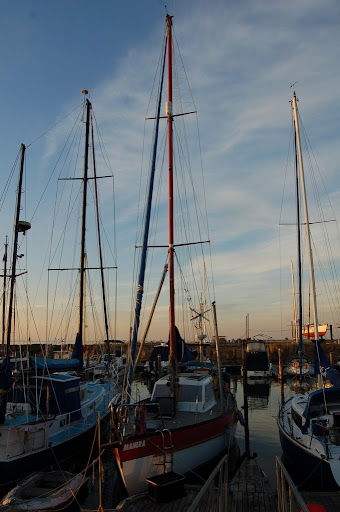 | ... giving us a clearer view of the boat. |
Unfortunately, I didn't take many pictures of the interior, but the photos on this link clearly show that there is plenty of room down below, in a Swanson 42.
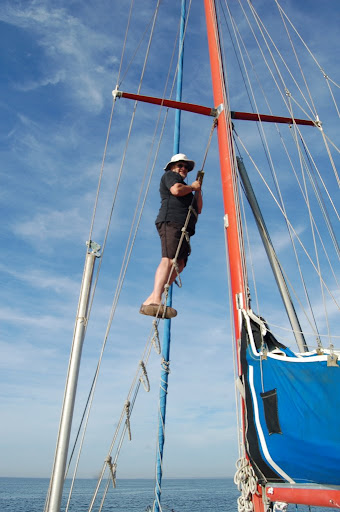
| After checking over the boat, which included the rigging as can be seen in the photograph, David and Glenda manoeuvred the yacht from its tight berth into the main channel of the marina. This required some magic with ropes and at the helm.
|  |
With Glenda at the helm we gently motored out of the marina. Westernport is very tidal, and we could only access the deeper water via channels. Sailing times are not determined by the whim of the captain, but by the requirements of the tide. We left at 9:20 am to ensure that our boat, with a draft of 1.8 metres could negotiate the two shallow places in the channel. David and Glenda discovered this once when sailing, getting firmly stuck on one of the shallow places. Although they spent a worrying couple of hours, they learned important information about the characteristics of the Manera on that occasion. The tide was still receding when they stuck fast, and after a while the boat rapidly tilted over to a 45 degree angle. Some boats do not recover well from such a predicament, but happily as the tide started rising, some hours later, the boat quickly righted itself.
When we finally cleared the channel, after about one nautical mile, David and his friend Jim, raised the sails. The Manera has a cutter rig, meaning that it has one mast, a mainsail, and can have two headsails set. We sailed with only the mainsail and one headsail.
I will try to use technical, nautical terms so the diagram below might be of help in deciphering my descriptions.
 | 1 main sail |
Another useful reference is this Wikipedia article.
The mainsail is raised using a rope called the main halyard.
The headsail is furled (wound) around the forestay, which is a piece of standing rigging which keeps a mast from falling backwards. It is attached to the top of the mast, at one end and to the bow of the boat at the other.
Before we left the marina, David had attached two ropes, called the headsail sheets, to the free corner of the headsail, the clew. These sheets were run through pulleys back to the cockpit, where the helm is located. David pulled the leeward sheet using a winch to set the headsail into position.
For a while the wind was too light for the sails to provide forward motion, though the water though the tide was moving us, slowly, in reference to the bottom of the bay. After a few minutes Glenda gave over the helm to Jim, a friend who lives on his boat at the marina. Jim is an experienced sailor, having participated in the >Sydney-Hobart race.
David and Glenda have also has experience in blue water sailing. They purchased the Manera in Brisbane and sailed the boat back to Victoria, with the help of Jim and a few other friends. They have also sailed her to from Western Port to Wilson's Promontory.
After Jim had sailed the boat for a while I took over the helm. This task is not quite as easy as it seems, as there are a range of issues to be considered.
An appropriate heading has to be determined. It is not always possible to go directly to the destination - the wind might be blowing from an inappropriate quarter, and shallow water has to be avoided. One method of keeping on the chosen heading is to pick out a landmark in the right direction and sail towards it. There are also instruments available to assist in maintaining the heading. The Manera has three of them, the compass at the helm, and electronic compass as shown at left in the photo below ...
... and the chart plotter, below.

The chart plotter provides a great deal of information. The black oval shape near the bottom of the screen is the location of the boat. The heading can be seen (on the right) as 357 degrees (this photograph was taken while we were returning to the marina). The green line shows the heading graphically and the blue line with arrow is the direction of the tide. The boat's speed of 7.4 nautical miles is a combination of speed through water and the tide. The white areas signify deeper water, the shallow blue areas should be avoided.
The depth of the water can be monitored in two ways. The first is via the depth meter next to the electronic compass the second is by using the chart plotter.
The third issue to be monitored was brought home to me when Jim cautioned me to watch the wind direction which was heading around aft, and which could cause an unintentional gybe. The definition of a gybe (or jibe) below is taken from this site.
A jibe or gybe is a sailing maneuver where a sailing vessel turns its stern through the wind, such that the wind direction changes from one side of the boat to the other. ... In this maneuver the mainsail will cross the center of the boat while the jib (foresail) is pulled to the other side of the boat.
As a result of Jim's comment I adjusted the heading a little to port (the left). An instrument is available to determine the direction of the wind, relative to the boat. It is shown to the right of the clock in the photo below.

The photograph was taken on our return trip, when we were using the motor rather than the sails. At the time of the photograph, the wind was coming from about 15 degrees to starboard. When I took over the helm the ideal direction of the wind was 120 degrees on the port side. After Jim's warning I carefully watched the wind direction.
As well as heading, depth of water and wind direction, the person at the helm must regularly scan the water for other vessels.
About 10 or 15 minutes after I took over the helm we started to approach the shallower water (as indicated by the chart plotter) and a change of heading was required. As we were reaching, in fact close to a broad reach, the appropriate manoeuvre was a gybe (described above).
Jim adjusted the main sheet to make sure that the boom did not come across too fast. Then David loosened the starboard headsail sheet (from the winch) and after I turned the helm to starboard, Jim pulled in the port headsail sheet, until the sail was positioned and drawing air on the port side. While all of this was going on, the main automatically changed from starboard to port.
We sailed for a while toward Lysart's pier and then gybed back to port.
We then sailed on passing French Island to port and the Mornington Peninsula to starboard, with me at the helm ...

and, Frankie ...
... Glenda ...

... Margaret ...
... Jim ...
... and David ...
... chilling.
A mile of so east of Cowes, on Philip Island, we noticed one of the Bass Straight oil platforms moored near the shore. A few hundred metres off Cowes we decided that we had travelled far enough to the south and decided to turn start our return to the marina. This time the appropriate turn was a tack. This involves turning the boat through the wind. It is important to have plenty of speed before performing a tack, as part of the way through the procedure, the boat looses power as it is pointing directly into the wind.
I turned the helm hard to starboard, and David and Jim started to move the headsail from port to starboard. Just after we had passed the half way point, they held the headsail in only part of the way across to get wind into it as quickly as possible so we could complete the turn as quickly. Then they secured the sail to its new position on the port side. Naturally the mainsail moved across automatically.
We took a heading reasonably close to the wind (close hauled), with the sails trimmed in fairly tightly. This was to avoid excessive rolling as Glenda was below preparing lunch - hot crossed buns and watermelon.
While we were sailing between Mornington Peninsula and French Island, we heard a radio communication with the ship Iron Monarch. Looking around we could see the ship a couple of miles aft. It was travelling much faster than we were and relatively soon it caught up to us and passed us. We kept out of its way, which was fairly easy as it had to stay in the channel.
Soon after we noticed that we were on a potential collision course with a trimaran. We watched the boat closely. We had the right of way as we were on starboard tack and he was on port tack, but not all sailors take notice of the rules. Happily the trimaran sailor did know the rules as he changed direction to pass aft of us.
The wind was coming from the direction we needed to go, so we were sailing close hauled, close to the wind, but not making much headway as the wind was dying. Consequently, we took down the sails and started motoring. There are not many landmarks in the northern section of Westernport, which would make for difficulties in finding the channel to the marina, if it were not for the fact that it was clearly marked on the chart plotter.
I was still at the helm, when David and Jim started a conversation about araldite. I suspected that it was about me, which was confirmed when they explained that someone who does not easily give up the helm is called Captain Alaldite. This has become my nickname according to David.
Six hours after leaving we arrived back at the marina. After a peaceful few hours on deck, a pleasant dinner, Margaret and I headed home into the sunset ...
... while Glenda and David stayed another couple of days on the yacht.
Thursday, October 4, 2007
Grand Final Weekend
The weekend of Saturday 29th September and Sunday 30th September was Grand Final Weekend in the AFL and NRL.
In the AFL Victoria's Geelong played South Australia's Port Adelaide. Naturally as a Victorian I wanted Geelong to win. As the game unfolded another reason for preferring Geelong developed. Geelong went away to an early lead which continued throughout the first half. You might expect that at half time I was hoping for a Port revival but instead I was hoping for Geelong to continue their dominance - in particular I was barracking for a win by Geelong by more than 96 points. The reason for this is that I am a Melbourne barracker and since 1988 Melbourne has had the ignominy of having lost a Grand Final by the largest Margin - 96 points. That loss is one of the reasons why I hate Hawthorne. By three quarter time Geelong were in front by 90 points. When the game ended the score was Geelong: 24.19 (163) to Port 6.8 (44) , a 119 point thrashing.
Geelong were superior in all facets of the game. I didn't see them much during the season, but know that they had an effective forward line. What impressed me most in their style of play was the defence. All over the ground, if a Port player had the ball there were Geelong players harassing him and either forcing a poor disposal or a turn over.
On Sunday night, Melbourne Storm played Manly Sea Eagles in the NRL Grand Final. We have seen quite a few Storm games during the season and knew that they deserved their position as minor premiers. We had seen them mainly at their home ground, Olympic Park, where they rarely lose - consequently Storm fans call it the Grave Yard. There were some reasons to be nervous about the result of this game though. Last year Storm has similarly dominated the NRL season but were beaten in the Grand Final by Brisbane Broncos. As well in the preliminary final - at Telstra Dome in Melbourne - they had been forced to play well to beet a fired up Paramatta. Although the end result of the Paramatta game indicated an easy win by Storm the game was much closer than the final scores indicated. See this post for details.
In the Grand Final Manly came out full of aggression. They might have over done the tough stuff as Storm scored their first try in the 11th minute which Cameron Smith converted. They scored again, but this time Smith missed the conversion. It looked like Storm would go into half time with a handy 10 to 0 lead when Manly scored in the last minute of the first half - score 10 to 4.
Early in the second half Michael Crocker smashed the Manly Full Back Brett Stewart with a fierce shoulder charge just after Stewart had caught a high ball kicked from Greg Ingliss. The incident took the wind out of Manly's sails. Soon after, to rub salt into the woulds, Crocker crossed over to score a try. In the end Storm won easily 34 to 8.
Storm and Geelong had similar final seasons and final series. Both were minor premiers and both won their first finals match easily. See this post for details. Consequently they both had the second week off. Geelong struggled to beat Collingwood in their preliminary final and the Storm win was closer than it appeared. Finally both teams thumped their opposition in the Grand Finals.
Sunday, September 23, 2007
Storm into another Grand Final
Sunday afternoon 23rd September we attended the Storm Vs Paramatta NRL Preliminary Final at Telstra Dome. It is interesting that the first game I saw at Telstra Dome was rugby. Storm usually play at Olympic Park - the Graveyard and it was interesting to watch the game in a large, modern venue.
It might not be an advantage to have the week off in the finals, as yesterday Geelong only just beat Collingwood in an AFL Prelim Final after having the week off. Storm, who likewise had had a rest last week, started the game in a lethargic frame of mind. Paramatta, on the other hand, came to play.
Paramatta applied relentless pressure from the opening kick off. It was not a surprise when Eric Grothe ran a try across the line in the eleventh minute. It was very wide so the conversion was difficult and was missed. From about the half way mark of the half Storm started to get their act together, and started to apply relentless pressure. At the 28 minute mark Steve Turner crossed over for a try which Cameron Smith did not convert. Four minutes later it was Cooper Cronk's turn to score close to the posts (see photo) and Cameron Smith converted easily. Storm continued to threaten to score more tries until half time but Paramatta held them out. With the score standing at 10 to 4 the predominantly Storm crowd enjoyed the half time break.
Paramatta started the second half as well as the first with a try to Joel Reddy after only three minutes, which was converted by Krishan Inu. The score now was even at 10 all. On the score board it looked like a run away win for Storm from then on as they scored two penalty goals and two converted tries in the second half. It wasn't an easy win though, as Paramatta with the Grand Final at stake continued to battle for a try. They had two tries disallowed in close decisions by the Video Ref.
This tough fought win was a better preparation for next week's Grand Final than a run away win like Storm's first win of the Final Series against the Broncos.
Another success for Storm on the afternoon is that the game attracted a crowd of 33,427, the largest crowd at a Storm game in Melbourne.
Telstra Dome is a much more convenient venue to attend that Olympic park. Finding a park for the car is always a problem at the Graveyard but today we took the train to Southern Cross station, and walked the hundred metres or so to the ground.
It might not be an advantage to have the week off in the finals, as yesterday Geelong only just beat Collingwood in an AFL Prelim Final after having the week off. Storm, who likewise had had a rest last week, started the game in a lethargic frame of mind. Paramatta, on the other hand, came to play.
Paramatta applied relentless pressure from the opening kick off. It was not a surprise when Eric Grothe ran a try across the
 line in the eleventh minute. It was very wide so the conversion was difficult and was missed. From about the half way mark of the half Storm started to get their act together, and started to apply relentless pressure. At the 28 minute mark Steve Turner crossed over for a try which Cameron Smith did not convert. Four minutes later it was Cooper Cronk's turn to score close to the posts (see photo) and Cameron Smith converted easily. Storm continued to threaten to score more tries until half time but Paramatta held them out. With the score standing at 10 to 4 the predominantly Storm crowd enjoyed the half time break.
Paramatta started the second half as well as the first with a try to Joel Reddy after only three minutes, which was converted by Krishan Inu. The score now was even at 10 all. On the score board it looked like a run away win for Storm from then on as they scored two penalty goals and two converted tries in the second half. It wasn't an easy win though, as Paramatta with the Grand Final at stake continued to battle for a try. They had two tries disallowed in close decisions by the Video Ref.
This tough fought win was a better preparation for next week's Grand Final than a run away win like Storm's first win of the Final Series against the Broncos.
Another success for Storm on the afternoon is that the game attracted a crowd of 33,427, the largest crowd at a Storm game in Melbourne.
Telstra Dome is a much more convenient venue to attend that Olympic park. Finding a park for the car is always a problem at the Graveyard but today we took the train to Southern Cross station, and walked the hundred metres or so to the ground.
Monday, September 10, 2007
Not Minor Premiers by Accident
On Sunday 9th September Margaret and I attended the NRL final between Storm and the Brisbane Broncos. Storm finished minor premiers (on top of the ladder at the end of the home-and-away matches). The Broncos defeated Storm in last year's NRL grand final, which gave added incentive for a Storm win. The Broncos were undermanned with four of their stars missing. Storm didn't take pity on them thumping Brisbane 40 - 0. Storm crossed the line for 8 tries - six of them in the first half. The only time that the Broncos crossed, the try was disallowed by the Video Ref.
Meanwhile at the MCG only a few hundred metres to the north, Geelong, the AFL minor premier, was handing out a similar thrashing to the Kangaroos. Geelong won by 106 points.
A 106 point win in the AFL is probably equivalent to a 40 point win in the NRL.
I kept tabs on both games by listening to the ABC broadcast of the AFL game while watching the NRL game. Often I had two earphones in my ears, one from the radio the other from NRL "sports ears" broadcasting the referee's comments.
Subscribe to:
Posts (Atom)