the statement of Fermat's Last Theorem is so simple that a middle secondary school student would understand it, but the solution is formidably difficult, as shown by the videos below.
Showing posts with label Maths. Show all posts
Showing posts with label Maths. Show all posts
Wednesday, March 9, 2011


Monday, January 31, 2011
Wind and Mr Ug
This is a lovely video story, from Vi Hart's Site . How quickly do you get the point, or do you have to wait for the end?
It is fun to play with moebius strips, but if you haven't got the time to make one and test what happens when you cut it in two (as happens at the end of the story) then the video below provides the answer, along with some other interesting properties of moebius strips.
So will Wind see her dog again? The answer is a bit tricky! Answers in the comments.
Escher used the idea of Moebius Strips in some of his designs; the one below is one of his most famous pieces.
This video is another great variation of a Möbius Strip theme.
Vi Hart is obviously a Harry Potter fan. She composed a seven movement musical tribute the the Harry Potter Series, called the Harry Potter Septet. Here is a video, from the Septet, of a of a song that uses Ginny Weasley's singing valentine from the Chamber of Secrets.
Here is more of Vi's Harry Potter music.
The New York Times printed an article on Vi Hart which can be found at this link.
It is fun to play with moebius strips, but if you haven't got the time to make one and test what happens when you cut it in two (as happens at the end of the story) then the video below provides the answer, along with some other interesting properties of moebius strips.
So will Wind see her dog again? The answer is a bit tricky! Answers in the comments.
Escher used the idea of Moebius Strips in some of his designs; the one below is one of his most famous pieces.
 |
This video is another great variation of a Möbius Strip theme.
Vi Hart is obviously a Harry Potter fan. She composed a seven movement musical tribute the the Harry Potter Series, called the Harry Potter Septet. Here is a video, from the Septet, of a of a song that uses Ginny Weasley's singing valentine from the Chamber of Secrets.
Here is more of Vi's Harry Potter music.
The New York Times printed an article on Vi Hart which can be found at this link.
Wednesday, December 15, 2010
XKCD Convincing

Tuesday, August 10, 2010
Magic Gopher
Introduction
A friend recently sent me this link to a puzzle.
Click on the link and try out the puzzle before continuing. (If the "music" annoys you it can be turned off at the top right of the screen.)
Spooky!
Before explaining the puzzle I will walk through an example.
The number I picked is 26.
Add 2 and 6 together to get 8.
Subtract 8 from 26 to get 18.
Here is the symbol chart; carefully note the symbol to the right of 18.
The gopher displayed that same symbol as shown below:
Basic Explanation
Obviously if there was anything "psychic" really going on then the mathematical and symbolic process would not be necessary. It follows that there is some trick in the process.
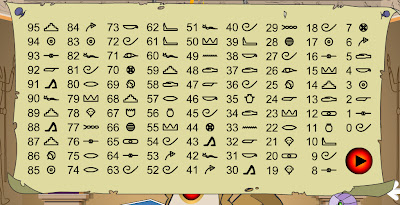
The basic point is that the maths always results in a number that is a multiple of 9. In the symbol chart all multiples of 9 have the same symbol. Check in the symbol chart above to confirm this. Of cause multiples of 9 are: 9, 18, 27, 36, 45, 54, 63, 72 and 81. The numbers 90 and 99 cannot be produced by the process that the gopher describes. (For example, 99 - 18 = 81). For the explanation of why the process always produces a multiple of 9 see the Matematical Explanation section below.
Every time that you do this puzzle a different symbol chart is used, but always multiples of 9 have the same symbol. Here is another example:
So all the gopher has to do is display the symbol for multiples of 9 that are used in the chart that he shows you.
Mathematical Explanation
Some basic maths can explain why the process will always produce a number that is a multiple of 9.
A two digit number can be written as:
10a + b (note 10a is and equivalent way of writing 10 X a)
The gopher asked us to add the two digits together which can be written as (a + b)
He then asked us to take the sum of the digits away from the original number, which can be written as:
10a + b - (a + b)
=10a + b - a - b
Rearranging we get:
10a - a + b - b
The b values cancel (ie b - b = 0) so
10a - a
= 9a
All results of the maths are multiples of 9. In the worked example, the number is 26. In that case a = 2 and b = 6 and 9a = 9 X 2 = 18, a multiple of 9.
A friend recently sent me this link to a puzzle.
Click on the link and try out the puzzle before continuing. (If the "music" annoys you it can be turned off at the top right of the screen.)
Spooky!
Before explaining the puzzle I will walk through an example.
The number I picked is 26.
Add 2 and 6 together to get 8.
Subtract 8 from 26 to get 18.
Here is the symbol chart; carefully note the symbol to the right of 18.
 |
The gopher displayed that same symbol as shown below:
 |
Basic Explanation
Obviously if there was anything "psychic" really going on then the mathematical and symbolic process would not be necessary. It follows that there is some trick in the process.
The basic point is that the maths always results in a number that is a multiple of 9. In the symbol chart all multiples of 9 have the same symbol. Check in the symbol chart above to confirm this. Of cause multiples of 9 are: 9, 18, 27, 36, 45, 54, 63, 72 and 81. The numbers 90 and 99 cannot be produced by the process that the gopher describes. (For example, 99 - 18 = 81). For the explanation of why the process always produces a multiple of 9 see the Matematical Explanation section below.
Every time that you do this puzzle a different symbol chart is used, but always multiples of 9 have the same symbol. Here is another example:
 |
So all the gopher has to do is display the symbol for multiples of 9 that are used in the chart that he shows you.
Mathematical Explanation
Some basic maths can explain why the process will always produce a number that is a multiple of 9.
A two digit number can be written as:
10a + b (note 10a is and equivalent way of writing 10 X a)
The gopher asked us to add the two digits together which can be written as (a + b)
He then asked us to take the sum of the digits away from the original number, which can be written as:
10a + b - (a + b)
=10a + b - a - b
Rearranging we get:
10a - a + b - b
The b values cancel (ie b - b = 0) so
10a - a
= 9a
All results of the maths are multiples of 9. In the worked example, the number is 26. In that case a = 2 and b = 6 and 9a = 9 X 2 = 18, a multiple of 9.
Sunday, June 13, 2010
Wednesday, February 10, 2010
Thursday, April 9, 2009
Two Ferry Boats
Martin Gardner, in his book Hexaflexagons, Probability Paradoxes, and the Tower of Hanoi presents the following problem on page 123.
I have left the units in yards for two reasons: firstly, it is the unit that is quoted in the book, and secondly, it adds another interesting element to the final solution.
I puzzled over this for a few days. I had got about half way through the calculation ( I now realise from hindsight ) but couldn't see a way forward. It even kept me awake at night. A few nights ago, at 1:00 am, I hit on the strategy, got up and tried it out on paper; when I checked Gardner's answer I found that we agreed.
My solution is algebraic, and Gardner gives a very brief description of it, but it is also possible to solve this without maths, as Gardiner demonstrates in a long written paragraph.
Try to find the answer for yourself before you "Click to read the rest of the post" for my solution.
Define variables
Two time periods can be defined
T1 = interval between the two times that the boats pass
T2 = interval between when both boats "start at the same instant from opposite sides" and the second time that they pass
Five distances can be defined
Distances relating to T1
D1 = distance fast boat travels between the two passes
D2 = distance the slow boat travels between the two passes
Distances relating to T2
D3 = distance the fast boat travels from start to second pass
D4 = distance the slow boat travels from start to second pass
W = the width of the river
The two boat speeds
S1 = the speed of the fast boat
S2 = the speed of the slow boat
The diagram below presents the problem graphically.

Using the diagram above we can assign values to the distance variables.
D1 = 720 + W - 400 = W + 320
D2 = W - 720 + 400 = W - 320
D3 = 2W - 400
D4 = W + 400
The basic strategy for solving this problem can be outlined as follows:
As two time lengths can be found and distances the boats travel in these time frames can be calculated, the ratio of the boat speeds can be defined in two ways, using the distances.
Equate the two ratio equations and solve for width of river (W).
Note: as both boats spend an equal amount of time in the slips (10 minutes) that can be ignored as it doesn't effect the result of the calculation (it is a red herring).
__________________________________________________________________________________
Calculate the ratio of the boat speeds using distance information for T1
Note: time = distance / speed
T1 = D1 / S1 = (W + 320) / S1
T1 = D2 / S2 = (W - 320) / S2
As both equations = T1 they can be equated
(W + 320) / S1 = (W - 320) / S2
Cross multiply to express in terms of the ratio of the speeds
S1 / S2 = (W + 320) / (W - 320) Equation 1
Calculate the ratio of the boat speeds using distance information for T2
T2 = D3 / S1 = (2W - 400) / S1
T2 = D4 / S2 = (W + 400) / S2
As both equations = T2 they can be equated
(2W - 400) / S1 = (W + 400) / S2
Cross multiply to express in terms of the ratio of the speeds
S1 / S2 = (2W - 400) / (W + 400) Equation 2
We have now defined the ratio of the boat speeds in two ways: Equation 1 and Equation 2
All that remains is to equate Equation 1 and Equation 2 and solve for W (width of the river).
(W + 320) / (W - 320) = (2W - 400) / (W + 400)
Cross multiply to remove fractions.
(2W - 400)(W - 320) = (W + 320)(W + 400)
-> 2W2 - 640W - 400W + 128000 = W2 + 400W + 320W + 128000
-> 2W2 - 1040W + 128000 = W2 + 720W + 128000
-> 2W2 - W2 - 1040W - 720W + 128000 - 128000 = 0
-> W2 - 1760W = 0
Extract W
-> W(W - 1760) = 0
-> W = 0 which can be ignored as it is nonsensical in terms of the practical problem (as the function is a parabola it should have two solutions, one of which is at the origin)
or
W - 1760 = 0
W = 1760
Therefore the width of the river is 1760 yards
Can you see the second reason why I kept the problem in yards rather than change the units into the modern value of metres?
Any comments?
Two ferry boats start at the same instant from opposite sides of a river, travelling across the water on routes at right angles to the shores. They pass at a point 720 yards from the nearest shore. Both boats remain in their slips for 10 minutes before starting back. On the return they meet 400 yards from the other shore.
How wide is the river?
I have left the units in yards for two reasons: firstly, it is the unit that is quoted in the book, and secondly, it adds another interesting element to the final solution.
I puzzled over this for a few days. I had got about half way through the calculation ( I now realise from hindsight ) but couldn't see a way forward. It even kept me awake at night. A few nights ago, at 1:00 am, I hit on the strategy, got up and tried it out on paper; when I checked Gardner's answer I found that we agreed.
My solution is algebraic, and Gardner gives a very brief description of it, but it is also possible to solve this without maths, as Gardiner demonstrates in a long written paragraph.
Try to find the answer for yourself before you "Click to read the rest of the post" for my solution.
Define variables
Two time periods can be defined
T1 = interval between the two times that the boats pass
T2 = interval between when both boats "start at the same instant from opposite sides" and the second time that they pass
Five distances can be defined
Distances relating to T1
D1 = distance fast boat travels between the two passes
D2 = distance the slow boat travels between the two passes
Distances relating to T2
D3 = distance the fast boat travels from start to second pass
D4 = distance the slow boat travels from start to second pass
W = the width of the river
The two boat speeds
S1 = the speed of the fast boat
S2 = the speed of the slow boat
The diagram below presents the problem graphically.
Using the diagram above we can assign values to the distance variables.
D1 = 720 + W - 400 = W + 320
D2 = W - 720 + 400 = W - 320
D3 = 2W - 400
D4 = W + 400
The basic strategy for solving this problem can be outlined as follows:
As two time lengths can be found and distances the boats travel in these time frames can be calculated, the ratio of the boat speeds can be defined in two ways, using the distances.
Equate the two ratio equations and solve for width of river (W).
Note: as both boats spend an equal amount of time in the slips (10 minutes) that can be ignored as it doesn't effect the result of the calculation (it is a red herring).
__________________________________________________________________________________
Calculate the ratio of the boat speeds using distance information for T1
Note: time = distance / speed
T1 = D1 / S1 = (W + 320) / S1
T1 = D2 / S2 = (W - 320) / S2
As both equations = T1 they can be equated
(W + 320) / S1 = (W - 320) / S2
Cross multiply to express in terms of the ratio of the speeds
S1 / S2 = (W + 320) / (W - 320) Equation 1
Calculate the ratio of the boat speeds using distance information for T2
T2 = D3 / S1 = (2W - 400) / S1
T2 = D4 / S2 = (W + 400) / S2
As both equations = T2 they can be equated
(2W - 400) / S1 = (W + 400) / S2
Cross multiply to express in terms of the ratio of the speeds
S1 / S2 = (2W - 400) / (W + 400) Equation 2
We have now defined the ratio of the boat speeds in two ways: Equation 1 and Equation 2
All that remains is to equate Equation 1 and Equation 2 and solve for W (width of the river).
(W + 320) / (W - 320) = (2W - 400) / (W + 400)
Cross multiply to remove fractions.
(2W - 400)(W - 320) = (W + 320)(W + 400)
-> 2W2 - 640W - 400W + 128000 = W2 + 400W + 320W + 128000
-> 2W2 - 1040W + 128000 = W2 + 720W + 128000
-> 2W2 - W2 - 1040W - 720W + 128000 - 128000 = 0
-> W2 - 1760W = 0
Extract W
-> W(W - 1760) = 0
-> W = 0 which can be ignored as it is nonsensical in terms of the practical problem (as the function is a parabola it should have two solutions, one of which is at the origin)
or
W - 1760 = 0
W = 1760
Therefore the width of the river is 1760 yards
Can you see the second reason why I kept the problem in yards rather than change the units into the modern value of metres?
Any comments?
Saturday, February 21, 2009
The Birthday Paradox
Recently two of my friends (and neighbours) in the village noticed that they shared a birthday. They expressed surprise at this revelation because it seems improbable. Actually it is likely that a relatively small group of people will have two members with the same birthday. For instance, with groups of 25 people, two will have birthdays on the same day of the year in 56% of cases; with groups of 60 the likelihood increases to more than 99%. These apparently unlikely facts can be demonstrated by some simple maths.
The simplest way to start this is to investigate the likelihood that people do not have the same birthday. The probability t hat two people do not have the same birthday is 364 / 365 , as there is only one chance in 365 that one person's birthday will coincide with another's). The probability that a third person's birthday will differ from the other two is 363 / 365; a fourth person's 362 / 365; a fifth person's 361 / 365; ans so on to the fraction for the 25th person which is 341 / 365. This gives us 24 fractions that have to be multiplied together to reach the probability that all 25 birthdays are different. This gives a percentage of 43.13%. Given that there are only two alternatives, either no birthdays match or two (or more) do match. Therefore the probability that there will be a match is 100 - 43.13 = 56.87%
I calculated these percentages in a spreadsheet. The formulas that I used are shown in the picture below. (Naturally, just enter them in row 3 and fill down.)

For a larger and clearer version click on this link.
I also charted the spreadsheet. The probabilities can be read off the chart below:

For a larger and clearer version click on this link.
So what to make of my friends' birthday coincidence. There are eleven people living in our street. If we just consider this group the birthday coincidence is relatively unlikely at 14% though not at all impossible. If you consider the wider village with almost 150 people it is virtually a certainty that two people will have the same birthday. Although I haven't checked, I expect that there is likely to be at least one other birthday coincidence.
The simplest way to start this is to investigate the likelihood that people do not have the same birthday. The probability t hat two people do not have the same birthday is 364 / 365 , as there is only one chance in 365 that one person's birthday will coincide with another's). The probability that a third person's birthday will differ from the other two is 363 / 365; a fourth person's 362 / 365; a fifth person's 361 / 365; ans so on to the fraction for the 25th person which is 341 / 365. This gives us 24 fractions that have to be multiplied together to reach the probability that all 25 birthdays are different. This gives a percentage of 43.13%. Given that there are only two alternatives, either no birthdays match or two (or more) do match. Therefore the probability that there will be a match is 100 - 43.13 = 56.87%
I calculated these percentages in a spreadsheet. The formulas that I used are shown in the picture below. (Naturally, just enter them in row 3 and fill down.)
For a larger and clearer version click on this link.
I also charted the spreadsheet. The probabilities can be read off the chart below:
For a larger and clearer version click on this link.
So what to make of my friends' birthday coincidence. There are eleven people living in our street. If we just consider this group the birthday coincidence is relatively unlikely at 14% though not at all impossible. If you consider the wider village with almost 150 people it is virtually a certainty that two people will have the same birthday. Although I haven't checked, I expect that there is likely to be at least one other birthday coincidence.
Thursday, October 4, 2007
Book Review: The Mathematical Universe
The Mathematical Universe was written by William Dunham, a Professor of Mathematics at Muhlenberg College, Allentown, Pennsylvania, United States.
The book is subtitled: An Alphabetical Journey Through the Great Proofs, Problems and Personalities. That is as good a one sentence summary as I could concoct. Consequently there are 25 chapters (not 26 as you would expect as X and Y are covered in one chapter). This structure creates difficulties for the author as logical progression is important in maths and it is unlikely a logical mathematical structure can be worked out in the order of the alphabet. On the whole Dunham manages this dilemma well, although there are some abrupt jumps - as he admits himself. The variation in topics is interesting in itself and the level of maths is not so difficult that each chapter needs a long introduction to preliminary ideas. It is not possible to discuss the maths in detail in a book only 295 pages long anyway. He is also able to concoct some logic to the order. For instance the first chapter is about arithmetic, which is a logical place to start mathematically and the first letter of the alphabet. He manages to discuss Newton in chapter K (Knighted Newton) and follow it with Leibniz, thus discussing their dispute over priority in calculus in consecutive chapters. Chapter X - Y on the Cartesian Plane precedes chapter Z on Complex numbers.
The book is subtitled: An Alphabetical Journey Through the Great Proofs, Problems and Personalities. That is as good a one sentence summary as I could concoct. Consequently there are 25 chapters (not 26 as you would expect as X and Y are covered in one chapter). This structure creates difficulties for the author as logical progression is important in maths and it is unlikely a logical mathematical structure can be worked out in the order of the alphabet. On the whole Dunham manages this dilemma well, although there are some abrupt jumps - as he admits himself. The variation in topics is interesting in itself and the level of maths is not so difficult that each chapter needs a long introduction to preliminary ideas. It is not possible to discuss the maths in detail in a book only 295 pages long anyway. He is also able to concoct some logic to the order. For instance the first chapter is about arithmetic, which is a logical place to start mathematically and the first letter of the alphabet. He manages to discuss Newton in chapter K (Knighted Newton) and follow it with Leibniz, thus discussing their dispute over priority in calculus in consecutive chapters. Chapter X - Y on the Cartesian Plane precedes chapter Z on Complex numbers.
There are many ideas in this book that could be included in a review, but one particularly struck me while I was reading it. James Garfield was elected US President in March 1881. Sadly he was assassinated a few months later, but what struck me was that had produced a clever proof of Pythagoras Theorem. One wonders if the present incumbent of the White House knows what Pythagoras Theorem is. It is certain that he wouldn't have a clue about developing a proof, and what is even sadder he wouldn't have any curiosity the theorem or a proof.
For those with an interest in maths and familiarity with maths to a secondary school standard, this is an interesting and entertaining read.
The chapters are as follows:
Arithmetic - issues regarding whole numbers are more complex than might be supposed
Bernoulli Trials - primarily Jacob Bernoulli's discoveries regarding probability but includes conflict and rivalry with brother Jonann
Circle - circumference, area and particularly the calculation of pi
Differential Calculus - basic intro to the theory, with some applications such as calculating tangents and maximums, minimum and stationary points of functins
Euler - emphasis on the stunning breadth and depth of Euler's contribution to maths
Fermat - brief biography and description of some of his contributions, including Last Theorem
Greek Geometry - contributions of Ancient Greeks with particular emphasis on Euclid (of cause)
Hypotenuse - three proofs of Pythagoras Theorem
Isoperimetric Problem - to determine, from among all curves of the same perimeter, the one enclosing the largest area
Justification - general discussion of the idea of mathematical proof
Knighted Newton - Newton's strange and prickly personality as well as his enormous contributions to mathematics and physics
Lost Leibniz - Leibniz's contributions to maths especially calculus and his conflict with Newton regarding priority of its discovery
Mathematical Personality - what type of people are attracted to mathematics?
Natural Logarithm - e (ie 2.718281828459045 ... ) and natural logarithms; theory and practice
Origins - some very early mathematical landmarss; Egyptian, Mesopotamian, Chinese and Indian
Prime Number Theorem - the proportion of primes less than or equal to a number is roughly equal to the reciprocal of the natural logarithm of the number
Quotient - development of the number systems (natural, rational, irrational and real) from the basic arithmetic processes of addition, subtraction, multiplication, division and extraction of roots
Russell's Paradox - Bertram Russell's paradoxical personality and life and his mathematical paradox which involved the set of all those sets that are not members of themselves
Spherical Surface - how Archimedes determined the surface area of a sphere
Trisection - the impossibility of trisecting an angle using just a compass and unmarked straight edge
Utility - brief discussion of why mathematics and the natural world should mirror each other; followed by some examples of the usefulness of maths taken from trigonometry
Venn Diagram - a simple idea that was invented before John Venn, but he got the credit
Where are the Women? - why there haven't been many women mathematicians historically and how that has changed in recent times
X - Y Plane - the Cartesian Plane
Z - complex numbers
Monday, September 24, 2007
Book Review: Imagining Numbers by Barry Mazur
The full title of the book is:
Imagining Numbers
(Particularly the square root of Minus Fifteen)
In his preface to the book Mazur states that the book is "written for people who have no training in mathematics ... but who may wish to experience an act of mathematical imagining and to consider how such an experience compares with the imaginative work involved in reading and understanding a phrase in a poem." A major aim of the book then is to draw analogies between the imaginative process of mathematics and poetry.
Mazur returns regularly to parts of the tone poem "Whatever It Is, Wherever You Are" by John Ashbery. In pondering the inventors of writing Ashbery writes:
I would like some of the "bog of certainty" in Mazur's description of the relationship between poetical and literary imagining and the mathematical variety. I have an interest in poetry and literature on the one hand and mathematics and science on the other, but if Mazur provides an explanation of the relationship between imagining in the humanities and the sciences then it is beyond my ken. This book can be seen as a contribution to breaking down the division between the two cultures described by C. P. Snow - the Humanities and the Sciences. Snow might have overstated his case but something of a division still exists. Even if the book does not finally succeed in drawing a convincing analogy between creativity in the sciences and creativity in the humanities, the erudition of Mazur in both literature and mathematics show that it is possible for a modern expert in the sciences to have and interest and skills in the humanities.
Consequently the rest of this post will concentrate on the mathematical ideas in the book. Mazur's description of the development of the idea of complex numbers by a range of mathematicians over three centuries is interesting and compelling.
A brief note on typology. Square foots will be mentioned frequently in this post. I will not use the conventional square root symbol - √ - as it will require too many graphics, instead I will represent square roots using the computer terminology, so that the square root of 4 will appear as: sqrt(4).
As Mazur describes (p39) the Italian mathematician Girolamo Cardono (1501-76) in his Ars Magna coming across an equation that contains (5 + sqrt(-15)) × (5 - sqrt(-15)) . There are three possible reactions to this piece of maths, but to make the discussion clearer I will use sqrt(-4).
A reaction from those who have little understanding of or interest in maths would be "what is all the fuss about? the answer is obviously -2" . Those who have a reasonably sophisticated understanding of maths would think 2i . Those who took some notice in their middle secondary school maths classes would be saying "that's impossible, there is no such thing as the square root of a negative number!" As i described in this post multiplying two negative numbers together will result in a positive one. If you multiply -2 by -2 the answer is +4, so there seems to be no solution to sqrt(-4). The problem for that point of view is that if you ignore the objection to square roots of negative numbers and just multiply out Cadano's expression you end up with the positive whole number 40, as demonstrated below:
(5 + sqrt(-15)) × (5 - sqrt(-15))
= 25 -5 × sqrt(-15) +5 × sqrt(-15) -(sqrt(-15)× (sqrt(-15)
-5 × sqrt(-15) +5 × sqrt(-15) cancel each other out os
= 25 -(-15)
= 25 +15
= 40
It is surprising that such an unusual expression evaluates to the simplest type of number - a positive integer. Although sqrt(-15) seems initially nonsensical if it is accepted without thinking too much about what it means it can produce acceptable results.
If we multiply the number line by -1 we rotate it by 180 degrees.
Writing sqrt(-1) is a little clumsy so mathematicians developed a notation for it" i . Sqrt(-4) can be written as sqrt(4) × sqrt(-1) which becomes 2i when sqrt(-1) is written as i . Numbers that contain i are called imaginary numbers but we can generalise the function by adding a real number to form a +bi. These are called complex numbers.
Previously we discussed multiplying by -1. What happens if we multiply a complex number by i? Lets see: i × (a + bi) = ai + b × i × i = ai - b (as i × i = -1). If you plot these numbers on a cartesian plane, with the real numbers on the X-axis and the imaginary ones on the Y-axis then it should be clear that multiplying by i is equivalent to rotating by 90 degrees. Mathematicians plot complex numbers on the complex plane with the horizontal axis for the real portion of the number and the vertical axis for the imaginary numbers. This makes sense if multiplying by i is equivalent to rotating by 90 degrees.
What happens if we multiply the complex number by i a second time. This is obviously another 90 degree rotation resulting in a cumulative 180 degree rotation - the same as multiplying by -1. That is multiplying by i2 produces the same result as multiplying by -1. This might not be particularly surprising as i2 = -1. We seem to have arrived at the same point from two different directions.
Many mathematicians use complex numbers without concerning themselves with the question of what imaginary numbers look like but for those or us who have less mathematical skill Mazur's description of i as a rotation of 90 degrees on the complex plane is satisfying.
This post just scratches the surface of the area of mathematics called Complex Analysis. Other reasons to believe in the reality of complex numbers is that complex maths is essential to a number of important areas of physics including Quantum Mechanics. Some time or other (when I learn something about it) I hope to further explain that claim.
Imagining Numbers
(Particularly the square root of Minus Fifteen)
In his preface to the book Mazur states that the book is "written for people who have no training in mathematics ... but who may wish to experience an act of mathematical imagining and to consider how such an experience compares with the imaginative work involved in reading and understanding a phrase in a poem." A major aim of the book then is to draw analogies between the imaginative process of mathematics and poetry.
Mazur returns regularly to parts of the tone poem "Whatever It Is, Wherever You Are" by John Ashbery. In pondering the inventors of writing Ashbery writes:
To what purpose did they cross-hatch so effectively, so that the luminous durface that was underneath is transformed into another, also luminous but so shifting and so alive with suggestiveness that it is like quicksand, to take a step there would be to fall through the fragile net of uncertainties into the bog of certainty ...
I would like some of the "bog of certainty" in Mazur's description of the relationship between poetical and literary imagining and the mathematical variety. I have an interest in poetry and literature on the one hand and mathematics and science on the other, but if Mazur provides an explanation of the relationship between imagining in the humanities and the sciences then it is beyond my ken. This book can be seen as a contribution to breaking down the division between the two cultures described by C. P. Snow - the Humanities and the Sciences. Snow might have overstated his case but something of a division still exists. Even if the book does not finally succeed in drawing a convincing analogy between creativity in the sciences and creativity in the humanities, the erudition of Mazur in both literature and mathematics show that it is possible for a modern expert in the sciences to have and interest and skills in the humanities.
Consequently the rest of this post will concentrate on the mathematical ideas in the book. Mazur's description of the development of the idea of complex numbers by a range of mathematicians over three centuries is interesting and compelling.
A brief note on typology. Square foots will be mentioned frequently in this post. I will not use the conventional square root symbol - √ - as it will require too many graphics, instead I will represent square roots using the computer terminology, so that the square root of 4 will appear as: sqrt(4).
As Mazur describes (p39) the Italian mathematician Girolamo Cardono (1501-76) in his Ars Magna coming across an equation that contains (5 + sqrt(-15)) × (5 - sqrt(-15)) . There are three possible reactions to this piece of maths, but to make the discussion clearer I will use sqrt(-4).
A reaction from those who have little understanding of or interest in maths would be "what is all the fuss about? the answer is obviously -2" . Those who have a reasonably sophisticated understanding of maths would think 2i . Those who took some notice in their middle secondary school maths classes would be saying "that's impossible, there is no such thing as the square root of a negative number!" As i described in this post multiplying two negative numbers together will result in a positive one. If you multiply -2 by -2 the answer is +4, so there seems to be no solution to sqrt(-4). The problem for that point of view is that if you ignore the objection to square roots of negative numbers and just multiply out Cadano's expression you end up with the positive whole number 40, as demonstrated below:
(5 + sqrt(-15)) × (5 - sqrt(-15))
= 25 -5 × sqrt(-15) +5 × sqrt(-15) -(sqrt(-15)× (sqrt(-15)
-5 × sqrt(-15) +5 × sqrt(-15) cancel each other out os
= 25 -(-15)
= 25 +15
= 40
It is surprising that such an unusual expression evaluates to the simplest type of number - a positive integer. Although sqrt(-15) seems initially nonsensical if it is accepted without thinking too much about what it means it can produce acceptable results.
If we multiply the number line by -1 we rotate it by 180 degrees.
Writing sqrt(-1) is a little clumsy so mathematicians developed a notation for it" i . Sqrt(-4) can be written as sqrt(4) × sqrt(-1) which becomes 2i when sqrt(-1) is written as i . Numbers that contain i are called imaginary numbers but we can generalise the function by adding a real number to form a +bi. These are called complex numbers.
Previously we discussed multiplying by -1. What happens if we multiply a complex number by i? Lets see: i × (a + bi) = ai + b × i × i = ai - b (as i × i = -1). If you plot these numbers on a cartesian plane, with the real numbers on the X-axis and the imaginary ones on the Y-axis then it should be clear that multiplying by i is equivalent to rotating by 90 degrees. Mathematicians plot complex numbers on the complex plane with the horizontal axis for the real portion of the number and the vertical axis for the imaginary numbers. This makes sense if multiplying by i is equivalent to rotating by 90 degrees.
What happens if we multiply the complex number by i a second time. This is obviously another 90 degree rotation resulting in a cumulative 180 degree rotation - the same as multiplying by -1. That is multiplying by i2 produces the same result as multiplying by -1. This might not be particularly surprising as i2 = -1. We seem to have arrived at the same point from two different directions.
Many mathematicians use complex numbers without concerning themselves with the question of what imaginary numbers look like but for those or us who have less mathematical skill Mazur's description of i as a rotation of 90 degrees on the complex plane is satisfying.
This post just scratches the surface of the area of mathematics called Complex Analysis. Other reasons to believe in the reality of complex numbers is that complex maths is essential to a number of important areas of physics including Quantum Mechanics. Some time or other (when I learn something about it) I hope to further explain that claim.
Thursday, September 20, 2007
Negative times Negative equals Positive
Introduction
Those with some familiarity with secondary school maths will be aware that a negative number multiplied by a negative number gives a positive number.
Those with some familiarity with secondary school maths will be aware that a negative number multiplied by a negative number gives a positive number.
For example:
-2 X -3 = +6 , it does not equal -6.
I thought that rule was an axiom or assumption. An equivalent in standard English is the double negative. The statement "I don't want nothing" means that you want something because whatever you don't want it isn't nothing. Of cause in colloquial English and other versions of English it can still mean a negative. As well a double negative can mean negative in some other languages, for example Africans and Greek.
The Distributive Law
In mathematics though negative times negative equals positive turns out to be a provable law. The first issue to deal with is the Distributive Law of Mathematics, which can be written as : A x C + B x C = (A + B) x C . Stated in words the distributive law says: to multiply a given number C by the sum of two numbers is the same as multiplying C by each of those numbe rs and and then adding the result. The Distributive Law links multiplication with addition and is one of the fundamental laws of maths.
Here is a demonstration of how the law works with positive whole numbers.
If A = 2, B = 3 and C = 4:
2 x 4 + 3 x 4 = (2 + 3) x 4
8 + 12 = 5 x 4
20 = 20
There are algebraic proofs of the Distributive Law, but they require considerable explanation. As a visual thinker I find the diagram at right compelling proof.
Let a and b be any two real numbers. Consider the number n defined by:
Applying the Distributive Law to Negative Numbers
Our task is to apply the distributive law to negative numbers.
When we do this two other rules will be resolved: positive x negative = ? and negative x negative = ?.
Positive x Negative = ?
Assume: positive x negative = positive ie -3 x 4 = +12 and -1 x 4 = 4
If A = 2, B = -3, C = 4
By the distributive law:
2 x 4 + -3 x 4 = (2 + -3) x 4
8 + 12 = -1 x 4
20 = 4
This result is clearly incorrect so our assumption (positive X negative = positive) is incorrect.
Assume: positive x negative = negative ie -3 x 4 = -12 and -1 x 4 = -4
By the distributive law:
2 x 4 + -3 x 4 = (2 + -3)x 4
8 + -12 = -1 X 4
-4 = -4
This is clearly correct so our assumption (positive X negative = negative) is correct.
Negative X Negative = ?
Assume: negative x negative = negative ie -3 x -4 = -12 and -1 x -4 = -4
If A = 2, B = -3, C = -4
By the distributive law:
2 x -4 + -3 x -4 = (2 + -3) x -4
-8 + -12 = -1 x -4
-20 = -4
This is clearly incorrect so our assumption (negative x negative = negative) is incorrect.
Assume: negative x negative = positive ie -3 x -4 = 12and -1 x -4 =4
If A = 2, B = -3, C = -4
By the distributive law:
2 x -4 + -3 x -4 = (2 + -3) x -4
-8 + 12 = -1 x -4
4 = 4
This is clearly correct so our assumption (negative x negative = positive) is true which is what we set out to do at the beginning of the post.
A More Concise Proof
The following proof is more shorter than that described above. The only extra mathematical rule that this contains is a number multiplied by zero is equal to zero, ie N x 0 = 0 .
An example is 5 x 0 = 0 which equals 0 + 0 + 0 + 0 + 0
which is of cause 0.
n = ab + (-a)(b) + (-a)(-b)
We can write
n = ab + (-a)[ (b) + (-b) ] (factor out -a)
= ab + (-a) (0)
= ab + 0
= ab
Also,
n = [ a + (-a) ]b + (-a)(-b) (factor out b)
= 0 x b + (-a)(-b)
= 0 + (-a)(-b)
= (-a)(-b)
So we have,
n = ab
and
n = (-a)(-b)
Hence ab = (-a)(-b)
UPDATE: 28 / 01/ 2013
Here is an argument from the Khan Academy using the distributive law, demonstrating that a negative times a negative equals a positive:
Here are two more videos from the Khan Academy explaining negative times negative equals positive.
The first one explains why positive times negative equals negative:
The next video uses ideas from the previous video to demonstrate that negative times negative equals positive:
Subscribe to:
Posts (Atom)