Loading...
Gadget by The Blog Doctor.

Friday, October 19, 2007

Climate Change: a risk management argument

Although I think that Climate Change due to Global Warming is a real threat to our future, I haven't written any posts about it as Climate Science is a very complex area of study. My Blog Roll contains a number of Climate Change sites, particularly Real Climate and Open Mind. I cannot match the detail and erudition of those sites and feel that there is little that I can post on the topic that would add to the arguments of professional climate scientists.


That was, until I came across the video below, which gives an interesting and entertaining perspective on the topic. It takes a risk management point of view.


One word of warning, the video is almost 10 minutes long.


The username of the producer of the video is wonderingmind42

Click on the link for other videos that he has produced.

Friday, October 12, 2007

Movie Review: Pan's Labrynth

Pan's Labyrinth by Mexican director Guillermo Del Toro is set in Spain in 1944. Although Franco has won the Spanish Civil War there are still pockets of resistance by bands of republican loyalists. The heroine a 12 year old girl named Ofelia, played beautifully by Ivana Baquero, is traveling with her heavily pregnant mother, Carmen (Ariadna Gil), to meet her step-father, Captain Vidal (Sergi López). Vidal is in command of a small military base deep in the countryside.


Vidal's brutal and callous character is quickly revealed. He is only concerned for his wife because she is carrying his son. He cares nothing for Ofelia. When after he casually murders two local farmers, accusing them of being republican sympathizers, it is revealed that they probably were innocent of the charge he blames his underlings for the mistake. His pleasure in inflicting pain, is shown when he tortures a captured partisan.

Why did Carmen marry the sadistic Vidal. In her discussions with Ofelia she hints at her need for male companionship. Vidal might have seemed a good meal ticket. Whatever the reason it is clearly now a very poor choice. Of cause Carmen might not have been given a choice at all, vidal takes what he wants.


Ofelia is certainly dissatisfied with her mother's passivity. This is possibly a reason for her attraction to the house keeper, Mercedes (Maribel Verdú). Mercedes' brother is one of the partisans, and she gives them assistance and intelligence from the military post.


Another character placed in a difficult position is the doctor (Alex Angulo), who attends Carmen but also provides medical assistance to the partisans. The doctor places his life in jeopardy when he puts a tortured partisan out of his misery.


The brutality of war is underscored by the fact that at film's end most of the principals are dead. Even though the republican partisans win this battle, any viewer with a sense of history will realize that Franco will rule Spain for another three decades. If this was all to the film, then it would be an interesting though brutal evocation of the horrors of war. What raised this film beyond the merely interesting is the addition of a fantasy theme to the brutal realism.


From the fantasy perspective, Ofelia is not just a 12 year old child caught up in a violent world over which she has little control, she has a mythic significance and a world where she has some control and options. She is required to preform three tasks, and her guide and mentor in the fantasy world is an old and very tall Fawn. One issue flowing through the fantasy scenes is the trustworthiness of the Fawn. In most of the fantasy tales that I am familiar with the young hero (or heroine) is guided by an older human mentor; Gandalf and Aragon for Frodo; Dumbledor for Harry Potter; Belgarath and Polgara for Belgarion. We have a clear understanding of the motivations, morality and trustworthiness of the human mentors. The motivations and honesty of the non-human fawn are not clear. This is particularly empahsised when the real import of the last task is finally revealed.


How seriously should we treat the fantasy theme? There are some observations that support the view that we should treat the fantasy element seriously. It does bookend the film. The first sequence sets the scene for the mythic story line, and the last scene shows the resolution of the fantasy storyline. The fantasy creatures are very solid and lifelike, right down to the crunch as faries are eaten by the White Man. There is nothing cartoonish about the fawn, he has a real dishevelled appearance. Observations supporting the view that that the fantasy should not be taken seriously include: that Ofelia reads fantasy books so the fantasy might be just her refuge from the harsh reality that surrounds her and that her step-father cannot see the fawn when she it talking to it. In the end the answer to the question is unclear and ambiguous.


Often the best stories are not "tied up with a bow" but have an element of uncertainty. The grim reality of Spain in 1944 is unequivocal, but it is the ambiguity of Ofelia's fantasy that makes this film one of my favourites.

Thursday, October 11, 2007

Cosi Fan Tutte

On Saturday 6th Octover, we attended Victorian Opera's production of Cosi at the Clocktower. It featured:
Mylinda Joyce - Fiordiligi Jacqueline Dark - Dorabella the two sisters,
Jacqueline Porter - Despina,the scheming maid,
Samuel Dundas - Guglielmo and James Egglestone - Ferrando the two fiances and
Gary Rowley - Don Alfonso, Guglielmo and ferrando's cynical, and mysogenist friend.
This production was directed by: Jean-Pierre Mignon.

I was initially surprised that this performance was sung in English, as the same company and cast has sung it in Italian at Her Majesties. I would have preferred the performance to be sung in Italian with surtitles as I found it difficult to understand the singing of Joyce and Dark. Reading the surtitles would have made the meaning of their songs clearer.


My favorite operas are by Puccini - Tosca and Madama Butterfly. My enjoyment of opera comes mainly from the beautiful arias. Examples from Tosca are: Recondita armonia, Mario! Mario! Mario!, Vissi arte, E lucevan le stelle snd Un bel di . This might be a sign of my lack of operatic sophistication. Unfortunately the only aria that I really enjoy in Cosi is the trio, "Soave sia il vento".


Margaret was offended on the sisters behalf by the mysogenist trick played on them by the men, and the maid. This is fair enough, though Despina did participate enthusiastically in the deception. Interestingly this opera fell out of favor in the 19th and early 20th Centuries not because of its treatment of women but because of its risque theme of fiancee swapping.


Even though I was taken back by some elements of the opera and performance it was an entertaining evening. When Cosi is performed again I will have to attend to make a more considered judgement.

Tuesday, October 9, 2007

Albert Park Walk

The name of the walk is Dunnies, Dairies and Deliveries. The official description is:

Take a time travel journey down suburban lanes in the footsteps of dunnymen, ice-men, bottle-o, milkmen, grocers, garbos and coal carts. Discover bluestone stables, old dairies, chimneys, gas worker cottages and the great Australian outhouse.

The map below shows the location of the walk and some places of interest marked by the blue place holders. Click on a place holder to view a photo of the site.


View Larger Map

We started at the park, where our guide Meyer Eidelson introduced himself. In the streets around the park stand majestic mansions that were build by very wealthy people. One of the mansions belonged to the Guests of Guests Biscuits fame. The park was originally fenced with only the well off having a key to the gate. The poor people who lived near by were excluded.


In the late 19th Century the city was very unhealthy. This was clearly the case for the poorer classes but ill health caused by poor sanitation also effected the wealthy. The Guest family, for instance, had 8 children, but only three of them lived to adulthood. Some people earned a living taking away the "night soil". These men would usually work at night taking the full cans of waste and replacing them with "fresh" ones. If the toilet was not accessible from the fence line they would enter properties to fetch the cans. They would often blow a whistle or sing to alert any occupant of their arrival.


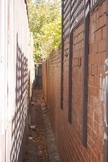
The area has many narrow lanes to allow access to the night soil cans, as illustrated at right. These were so narrow that the men had to carry the cans on their heads, requiring cushioned hats to protect their heads. This was obviously a noisome occupation, but it would be damaging to the health in other ways as well; imagine the back injuries from swinging a heavy can onto your head! And what would you do if you dropped it? These men did an essential task, and helped to protect public health, but were not appreciated. Meyer read a number of amusing letters that complained about the offensive smell of the night carts and the night carters.  


Irrespective of the labor of the night soil men, a great deal of waste seeped into the city's ground water and water supplies. This was a major cause of the ill health of 19th Century Melbourne. It became obvious in the late 19th Century that the city had to be sewered as a matter of urgency. The Melbourne and Metropolitan Board of Works was constituted by an Act of Parliament in 1890 and began operations in July 1891, but the process of sewering did not begin until 1897 when the Spotswood Pumping Station was completed. Most services at the time were private and commercial, but the risk to public health was so palpable that connection to the new sewer system was compulsory.


The rich and poor lived cheek by jowl. If you click on the place marks on the Google Map you will notice that houses built for working people are just a block away from the mansions around the park. The small houses were occupied by large families, which meant that much of the socializing and entertainment was carried on in the streets. Consequently community was much more important than today. In many suburbs today we stay behind our locked doors for security reasons. Ironically, in earlier times the community provided security as there were always people mingling in the streets. Interestingly,a according to Meyer, this tradition continues in the, now gentrified, Albert Park area, at least partly because of the small size of the houses.


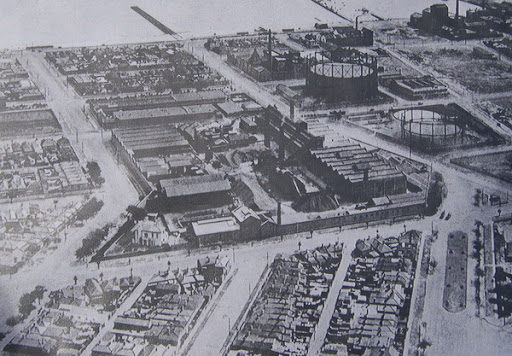
Many of the working people found jobs at the South Melbourne Gas Works, not far away on the other side of Richardson Street. Part of the site is now occupied by the Gasworks Arts Park. Formed in 1872, the Gasworks began supplying gas in 1873. It operated 24 hours a day and employed several hundred men. Black coal was hauled from the town pier at the end of Bay Street, Port Melbourne by horse drawn tram. The working conditions were harsh, strenuous and dirty. The heat could be felt outside the fence surrounding the works. Workers wore wooden clogs to insulate their feet from the heat of the floors. As well a layer of coal dust quickly covered all surfaces in the gasworks and in surrounding streets.

The aerial photograph of the gasworks, below, was one of the many documents that Meyer displayed during the walk. Notice, in particular, the gasholder at the top right of the photo. It could also be a dangerous place to work. In 1920 one of the gasholders exploded without warning. There are stories of people praying in the streets because they thought that it was the end of the world. One eyewitness reported:


I was 12 or 14, playing alleys with me mates on the corner…there was a big rumble, a great big fireball, heat scorched us; ran home to mother, scared out of our wits, to see if she was all right."

 
The explosion was so loud that it was heard from Rosebud to Hurstbridge. Surprisingly no one was killed in the explosion.

Another famous event at the gasworks was the 1937 stay-in-strike, the first of its kind in Australia. The workers entertained themselves with dances, including clog dances.

The women stayed home while their menfolk were off working, though to augment the family income women often ran small businesses from their front doors and windows. One example that we saw was a dairy. The barn which has been converted into a modern garage, could clearly be seen. Obviously the cow was "pastured" in the small back yard. A photograph of the dairy can be seen by clicking on the place holder in Little Glover Street, on the map. Meyer showed us documents that indicated that there were many small dairies in the area. As well it was obvious that many of them were unsanitary, causing some of the ill-health of the community.

Meyer gave us an interesting and informative tour of a small part of Albert Park, which I would recommend to anyone interested in Melbourne's heritage.

Friday, October 5, 2007

Weird Al: The Saga Begins

This is one of my favourite Weird Al Yankovic parodies.


Click on the link for the lyrics.


"The Saga Begins"

A long, long time ago
In a galaxy far away
Naboo was under an attack
And I thought me and Qui-Gon Jinn
Could talk the federation into
Maybe cutting them a little slack
But their response, it didn't thrill us
They locked the doors and tried to kill us
We escaped from that gas
Then met Jar Jar and Boss Nass
We took a bongo from the scene
And we went to Theed to see the Queen
We all wound up on Tatooine
That's where we found this boy...

Oh my my this here Anakin guy
May be Vader someday later - now he's just a small fry
And he left his home and kissed his mommy goodbye
Sayin' "Soon I'm gonna be a Jedi"
"Soon I'm gonna be a Jedi"

Did you know this junkyard slave
Isn't even old enough to shave
But he can use the Force, they say
Ahh, do you see him hitting on the queen
Though he's just nine and she's fourteen
Yah, he's probably gonna marry her someday
Well, I know he built C-3PO
And I've heard how fast his pod can go
And we were broke, it's true
So we made a wager or two
He was a prepubescent flyin' ace
And the minute Jabba started off that race
Well, I knew who would win first place
Oh yes, it was our boy

We started singin' ...
My my this here Anakin guy
May be Vader someday later - now he's just a small fry
And he left his home and kissed his mommy goodbye
Sayin' "Soon I'm gonna be a Jedi"
"Soon I'm gonna be a Jedi"

Now we finally got to Coruscant
The Jedi Council we knew would want
To see how good the boy could be
So we took him there and we told the tale
How his midi-chlorians were off the scale
And he might fulfill that prophecy
Oh, the Council was impressed, of course
Could he bring balance to the Force?
They interview the kid
Oh, training they forbid
Because Yoda sensed in him much fear
And Qui-Gon said "Now listen here"
"Just stick it in your pointy ear"
"I still will teach this boy"

He was singin' ...
My my this here Anakin guy
May be Vader someday later - now he's just a small fry
And he left his home and kissed his mommy goodbye
Sayin' "Soon I'm gonna be a Jedi"
"Soon I'm gonna be a Jedi"

We caught a ride back to Naboo
'Cause Queen Amidala wanted to
I frankly would've liked to stay
We all fought in that epic war
And it wasn't long at all before
Little Hotshot flew his plane and saved the day
And in the end some Gunguns died
Some ships blew up and some pilots fried
A lot of folks were croakin'
The battle droids were broken
And the Jedi I admire most
Met up with Darth Maul and now he's toast
Well, I'm still here and he's a ghost
I guess I'll train this boy

And I was singin' ...
My my this here Anakin guy
May be Vader someday later - now he's just a small fry
And he left his home and kissed his mommy goodbye
Sayin' "Soon I'm gonna be a Jedi"
"Soon I'm gonna be a Jedi"

We were singin' ...
My my this here Anakin guy
May be Vader someday later - now he's just a small fry
And he left his home and kissed his mommy goodbye
Sayin' "Soon I'm gonna be a Jedi"

Thursday, October 4, 2007

Book Review: The Mathematical Universe

The Mathematical Universe was written by William Dunham, a Professor of Mathematics at Muhlenberg College, Allentown, Pennsylvania, United States.

The book is subtitled: An Alphabetical Journey Through the Great Proofs, Problems and Personalities. That is as good a one sentence summary as I could concoct. Consequently there are 25 chapters (not 26 as you would expect as X and Y are covered in one chapter). This structure creates difficulties for the author as logical progression is important in maths and it is unlikely a logical mathematical structure can be worked out in the order of the alphabet. On the whole Dunham manages this dilemma well, although there are some abrupt jumps - as he admits himself. The variation in topics is interesting in itself and the level of maths is not so difficult that each chapter needs a long introduction to preliminary ideas. It is not possible to discuss the maths in detail in a book only 295 pages long anyway. He is also able to concoct some logic to the order. For instance the first chapter is about arithmetic, which is a logical place to start mathematically and the first letter of the alphabet. He manages to discuss Newton in chapter K (Knighted Newton) and follow it with Leibniz, thus discussing their dispute over priority in calculus in consecutive chapters. Chapter X - Y on the Cartesian Plane precedes chapter Z on Complex numbers.


There are many ideas in this book that could be included in a review, but one particularly struck me while I was reading it. James Garfield was elected US President in March 1881. Sadly he was assassinated a few months later, but what struck me was that had produced a clever proof of Pythagoras Theorem. One wonders if the present incumbent of the White House knows what Pythagoras Theorem is. It is certain that he wouldn't have a clue about developing a proof, and what is even sadder he wouldn't have any curiosity the theorem or a proof.


For those with an interest in maths and familiarity with maths to a secondary school standard, this is an interesting and entertaining read.


The chapters are as follows:
Arithmetic - issues regarding whole numbers are more complex than might be supposed
Bernoulli Trials - primarily Jacob Bernoulli's discoveries regarding probability but includes conflict and rivalry with brother Jonann
Circle - circumference, area and particularly the calculation of pi
Differential Calculus - basic intro to the theory, with some applications such as calculating tangents and maximums, minimum and stationary points of functins
Euler - emphasis on the stunning breadth and depth of Euler's contribution to maths
Fermat - brief biography and description of some of his contributions, including Last Theorem
Greek Geometry - contributions of Ancient Greeks with particular emphasis on Euclid (of cause)
Hypotenuse - three proofs of Pythagoras Theorem
Isoperimetric Problem - to determine, from among all curves of the same perimeter, the one enclosing the largest area
Justification - general discussion of the idea of mathematical proof
Knighted Newton - Newton's strange and prickly personality as well as his enormous contributions to mathematics and physics
Lost Leibniz - Leibniz's contributions to maths especially calculus and his conflict with Newton regarding priority of its discovery
Mathematical Personality - what type of people are attracted to mathematics?
Natural Logarithm - e (ie 2.718281828459045 ... ) and natural logarithms; theory and practice
Origins - some very early mathematical landmarss; Egyptian, Mesopotamian, Chinese and Indian
Prime Number Theorem - the proportion of primes less than or equal to a number is roughly equal to the reciprocal of the natural logarithm of the number
Quotient - development of the number systems (natural, rational, irrational and real) from the basic arithmetic processes of addition, subtraction, multiplication, division and extraction of roots
Russell's Paradox - Bertram Russell's paradoxical personality and life and his mathematical paradox which involved the set of all those sets that are not members of themselves
Spherical Surface - how Archimedes determined the surface area of a sphere
Trisection - the impossibility of trisecting an angle using just a compass and unmarked straight edge
Utility - brief discussion of why mathematics and the natural world should mirror each other; followed by some examples of the usefulness of maths taken from trigonometry
Venn Diagram - a simple idea that was invented before John Venn, but he got the credit
Where are the Women? - why there haven't been many women mathematicians historically and how that has changed in recent times
X - Y Plane - the Cartesian Plane
Z - complex numbers

Anniversary: the Launching of Sputnik 1

On October 4th 1957 - 50 years ago today - the Soviet Union launched Sputnik 1, the first artificial satellite to orbit the earth.


It was 58 cm in diameter and weighed approximately 83.6 kg. It was placed in an elliptical orbit and took about 96 minutes to circle the Earth.


Sputnik 1 is shown in the photograph at right.


The launching of Sputnik caused great consternation amongst the Americans. They feared that it showed that the Soviets were technologically superior and also that the US might be within range of Soviet intercontinental rockets. That, of cause, was a real concern in those Cold War days.


The launching of sputnik led directly to the establishment of NASA in the US in the middle of 1958.


As a seven year old I remember watching Sputnik with my family. I remember being disappointed that it just looked like a star moving across the sky. I think I expected it to look bigger. Although the satellite was very shiny, as can be seen in the photograph, it was actually too small to see from the ground. What we really saw was the burnt out second stage of the rocket booster.

Grand Final Weekend

The weekend of Saturday 29th September and Sunday 30th September was Grand Final Weekend in the AFL and NRL.


In the AFL Victoria's Geelong played South Australia's Port Adelaide. Naturally as a Victorian I wanted Geelong to win. As the game unfolded another reason for preferring Geelong developed. Geelong went away to an early lead which continued throughout the first half. You might expect that at half time I was hoping for a Port revival but instead I was hoping for Geelong to continue their dominance - in particular I was barracking for a win by Geelong by more than 96 points. The reason for this is that I am a Melbourne barracker and since 1988 Melbourne has had the ignominy of having lost a Grand Final by the largest Margin - 96 points. That loss is one of the reasons why I hate Hawthorne. By three quarter time Geelong were in front by 90 points. When the game ended the score was Geelong: 24.19 (163) to Port 6.8 (44) , a 119 point thrashing.


Geelong were superior in all facets of the game. I didn't see them much during the season, but know that they had an effective forward line. What impressed me most in their style of play was the defence. All over the ground, if a Port player had the ball there were Geelong players harassing him and either forcing a poor disposal or a turn over.


On Sunday night, Melbourne Storm played Manly Sea Eagles in the NRL Grand Final. We have seen quite a few Storm games during the season and knew that they deserved their position as minor premiers. We had seen them mainly at their home ground, Olympic Park, where they rarely lose - consequently Storm fans call it the Grave Yard. There were some reasons to be nervous about the result of this game though. Last year Storm has similarly dominated the NRL season but were beaten in the Grand Final by Brisbane Broncos. As well in the preliminary final - at Telstra Dome in Melbourne - they had been forced to play well to beet a fired up Paramatta. Although the end result of the Paramatta game indicated an easy win by Storm the game was much closer than the final scores indicated. See this post for details.


In the Grand Final Manly came out full of aggression. They might have over done the tough stuff as Storm scored their first try in the 11th minute which Cameron Smith converted. They scored again, but this time Smith missed the conversion. It looked like Storm would go into half time with a handy 10 to 0 lead when Manly scored in the last minute of the first half - score 10 to 4.


Early in the second half Michael Crocker smashed the Manly Full Back Brett Stewart with a fierce shoulder charge just after Stewart had caught a high ball kicked from Greg Ingliss. The incident took the wind out of Manly's sails. Soon after, to rub salt into the woulds, Crocker crossed over to score a try. In the end Storm won easily 34 to 8.


Storm and Geelong had similar final seasons and final series. Both were minor premiers and both won their first finals match easily. See this post for details. Consequently they both had the second week off. Geelong struggled to beat Collingwood in their preliminary final and the Storm win was closer than it appeared. Finally both teams thumped their opposition in the Grand Finals.