Today, 30th April 2018, is the 100th anniversary of the wounding of my paternal grandfather, Samuel Charles Spencer, on the Western Front.
My grandfather was born 8th January, 1896, in Broadford, Victoria (Australia) where he grew up. He did not speak much about his youth. We can imagine him as a boy and young man living a peaceful life in a small country town in Victoria, Australia. The seminal experience for him and all people of his generation was the outbreak of War in 1914.
My grandfather served during the World War I which until 1939 was called the Great War. During 1915, along with many other young men, he attempted to enlist. The physical qualifications standards were very high. He was rejected because his chest expansion was not sufficient. To remedy this he used exercises with dumbbells and was successful in his second application and was inducted on 4th April 1916, when he was 20 Years old. His best friend and neighbour, Dave Newnham, was rejected because he had flat feet.
He initially joined the 12 training battalion at Broadmeadows military camp. He embarked in Sydney on the “Borda” on 5th June 1916 with the 3rd reinforcements of the 46th Battalion. He arrived in France on 16th September 1916 and joined the 46th Battalion in the field on 24 November 1916.
Conditions were horrific on the Western Front and along with many other soldiers he suffered from illness. The main illness was Dysentery. These periods of illness were so serious that he spent time in English military hospitals, in Birmingham, Aldershot and Barton-on-sea. These hospitalisations occurred in the early part of his service from 17th November 1916 to 25th April 1917. After this bout of illness he was granted furlough and returned to duty on 17th May 1917.
The 46th Battalion was rotated in and out of the line during the rest of 1917 and early 1918. Grandfather did not talk much about his war experiences but did mention an experience in March 1918, near Doullons. This was during the last great German offensive of the war. There was often a need to shore up the defences, and grandfather talked about being transported by train and a forced 20 mile route march at night to get to the front. This involved carrying a full pack of equipment. After his return in May 1917 grandfather was with his battalion for almost a year.
Another incident he described occurred when a German shell exploded on the parapet of his trench causing the trench wall to collapse. He was buried alive in the collapse but was saved by his fellow soldiers digging him out with their bayonets.
The following is a quotation from a book detailing the history of the 46th battalion called We Were the 46th. The passage describes the action in which he was wounded.
Photo from Official History of Australia in the War 1914 – 1918, C.E.W. Bean , Volume V page 508
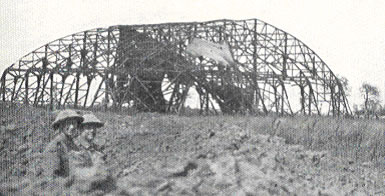
Caption Reads:
One of the hangers on the Aerodrome east of Villers-Bretonneux
This photograph was taken on 23rd June 1918. In April the hangars were still covered with fabric, until they were burned.
Grandfather was one of the soldiers in the raid of 30th April described above. He said that some of the defending Germans were hidden in a line of haystacks leading up to the farmhouse, and he was shot by one of the German soldiers in one of the haystacks. Although he was severely wounded, he said that he walked back to the lines which were not far distant.
Map from Bean Volume 5 p 645.
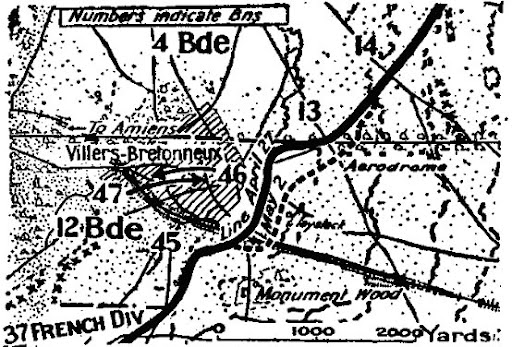
This is a map of the position on April 27th a few days before grandfather was wounded. The aerodrome is clearly marked and note a haystack is also indicated. The position of the 46 battalion is also on the outskirts of the town.
This photo is reproduced from Bean Volume VI, p 57.
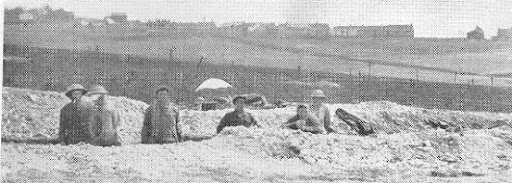
This is a view of the Villers-Bretonneux village.
The caption reads:
This view from the rear lines North West of the village indicates the nature of the country around it. (One man has just been wounded by a shell. Two of his comrades wear civilian hats from the village. A third is sleeping under a salvaged parasol.)
A photograph taken from We Were the 46th .
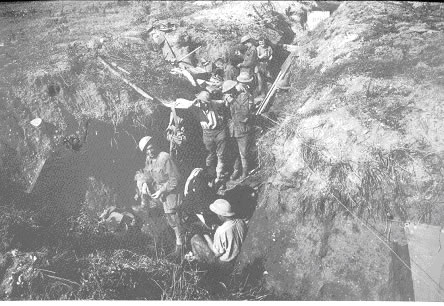
Although this was taken in September 1918 after grandfather was wounded it illustrates the conditions of trench warfare. The soldiers shown in the photograph were from the 46th Battalion. We are all familiar with the horrors of WWI, but to me this picture is important as it contains members of grandfather's battalion.
The day after he was wounded, 1st May, grandfather was admitted to the Australian Field Ambulance with a gunshot wound.
Then he was moved to six different hospitals.
One month after the end of the war, on 11th December, he left England for the return journey to Australia via hospital transport Saxon, and arrived in Melbourne on 30th January 1919. He was discharged as medically unfit on 12 April 1919.
Soon after, grandfather returned to Broadford where he was met at the station by a deputation of Victorian residents and marched with them to the Mechanics Institute where a welcome back ceremony was conducted.
Although the war was over its effects continued for many years. Sergeants were very important during the war as supporters and confidants to the lower ranks, and Sergeant “Lem” fulfilled this role with grandfather. My grandfather was forever grateful for his support in the harrowing conditions of the war. The war experience obviously took a great toll on “Lem”. He took up a soldier settlement farm after the war. The land was unsuitable for farming and he struggled unsuccessfully to make a living. The strain was too much and he had a severe nervous breakdown. He was admitted to Mont Park Mental Asylum. He was engaged to Sue, grandfather’s sister. My father remembers her taking him to visit Lem in Mont Park. Lem was sitting on the veranda at the front and my father doesn't remember him saying a word. He was obviously very ill.
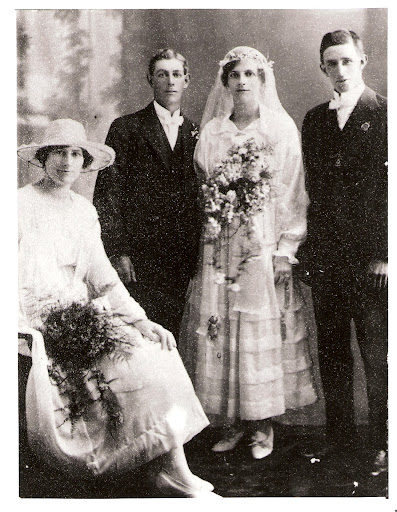
The photograph below was taken in 1920. It is the occasion of the wedding of grandfather's fiancee's brother. Grandfather is the man standing on the right of the photo. Compare this photo with the one at the beginning of the post. They were taken only four years apart and starkly display the war's legacy of ill health that plagued grandfather for the rest of his life.
The Australian "diggers" of WWI are famous for their physical strength and vigour. It is something of an irony that I am alive to write this post in part because my grandfather did not have a strong constitution. This meant that he did not arrive in France until 18 months after the war started and then was ill for almost a year. I can also thank some anonymous German soldier for his poor shooting! Nine and a half years after his close brush with death grandfather and his wife produced a son who 22 years later fathered me.
Margaret and I visited France in 2013. Our main objective was to see Villers-Bretonneux, in remembrance of my Grandfather. It was quite an eerie feeling to be in the area that he fought in and was wounded in 95 years earlier.
The main Australian war memorial in France is located at Villers-Bretonneux. The photograph below shows the two major features of the memorial, the cross and the tower.

The photo below is taken from the War Memorial and shows Villers-Bretonneux across the valley.

The school in the village houses a museum and the school yard has a sign "Do not forget Australia" as can be seen in the photo below. Click on the photo to see a larger version, click on the "X" in the top right of the enlarged picture to return to this post.

We visited many more locations on the battlefields tour, including some where trenches had been preserved.

My grandfather was born 8th January, 1896, in Broadford, Victoria (Australia) where he grew up. He did not speak much about his youth. We can imagine him as a boy and young man living a peaceful life in a small country town in Victoria, Australia. The seminal experience for him and all people of his generation was the outbreak of War in 1914.
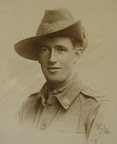 | When Britain declared war on Germany the Labor Australian Prime Minister, Andrew Fisher, pledged that Australia would "stand beside the mother country to help and defend her to the last man and the last shilling." It was natural that grandfather was enthusiastic to enlist. The photograph was taken before he left for Europe. |
My grandfather served during the World War I which until 1939 was called the Great War. During 1915, along with many other young men, he attempted to enlist. The physical qualifications standards were very high. He was rejected because his chest expansion was not sufficient. To remedy this he used exercises with dumbbells and was successful in his second application and was inducted on 4th April 1916, when he was 20 Years old. His best friend and neighbour, Dave Newnham, was rejected because he had flat feet.
He initially joined the 12 training battalion at Broadmeadows military camp. He embarked in Sydney on the “Borda” on 5th June 1916 with the 3rd reinforcements of the 46th Battalion. He arrived in France on 16th September 1916 and joined the 46th Battalion in the field on 24 November 1916.
Conditions were horrific on the Western Front and along with many other soldiers he suffered from illness. The main illness was Dysentery. These periods of illness were so serious that he spent time in English military hospitals, in Birmingham, Aldershot and Barton-on-sea. These hospitalisations occurred in the early part of his service from 17th November 1916 to 25th April 1917. After this bout of illness he was granted furlough and returned to duty on 17th May 1917.
The 46th Battalion was rotated in and out of the line during the rest of 1917 and early 1918. Grandfather did not talk much about his war experiences but did mention an experience in March 1918, near Doullons. This was during the last great German offensive of the war. There was often a need to shore up the defences, and grandfather talked about being transported by train and a forced 20 mile route march at night to get to the front. This involved carrying a full pack of equipment. After his return in May 1917 grandfather was with his battalion for almost a year.
Another incident he described occurred when a German shell exploded on the parapet of his trench causing the trench wall to collapse. He was buried alive in the collapse but was saved by his fellow soldiers digging him out with their bayonets.
The following is a quotation from a book detailing the history of the 46th battalion called We Were the 46th. The passage describes the action in which he was wounded.
On the morning of 27th April 1918, news finally came through that the 46th was to take over the line in front of Villers-Brettoneux, and under cover of darkness relieved a unit of the 5th division. The fighting in this area had been particularly savage and after the 46th had made its move into the new positions it was noted … that the ground was still thickly littered with the dead from both sides of the recent battle.
It was also in this area that the 46th employed its version of “Peaceful Penetration”, this practice being of great importance at the moment as the allies only had a small foothold in front of Villers-Brettoneux. In order to gain themselves more ground the men would push their advance posts closer to the German lines during the night; as per usual, the enemy would send down his “Artillery Hate” first thing in the morning, but as the positions kept moving, his shots were mostly ineffective. Patrolling was also undertaken to find out the enemy’s strengths and weaknesses and on one such occasion on April 30, Lieutenants Muriel and Colson of A and D companies respectively, took a platoon each of approximately 25 men to reconnoitre a farm house that the higher powers wanted taken. It was known that the farm itself was not strongly garrisoned, but behind it lay a strong line of enemy trenches. The patrol set out well enough, but after some distance were lit up by a couple of airplane hangers that had been set ablaze earlier in the day. Despite this difficulty they went on towards their objective but were evidently seen in the glow of the fires. A withering barrage of machine gun fire came from the enemy positions and was startling to inflict casualties on the Australians, forcing them to retire to their lines with Lieutenant Murial being severely wounded in the process. Sometimes, “Peaceful Penetration” didn’t work too well, and when that happened the attacking force usually paid dearly.”
Photo from Official History of Australia in the War 1914 – 1918, C.E.W. Bean , Volume V page 508
Caption Reads:
One of the hangers on the Aerodrome east of Villers-Bretonneux
This photograph was taken on 23rd June 1918. In April the hangars were still covered with fabric, until they were burned.
Grandfather was one of the soldiers in the raid of 30th April described above. He said that some of the defending Germans were hidden in a line of haystacks leading up to the farmhouse, and he was shot by one of the German soldiers in one of the haystacks. Although he was severely wounded, he said that he walked back to the lines which were not far distant.
Map from Bean Volume 5 p 645.
This is a map of the position on April 27th a few days before grandfather was wounded. The aerodrome is clearly marked and note a haystack is also indicated. The position of the 46 battalion is also on the outskirts of the town.
This photo is reproduced from Bean Volume VI, p 57.
This is a view of the Villers-Bretonneux village.
The caption reads:
This view from the rear lines North West of the village indicates the nature of the country around it. (One man has just been wounded by a shell. Two of his comrades wear civilian hats from the village. A third is sleeping under a salvaged parasol.)
A photograph taken from We Were the 46th .
Although this was taken in September 1918 after grandfather was wounded it illustrates the conditions of trench warfare. The soldiers shown in the photograph were from the 46th Battalion. We are all familiar with the horrors of WWI, but to me this picture is important as it contains members of grandfather's battalion.
The day after he was wounded, 1st May, grandfather was admitted to the Australian Field Ambulance with a gunshot wound.
Then he was moved to six different hospitals.
- 2nd May he was transferred to the 4th General Hospital in France
- 12th May he was transferred to England
- 14th May he was admitted to Cambridge Military Hospital, Aldershot
- 25th June transferred to 3rd Australian Military Hospital Dartford
- 28th June transferred to No. 3 Command depot Hurdcott
- 7th September transferred to No 1 Command Depot Sutton Veny
One month after the end of the war, on 11th December, he left England for the return journey to Australia via hospital transport Saxon, and arrived in Melbourne on 30th January 1919. He was discharged as medically unfit on 12 April 1919.
Soon after, grandfather returned to Broadford where he was met at the station by a deputation of Victorian residents and marched with them to the Mechanics Institute where a welcome back ceremony was conducted.
Although the war was over its effects continued for many years. Sergeants were very important during the war as supporters and confidants to the lower ranks, and Sergeant “Lem” fulfilled this role with grandfather. My grandfather was forever grateful for his support in the harrowing conditions of the war. The war experience obviously took a great toll on “Lem”. He took up a soldier settlement farm after the war. The land was unsuitable for farming and he struggled unsuccessfully to make a living. The strain was too much and he had a severe nervous breakdown. He was admitted to Mont Park Mental Asylum. He was engaged to Sue, grandfather’s sister. My father remembers her taking him to visit Lem in Mont Park. Lem was sitting on the veranda at the front and my father doesn't remember him saying a word. He was obviously very ill.
The photograph below was taken in 1920. It is the occasion of the wedding of grandfather's fiancee's brother. Grandfather is the man standing on the right of the photo. Compare this photo with the one at the beginning of the post. They were taken only four years apart and starkly display the war's legacy of ill health that plagued grandfather for the rest of his life.
The Australian "diggers" of WWI are famous for their physical strength and vigour. It is something of an irony that I am alive to write this post in part because my grandfather did not have a strong constitution. This meant that he did not arrive in France until 18 months after the war started and then was ill for almost a year. I can also thank some anonymous German soldier for his poor shooting! Nine and a half years after his close brush with death grandfather and his wife produced a son who 22 years later fathered me.
Margaret and I visited France in 2013. Our main objective was to see Villers-Bretonneux, in remembrance of my Grandfather. It was quite an eerie feeling to be in the area that he fought in and was wounded in 95 years earlier.
The main Australian war memorial in France is located at Villers-Bretonneux. The photograph below shows the two major features of the memorial, the cross and the tower.

The photo below is taken from the War Memorial and shows Villers-Bretonneux across the valley.

The school in the village houses a museum and the school yard has a sign "Do not forget Australia" as can be seen in the photo below. Click on the photo to see a larger version, click on the "X" in the top right of the enlarged picture to return to this post.

We visited many more locations on the battlefields tour, including some where trenches had been preserved.


