Loading...
Gadget by The Blog Doctor.

Monday, June 28, 2010

Introduction to Peak Oil

We are nearing the end of a two century cycle - the end of the fossil fuel era in part because we cannot continue to pump carbon dioxide into the atmosphere: see these posts for discussion of that topic.

A second reason for the end of the fossil fuel era is that we are at or nearing peak oil.

Before considering this issue in detail, here is a cartoonist's take on the issue of increasing fuel prices:


An excellent resource on the issue of energy policy and peak oil is The Oil Drum. For a letter that I wrote to the Age on this topic, see this post.

I hope the fears of the Peak Oil theorists are significantly overstated - if they are correct then we are in for a very bad time in the next decade.

The video below, Produced by Chris Martenson in 2008, explains the evidence and issues of peak oil.


Peak Oil will have serious implications for our economy and society. Jeff Rubin discusses these issues with Allan Gregg, in the video below:


Here is a speech that Rubin gave to the Association for the Study of Peak Oil and Gas (ASPO) conference 2010:

Oil and the End of Globalization : Mr. Jeff Rubin from ASPO-USA on Vimeo.


Here is a transcript of the speech:

You know, knowing the nature of the disease is usually an essential first step to finding a cure. And so too, it is with a recession. Knowing the true nature of a recession goes a long way in helping us to avoid falling into another one. Particularly when the recession we are just coming out of happens to be the deepest global post-war recession on record.

Conventional wisdom, as espoused by central bankers, finance ministers, and the pundits that you watch on TV would have you believe that the recession that we are still feeling here in America, and, indeed, throughout the world, was all about a financial crisis, whose roots lie in the failed sub-prime mortgage market in the United States. In other words, a whole bunch of boarded up, repossessed unsalable houses and depressed property markets in places like Cleveland, all financed with easy credit and subprime mortgages, hit financial markets like some toxic hydrogen bomb, and then all of a sudden, a property market crash in the United States, somehow morphed into a deep, global recession.

Gee, I never knew that Cleveland was that big. No one has to tell me about the impact of the subprime mortgage market on financial markets. Why do you think I am an author now? But there is a big difference between blowing up the bonus pools of investment banks, and blowing up Wall Street, and what happened.

If you are wondering why risk-averse institutions like the bank that I used to work for had to write down almost $10 billion of assets of things called Collateralized Debt Obligations that were funded by pools of subprime mortgages, the reason is pretty simple: they were rated AAA, which meant that rating agencies assigned the risk of default with the same probability that the US Treasury would default. What the banks lost sight of is how rating agencies get paid. Rating agencies don't get paid by investors; they get paid by issuers. In Economics, we call this moral hazard problem. In investment banking, we call it, "Shit happens."

It is easy to see how sub-prime mortgages blew up Wall Street; it is a little more challenging to see it as the author of the global recession. Why were there economies that had no sub-prime mortgages that experienced even deeper recessions than the United States? Why did those economies go into recession even before the US economy went into recession? Maybe, just maybe, there was something more important going on--more important to the global economy than Wall Street or sub-prime mortgages, like $147 barrel oil, for example. If we know anything about watching the global economy in the last 40 years, we know this: feed it cheap oil, and it runs very smoothly. All of the sudden, give it expensive oil, and it stops in its tracks.

Every major recession in the post-war period has oil's fingerprints all over it. The 1973 first oil shock led to what was then the deepest post-war recession, at the time. The second OPEC oil shock led to no less than two recessions: 1979 and 1982. And then when Saddam Hussein invaded Kuwait, and left half of its oil fields on fire, and oil spiked to the then unheard-of price of $40 barrel, lo and behold, the industrialized world again fell into recession.

Gee, I wonder what happened to oil prices before this recession. It seems to me that oil prices went from about $30 barrel, at the beginning of 2004, to almost $150 barrel by 2008. Even in real terms, that is, inflation-adjusted, that price increase was over double the price increase of either the first or the second OPEC oil shock. If they had led to devastating recessions, why would not the biggest oil shock of them all, be the obvious culprit for what has been the deepest recession to date?

There are many ways in which oil shocks create global recessions. First, the transfer of income. When oil went from $30 barrel, to about $147 barrel, over $1 trillion of income was transferred from the industrialized oil consuming world to OPEC. Now, that was not neutral for the economy, because the savings rates from which money was coming from, like the United States, was virtually 0%, meaning that consumers spent everything they made. And where the money was going to, places like Saudi Arabia, or Kuwait, or the United Arab Emirates, had savings rates of almost as high as 50%, so it certainly was not demand neutral.

High price also create recessions by crowding out non-energy expenditures. Two years ago, when gasoline cost us $4 gallon, low-income Americans were paying more to fill their tanks than they were to fill their stomachs.

But by far, the most important mechanism, the most important path, by which oil prices cause recession is through their impact on inflation, and their impact on interest rates.

There is no shortage of people to blame for the subprime mortgage crisis. We could start with fraudulent mortgage companies that approved mortgages, then quickly sold them to financial institutions. We can blame financial institutions who played Russian roulette with depositors money, and of course we can blame rating agencies who assigned AAA ratings to this. And we can blame regulators, who were asleep at the wheel, like the Securities Exchange Commission, who were either blind or indifferent to Wall Street's systemic risk to subprime mortgages.

However, the real culprit behind subprime mortgages was the very low cost of capital and 0% interest rates. All the greed in the world could not do what the Fed's easy money made possible. The subprime mortgage rates were created by interest rates and the subprime mortgage market was pricked by interest rates. Everybody would agree with that. What people don't seem to ask is, "Just why did interest rates go from 1% to 5.5% from 2004 to 2006?"

Well, any central banker, even Alan Greenspan, will acknowledge that your borrowing cost is a mirror image of your inflation rate. We had 1% federal funds' rate in 2004, because we had a 1% inflation rate. All of the sudden, in 2006, inflation was over 5.5%, the highest it had been in America, since, coincidentally, 1991, when we just happened to have the last oil shock. All of the sudden, money wasn't free any more. All of the sudden, you weren't getting credit cards in the mail any more that you never applied for. And all of the sudden, people who held negative amortization sub-prime mortgage rates had to start paying 7% or 8%.

Well, if interest rates hadn't risen, that wouldn't have occurred. Why did inflation move up? Virtually all of the increase in inflation came from one component of the US consumer price index basket--the energy component. By the end of 2006, energy inflation was running at 35%, because of one price: the price of oil. The price of oil went from $30 barrel, which incidentally, every oil analyst at the time said it was going to stay at that level, to over $70 barrel. If oil had stayed at $30 barrel, inflation would never have spiked; neither would have interest rates. All of those good folk in Cleveland would probably still be there, in their homes financed by 0% interest rate sub-prime mortgages. Lehman Brothers and Bear Stearns would probably still exist, and I'd probably still be the chief economist at CIBC.

But that is not what happened. Why did oil prices go up to $147 barrel? Somewhere where virtually every economist said it could not go. Well, there were two reasons that economists said that oil prices could not get into triple digit range, and that was the cherished principles of supply and demand. First, the theory of the upward sloping supply curve--higher oil prices would bring new supply, just like it did after the OPEC oil shocks, where oil gushed from Prudhoe Bay and the North Sea. And not only did that break OPEC's strangle-hold on the market, but sent oil prices tumbling down.

Unfortunately, as you all know, there are no more Prudhoe Bays or North Seas to come on tap. Yes, there are tar sands, and theres is deep water, and the upward sloping supply curve did bring new sources of supply, but only at prices that we at the end couldn't afford to burn.

What about the cherished principle of demand? Would not triple digit oil prices quash demand? Well, it did, in certain places. It did in the United States. It did in Canada. It did in Japan. It did in Western Europe. Fifteen years ago, if those economies suddenly cut back their appetite for oil, oil prices would have fallen, because 15 years ago, those countries would have accounted for almost three-quarters of world oil consumption. Today, they account for barely half. Tomorrow, they will account for less than half. It wasn't the US consumer that drove oil demand to $147 barrel in the last cycle, and it certainly won't be the American consumer that drives a barrel of oil to $147 and higher in the next cycle. We have already seen peak demand, in this economy, and in the economy of the other industrialized countries.

Where do you think oil demand has been growing the strongest? Many of you will probably be saying China, and indeed it has. It's grown from around 2 million barrels a day, to about 9 million barrels a day. But I know a place where the demand for oil is growing even faster than in China. And it is the same place your politicians have told you your supply is coming from in the future. Last year, OPEC and two non-cartel producers, Mexico and Russia, consumed 14 million barrels a day. That is almost two Chinas.

What makes OPEC so thirsty for its own fuel? Well, if you ever filled your tank up in Caracas, you would get some sense of it. It is 20 cents a gallon. And if you go to Riad, in Saudi Arabia, it is a little bit more-it's 40 cents a gallon. And it's 40 cents a gallon, whether oil costs $20 barrel, or whether oil costs $150 barrel.

If you think drivers have a good deal in OPEC countries, they don't have anything as good a deal as power users. What's the coolest thing to do in Dubai? Ski, of course. I love skiing; I'm Canadian. But going skiing in an area where it's hot enough to fry an egg on the pavement uses up a whole lot of energy. In fact, one day at Ski Dubai uses the equivalent energy that a North American would consume in a month's worth of driving. So the question isn't really how much productive capacity that OPEC has. How much export capacity is the real question, and every year that is less and less, because every year, more and more is consumed at home.

Now, it's their oil and gas, and if they want to consume their oil and gas going skiing in one of the hottest deserts in the world, that is their right. All I'm saying is, chances are, your future oil supply ain't coming from OPEC, and chances are, it ain't going to be cheap.

Now sure, oil prices fell to $40 barrel during the recession. And for many folk, that was evidence enough that it never had any business being in triple digit range in the first place. But what a lot of those folk forget is that in the last recession, world oil demand actually fell. It fell for the first time since 1983. Such was the severity that the recession was.

Peak oil is not a problem if the economy that it is powering is shrinking. Peak oil is only a problem if the economy we are in is starting to grow. The first thing you know about an economic recovery is that economies start burning more oil. The next thing you know about an economic recovery is that oil prices start rising. Where is oil trading today? It is trading at over $80 barrel. With the exception of Germany and Canada, every other economy in the G7 is still miles below the level of GDP that they were at before the recession began.

And yet, where oil is trading today, turn the clock back to three years ago, and that would have been a world all-time record high. Now, it is where oil trades in the shadow of the deepest global post-war recession. Where do you think oil prices are going?

I will tell you where I think oil prices are going. Even in this most anemic of economic recoveries, we are going to see triple digit oil prices. We are not going to see triple digit oil prices in 10 to 15 years. And it is certainly not clear to me that the global economy is better able to handle that than in 2008. Now, a lot of people will say, "Jeff, economic history tells us that scarcity is the mother of invention. Give us 10 to 15 years of adjustment, and we will develop alternate technology, so we won't be carbon-dependent."

And they are right. Give us 10 to 15 years, and we will solve this on the supply side. But as I say, our rendezvous with triple digit oil prices is not in 10 or 15 years; it is in 10 or 15 months. So instead of trying to turn cow-shit into high octane fuel, we are going to have to learn to get off the road, and that is just what happened. In 2009, there were 4 million fewer cars on the road than there were the year before. In the next ten years, 40 million North Americans will be taking the exit lanes. The question is, "Will there be a bus to get on?" Instead of giving $40 billon to General Motors, what we should have done is spend $40 billion on public transit, so there would be a bus to get on.

In a world of triple digit oil prices, all of the sudden the economy's speed limit changes. And that is one of the problems that we have here in America, is that we don't recognize that our economy's speed limit has changed. What the economy could grow at when oil was $20 to $30 barrel is a whole different speed limit than what the US economy can grow at when oil is $80 to $150 barrel.

And that is something that I don't think the Administration recognizes. Because what President Obama cannot bring is cheap oil. He can get expensive oil. We can build a pipeline from the Canadian tar sands down to the Gulf refineries, and we can get oil. But in order to get the kind of oil that will be required, that will require the triple digit oil prices that we can't afford to pay. But trying to pump-prime the economy with fiscal stimulus is not a substitute for cheap oil. It won't make the economy grow any faster. It will just make the deficit that much bigger.

Worse than that, triple digit oil prices will not only take millions off the road, it will send our economy right back into recession, unless of course, the economy changes. We can't do a whole lot about triple digit oil prices. That is where the supply curve lies. And if you doubt that, just look at the Canadian tar sands. Like sure, there is 170 billion barrels of it there, and there is 500 billion barrels in the Orinoco heavy oil belt, but that is not the issue. Depletion is not just the geological concept, it is more fundamentally an economic concept. Because if the cost of extracting that oil from the tar is greater than we can afford to burn, it doesn't matter how many billion barrels of oil there are in the tar sands.

So how do we adapt? How do we grow in an economy of triple digit oil prices? We change the nature of our economy. In a world of triple-digit oil prices, distance costs money. The global economy, where we produce one thing at one end of the world, to be sold at the other end of the world, doesn't make any economic sense, because in too many cases, what will be penny-wise, will soon become pound-foolish. The wage "arb", what we save on wages, we will more than squander on bunker fuel.

Take the steel industry, for example. Just before the recent recession, some very curious things were happening in the US market. When oil prices got to be over $100 barrel, all of the sudden, Chinese steel exports to the US fell at double-digit rates. And all of the sudden, US steel production was up. And all of the sudden, US Steel Corp., which was one of the biggest dogs in the market, all of the sudden its share price doubled.

What was going on? I'll tell you what was going on. For the first time in 20 years, it was cheaper to make steel in the United States than to import it from China. Why? Consider what China has to do to send you steel. First, it has to ship iron ore from Brazil, across the Pacific Ocean, turn it into steel, which is itself a very energy-intensive process, then ship it back, across the Pacific Ocean, to you. At $20 barrel, that works. At $100 barrel, that doesn't work. It added on $60 to $70 dollars, to the cost of a ton of hot-rolled steel. How much labor time do you think there is in making steel these days? One and a half to two hours. The transit costs all of a sudden exceeded the labor costs. Who would dream that triple digit oil prices would breathe new life into our hollowed-out Rust Belt? But in a world where distance costs money, that is exactly what is going to happen.

Take food. Last year, China exported $6 billion of food to America, everything from apples to frozen chicken wings, bringing a whole new meaning to having your Chinese food delivered. Steel doesn't have to be refrigerated. Hopefully, frozen chicken wings do. What do you think powers that refrigeration unit? Bunker fuel! The same thing that is powering the boat. The world of triple digit oil prices--it won't matter that farm labor is cheaper in China than in the United States, because the cost of bringing those frozen chicken wings to us will be too expensive.

it's not like we are going to stop using steel in America, and it is certainly not like we are going to stop eating. What we are going to have to do is make our own steel. What we are going to have to do is grow more of our own food. Unfortunately, much of our agricultural land has been paved over with suburban sprawl. Just as triple digit oil prices will breathe new life into our hollowed out Rust Belt, triple digit oil prices will turn those far-flung suburbs and exurbs back into the farmland they were, thirty to forty years ago. The very same economic forces that gutted our manufacturing sector, that paved over our farm land, when oil was cheap and abundant, and transport costs were incidental, those same economic forces will do the opposite in a world of triple digit oil prices. And that is not determined by government, and that is not determined by ideological preference, and that is not determined by our willingness or unwillingness to reduce our carbon trail. That is just Economics 100.

Triple digit oil price is going to change cost-curves. And when it changes cost curves, it is going to change economic geography at the same time. I know that the world of triple digit oil prices has been the domain of the apocalypse. For many people, the advent of peak oil and triple digit oil price means the end of our economy. For some, civilization as we know it. I don't share that pessimism. I don't share that outlook. I'm an economist. I believe in the power of prices.

Sure, if we continue to want to get our frozen chicken wings from half-way around the world, where labor is cheap, if we want to get our steel from half way around the world, if we want to commute back and forth eighty miles to work in our SUVs, peak oil won't just be a recession, peak oil will be peak GDP, and that will be apocalyptic. But as I say, I am an economist, and I believe in the power of prices. I believe we are going to change. I believe that we are not going to end up importing food from half-way around the world, or steel from half-way around the world. I don't think we are committed, irrevocably, to suburban sprawl.

And we might just find that that new smaller world around the corner is a whole lot more livable, and a whole lot more sustainable, than the big "oily" one we are about to leave behind.

Thank you very much.

We have seemed to have reached an undulating plateau, rather than a peak, as predicted by the Hubbert Model. This link discusses the Hubbert Model in an number of contexts including the current circumstances.

Here is the author's introduction:

The Hubbert model says that, within a reasonably large region, oil production should follow a bell shaped curve. When the model is applied to worldwide oil production, the maximum level of production is called "peak oil." Fat cows and lean cows are commonly seen as the consequence of being on one or the other side of the curve. Peak oil has been often predicted to occur within the first decade of the 21st century, however, up to now, we are not seeing a well defined peak but, rather, a plateau that has been going on from 2004. This article examines the situation and argues that Hubbert's model, as all models, is valid only in some specific conditions. In particular, we may expect the production plateau to keep going as long as the economy can transfer to oil extraction resources from other industrial sectors.

Sunday, June 27, 2010

Negative Effects of Globalisation

Introduction
In the first week of the Our World in Crisis? course, each group held a debate on Globalisation. The topic was "Globalisation is a good thing". Find some arguments favouring Globalisation at this post. This post presents arguments opposing globalisation.

An Australian example of the negative effects of globalisation

At this time one of the major issues raging in Australia involved powerful globalisation issues. The government had proposed an extra tax on the "super profits" of mining companies. Not surprisingly the multi-national mining companies that were making the huge profits objected and mounted a powerful public campaign against the government. The mulit-national mining companies campaign was strongly supported by the multi-national media (News Limited) and the conservative oppostion parties. The government decided that it could not withstand such a powerful (and extremely well funded campaign) so it came to an agreement with the mining companies under which the companies would pay much less tax.

What was disturbing about this episode was how it was handled by the media, that reported with glee the gladitiorial contest but ignored the wider implications for national sovereignty and democratic government. Clearly here was and example where a national government was thwarted by powerful international companies but no one in the media seemed particularly concerned by this limitation of national sovereignty.

Laura Tingle has an interesting take on though more in the context of Australian politics and media than from a global perspective.

Theoretical arguments against globalisation

The main arguments supporting Globalisation are free market neo-liberal ones. The critiques of Globalisation involve attacks on the neo-liberal agenda.

One of the major critics of Globalisation is Joseph E. Stiglitz, whose book Globalization and its Discontents is a powerful attack on globalisation.

Stiglitz particularly attacks the interventions of the International Monetary Fund (IMF) and considers that the policies pursued by the IMF are based on neoliberal assumptions that are fundamentally unsound:

Behind the free market ideology there is a model, often attributed to Adam Smith, which argues that market forces--the profit motive--drive the economy to efficient outcomes as if by an invisible hand. One of the great achievements of modern economics is to show the sense in which, and the conditions under which, Smith's conclusion is correct. It turns out that these conditions are highly restrictive. Indeed, more recent advances in economic theory --ironically occurring precisely during the period of the most relentless pursuit of the Washington Consensus policies--have shown that whenever information is imperfect and markets incomplete, which is to say always, and especially in developing countries, then the invisible hand works most imperfectly. Significantly, there are desirable government interventions which, in principle, can improve upon the efficiency of the market. These restrictions on the conditions under which markets result in efficiency are important--many of the key activities of government can be understood as responses to the resulting market failures.

The point, according to Stiglitz is not that neo-liberalism is always incorrect, but rather that it has to be applied carefully and in accordance with the culture and history of individual countries.

As W.W. Norton states:


The main tenet of the book is simple, and goes something like this: pro-globalization
policies have the potential of doing a lot of good, if undertaken properly and if
they incorporate the characteristics of each individual country. Countries should
embrace globalization on their own terms, taking into account their own history,
culture, and traditions. However, if poorly designed—or if a cookie-cutter approach is followed—pro-globalization policies are likely to be costly. They will increase
instability, make countries more vulnerable to external shocks, reduce growth, and
increase poverty.

The problem, according to Stiglitz, is that globalization has not been pushed
carefully, or fairly. On the contrary, liberalization policies have been implemented too fast, in the wrong order, and often using inadequate—or plainly wrong—economic
analysis. As a consequence, he argues, we now face terrible results, including
increases in destitution and social conflict, and generalized frustration. The culprits are the IMF and its ‘‘market fundamentalists,’’ the ‘‘Washington Consensus,’’ and the US Treasury.

Not surprisingly the strongest critics of Stiglitz are from the neo-liberal camp. For one example follow this link.

The video below is a brief excerpt from an extended interview with Stiglitz. For the full interview follow this link.


Another strong critic of Globalisation is Noam Chomsky.

The video below is the sound track of a brief talk on globalisation.


I particularly liked the poem quoted by Chomsky:

The poor complain; they always do
But that’s just idle chatter
Our system brings reward to all
At least all those who matter.

Poem by a Canadian economist (Gerald Helleiner)

For Helleiner the development of a just and effective global economic system is a work in progress. See this link for details.

The most important implications of the globalisation of world markets, then, are: the pressing need for development of appropriate policies, at national, regional and community levels, for optimal use of the global economy in the interest of national, regional and local human welfare and development; and, perhaps even more difficult, the greatly increased need for improved arrangements for global economic governance.

Given the limitations of our knowledge and the enormous diversity of national, regional and local circumstances, it is difficult to generalise about the former; that, in turn, implies the need for global governance and rules systems that eschew over-harmonisation and ‘one-size-fits-all’ approaches.

Market forces are powerful, and can be so for good. But, left unchecked, they can yield socially deleterious outcomes... Markets may be important and market incentives can indeed be powerful, but they are neither all-pervasive, nor do they solve all problems. In their proper context, with appropriate safeguards and institutions, markets and their incentives can do much good. It is also, of course, well-known that great harm can be done when governments try to replace or outdo markets in circumstances where they do not have the capacity effectively to do so.

Positive Effects of Globalisation

In the first week of the Our World in Crisis? course, each group held a debate on Globalisation. The topic was "Globalisation is a good thing". I chose the affirmative because I thought it would be a more difficult issue to argue.

The first task was to define Globalisation.

Definitions


Economic globalization refers to increasing economic interdependence of national economies across the world through a rapid increase in cross-border movement of goods, service, technology and capital. [1] It is the process of increasing economic integration between countries, leading to the emergence of a global marketplace or a single world market[2].

Or to put it another hopefully clearer way:

... the integration of national economies into the international economy, through the exchange of goods and services across national borders, the ownership of businesses and organisations in other countries, the movement of money internationally, the spread of modern technologies, particularly computer and communications products and the movement of people between countries.

Economic Globalisation Processes

A major element is the promotion of free trade. International free trade involves:

• elimination of tariffs; (ie a tax on imports) creation of free trade zones with small or no tariffs
• Reduced transportation costs, especially resulting from development of containerization for ocean shipping.
• Reduction or elimination of capital controls such as limitations on buying currency, taking currency from the country, taxing of monetary transactions
• Making intellectual property laws across the majority of countries similar
• International recognition of intellectual property restrictions (e.g. patents granted by China would be recognized in the United States

Arguments supporting Globalisation

The main advantages of Globalisation relate to free markets:

• It enhances the general economic welfare by allowing savings to be channelled to their most productive use.[17]
• By encouraging foreign direct investment it helps developing economies to benefit from foreign expertise.[17]
• Allows states to raise funds from external markets to help them mitigate a temporary recession.[17]
• Enables both savers and borrowers to secure the best available market rate.[4]
• When controls include taxes, funds raised are sometimes siphoned off by corrupt government officials for their personnel use.[4]

These processes haven’t always worked out the way the initial backers expected. Economic globalisation was initially pushed by Western Countries particularly the US, because they thought that it benefited them.

As Mark Thirlwell noted in a Lowy Institute publication called “Second Thoughts on Globalisation” :

It is the developed world that is now having second thoughts about
globalisation. [Although] discontent with globalisation is apparent in much of the developed World … most of the current re-evaluation of globalisation is being spurred not by its failures but by its successes, in particular the economic emergence of China and (to a lesser extent) India.

(Source here)

A criticism of Globalisation is that it disadvantages developing countries. Although there is some truth to this it has also led to the spectacular economic development of some undeveloped countries particularly China, India and Brazil. China has become the workshop of the world and consequently many hundreds of millions of people have been lifted out of dire poverty to a modicum of prosperity.

On a personal note: I first travelled to China in the early 1980s and noticed that the main method of transport was the bicycle. During my 2009 visit I noticed that most of the bikes had been replaced by motor scooters and that there was a large fleet of modern cars on the road.

This Chinese development is assisting other areas of the World. China is giving African countries more aid for Infrastructure that the IMF and World Bank combined, according to Joseph Stiglitz, Nobel Prize Winning Economist.

As an American foreign policy analyst, Deborah Brautigam, noted:

This is an opportunity for African states to ride into the global economy on China's shirt tails rather than remain natural-resource suppliers to the world.
(Source here )

Although economic globalisation has had some detrimental effects they are far outweighed by its advantages.

Wednesday, June 23, 2010

Dover Beach

My favourite poem.

It was written by Matthew Arnold

Cat Stevens

Last Saturday Margaret, Michelle, Jonathan and I went to a Cat Stephens tribute show at the Werribee Cultural Centre.

Here are some of the songs that were sung:


As I Walked Out One Evening

Here is a video of W.H. Auden reciting his marvellous poem, As I Walked Out One Evening.

Here is a review of the poem.

Sunday, June 20, 2010

The Pattern Behind Self-deception

Michael Shermer is the editor of Skeptic magazine. I already have two TED talks by Michael, here and here

TED describes this talk as follows:

Michael Shermer says the human tendency to believe strange things -- from alien abductions to dowsing rods -- boils down to two of the brain's most basic, hard-wired survival skills. He explains what they are, and how they get us into trouble.

Where I Stand

We all think that our political views are reasonable and somewhere near centre of mainstream politics, so I was interested to come across a quiz that calculates a person's position in the political spectrum. The site can be found here.

The site provides two web pages of questions with buttons to click indicating the degree to which you agree of disagree with each statement and how important the issue is to you.

According to the site:

This quiz will let you know where you fall on social liberties, economics, foreign policy-- even the culture war. In truth, this isn't a quiz so much as a set of statements that you must agree or disagree with. Based on your responses we will place you on a graph--also termed a political compass--that separates social liberties from economic opinion ... We will also show you what type of foreign policy you support, and how liberal or conservative you rank in the culture war

Note that this is an American site so that they use the word liberal in its traditional sense. In Australia this can be confusing as our major conservative party is called the Liberal Party.

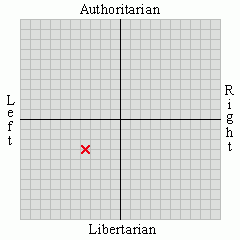
I was not surprised to find that I was a left social libertarian.

My Political Views
I am a left moderate social libertarian
Left: 3.31, Libertarian: 2.78


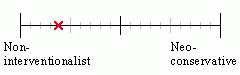
My Foreign Policy Views
Score: -6.23


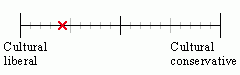
My Culture War Stance
Score: -5.72

Thursday, June 17, 2010

Eight US Presidents and Oil Dependency

Jon Stewart does entertaining and wonderfully perceptive commentary.

There are plenty of blog posts and books explaining why we are unlikely to solve the many problems facing us, but this seven minute video pretty much explains it all.

Keep listening to the end as the last comment on Nixon is priceless.

The Daily Show With Jon StewartMon - Thurs 11p / 10c
An Energy-Independent Future
www.thedailyshow.com
Daily Show Full EpisodesPolitical HumorTea Party

Wednesday, June 16, 2010

Arctic Sea Ice

That the anthropogenic warming of the planet is causing serious problems can no longer be credibly denied. See this link at Skeptical Science for 16 examples. (The discussions in the comments at the Skeptical Science site are always polite, interesting and well worth reading.)

One of the most obvious of these effects is the decline in Arctic Sea Ice.

The graphs is Figure 1 and Figure 2, show that Arctic Sea Ice has been declining ever since satelite measurements became available in 1979. Although there is year to year variation the trends in both maximum sea ice and minimum seaice are negative. Figure 1 shows that 2007 was a particularly bad year for the sea ice with a spectacular drop in sea ice minimum extent. Although 2008 and 2009 minimums were higher than 2007 they are still respectively the second lowest and third lowest levels on record. The "recovery" has just returned levels back to that of the declining trend line.


figure 1. Arctic Sea Ice trend at the end of the melt season since 1979 Source:
NSIDC


figure 2. Arctic Sea Ice trend of maximum sea ice levels since 1979 Source:
NSIDC


The question arises: "What is currently happening to the Arctic Sea Ice?" Figure 3 and Figure 4 show the changes to the sea ice since last year's minimum extent. It is clear from them that the ice grew quite slowly during the northern winter - it started from a higher level than 2007 but followed the 2007 trajectory for most of the ice growing season. For about a month the ice extent was close to the long term average but for the last month and a half has declined very quickly.

As an aside it is interesting to note how the global warming deniers handle this information. The denier's approach is to ignore the larger picture - for instance you will never see figures 1 and 2 on a denier site - instead they search through a mountain of contrary evidence to find anything that can be manipulated to provide the answer that they desperately desire. It is hardly surprising then that as soon as the ice neared the average values the denier sites started claiming that the ice isn't declining as it is near average levels. It is irrelevant to such people that the ice approached average levels for a short period of time. Here is a post by Australia's premier denier during that short period of time.

The sea ice decline has been dramatic since the beginning of May. The amount of ice lost in May 2010 is the largest amount lost in any May in the record. As the NSIDC noted in the June 8 2010 update:

Arctic sea ice extent averaged 13.10 million square kilometers (5.06 million square miles) for the month of May, 500,000 square kilometers (193,000 square miles) below the 1979 to 2000 average. The rate of ice extent decline for the month was -68,000 kilometers (-26,000 square miles) per day, almost 50% more than the average rate of -46,000 kilometers (18,000 square miles) per day. This rate of loss is the highest for the month of May during the satellite record.

Figure 5 shows that currently the Arctic Sea Ice extent is at its lowest recorded level for this time of year.


figure 3. Arctic Sea Ice Levels - March to Jume 2010 Source: NSIDC


figure 4. Arctic Sea Ice levels September 2009 to January 2010, Source: NSIDC


figure 5. Arctic Sea Ice levels since 2003, source: AMSR-E

Ice extent is not the only method of measuring Arctic Sea Ice, an alternative is to determine ice volume. The Polar Science Center (PSC) has developed a method of determining Arctic Sea Ice Volume. The PSC arctic ice volume chart can be seen in Figure 6. Note that, like the ice extent data, this also has a long term downward trend. As well the apparent "recovery" since 2007 does not appear in volume information. In fact, ice volume has declined since 2007 and currently is at its lowest level.

Deniers will immediately cry foul, as this chart is produced by a combination of observation and modelling. The results, though, have been carefully validated in relation to the ICEsat satelite. ICEsat measurements, which have in turn been validated by measurements taken by US Navy submarines, have confirmed that Arctic sea ice volume is significantly declining.

Here are some quotations from the ICEsat site:

The Arctic ice cap grows each winter as the sun sets for several months and intense cold ensues. In the summer, wind and ocean currents cause some of the ice naturally to flow out of the Arctic, while much of it melts in place. But not all of the Arctic ice melts each summer; the thicker, older ice is more likely to survive. Seasonal sea ice usually reaches about 2 meters (6 feet) in thickness, while multi-year ice averages 3 meters (9 feet).

Using ICESat measurements, scientists found that overall Arctic sea ice thinned about 0.17 meters (7 inches) a year, for a total of 0.68 meters (2.2 feet) over four winters. The total area covered by the thicker, older "multi-year" ice that has survived one or more summers shrank by 42 percent.

In recent years, the amount of ice replaced in the winter has not been sufficient to offset summer ice losses. The result is more open water in summer, which then absorbs more heat, warming the ocean and further melting the ice. Between 2004 and 2008, multi-year ice cover shrank 1.54 million square kilometers (595,000 square miles) -- nearly the size of Alaska's land area.

During the study period, the relative contributions of the two ice types to the total volume of the Arctic's ice cover were reversed. In 2003, 62 percent of the Arctic's total ice volume was stored in multi-year ice, with 38 percent stored in first-year seasonal ice. By 2008, 68 percent of the total ice volume was first-year ice, with 32 percent multi-year ice


Figure 6. Arctic Sea Ice Volume. Source PSC

Evidence for the decline in Arctic sea ice thickness has been found by polar scientists visiting the Arctic. Figure 7 is a video of a relatively brief talk given by Dr David Barber. The implications of his eye witness account are quite sobering. A longer and more detailed talk on this topic can be found here.


Figure 7. Direct observations of sea ice by scientists

So, what is my prediction for sea ice minimum in 2010? I expect that this year's ice minumum will be between the 2007 level and the 2009 level. The sea ice minimum in 2007 was exceptional, and I expect that this year's ice melt will not reach the same low level. The ice is very thin, though, and susceptible to melt, so it could quite well be lower than last year.

We will know in September.

UPDATE: 14/09/2010
Peter Sinclair has produced a video on the topic of Arctic Sea Ice. It covers many of the points made in this post, but is still well worth watching, as Sinclair has an interesting and direct style.


UPDATE: 20/10/2010

In the post I made the (not very brave) prediction that this year's melt would be between that of 2007 and 2010. That turned out to be true. As NSIDC noted:

Ice extent for September 2010 was the third lowest in the satellite record for the month, behind 2007 (lowest) and 2008 (second lowest).

Here is the NSIDC graph:


Here is the AMSR-E graph:


The main issue though is the long term trend. As NSIDC notes:

The linear rate of decline of September ice extent over the period 1979 to 2010 is now 81,400 square kilometers (31,400 square miles) per year, or 11.5% per decade relative to the 1979 to 2000 average.

Here is the NSIDC trend graph:


It might be that a linear trend is not the best way of showing the trend. Tamino has fitted a quadratic trend line to the data, and it looks like a very good fit. This indicates that the declining trend might be accelerating. Here is Tamino's graph:


The cross at the right is the actual lowest level for this year.

UPDATE (23/11/2010)
Climate disinformers keep missing the point and keep making fools of themselves.

Here is a video by Peter Sinclair on the effects of warming on planetary ice which incudes absurd claims by climate disinformers which are contradicted by a scientist and an admiral in the US navy:

Many Reasons for Clean Energy

Tuesday, June 15, 2010

Hitchins Intellectual Limericks

I listened to a podcast of an interview of Christopher Hitchins at the Sydney Writers Festival. Hitchins has a great way with words and started to recite some limericks for the entertainment and edification of the audience.

Before getting to Hitchins' limericks let me quote the following definition of limerick which is funny in its po-faced seriousness:

A limerick is a five-line poem in anapestic or amphibrachic meter with a strict rhyme scheme (aabba), which intends to be witty or humorous, and is sometimes obscene with humorous intent.

And here is a limerick about limericks:

The limerick packs laughs anatomical
In space that is quite economical,

But the good ones I've seen
So seldom are clean,

And the clean ones so seldom are comical.

For those interested in the Hitch's suggestive limericks try this post.

His limeicks which follow, prove that clean ones can be still be entertaining.

Robert Conquest, the British Historian, wrote a limerick summarising the Seven Ages of Man speech from As You Like It.

First a reminder of the Shakespear:

All the world's a stage,
And all the men and women merely players;
They have their exits and their entrances;
And one man in his time plays many parts,
His acts being seven ages. At first the infant,
Mewling and puking in the nurse's arms;
Then the whining school-boy, with his satchel
And shining morning face, creeping like snail
Unwillingly to school. And then the lover,
Sighing like furnace, with a woeful ballad
Made to his mistress' eyebrow. Then a soldier,
Full of strange oaths, and bearded like the pard,
Jealous in honour, sudden and quick in quarrel,
Seeking the bubble reputation
Even in the cannon's mouth. And then the justice,
In fair round belly with good capon lin'd,
With eyes severe and beard of formal cut,
Full of wise saws and modern instances;
And so he plays his part. The sixth age shifts
Into the lean and slipper'd pantaloon,
With spectacles on nose and pouch on side;
His youthful hose, well sav'd, a world too wide
For his shrunk shank; and his big manly voice,
Turning again toward childish treble, pipes
And whistles in his sound. Last scene of all,
That ends this strange eventful history,
Is second childishness and mere oblivion;
Sans teeth, sans eyes, sans taste, sans everything

And here is Conquest's five line version:

First puking and mewling
Then very pissed off with your schooling
Then fucks and then fights
Then judging chaps rights
Then sitting in slippers, then drooling


Conquest was a historian of the Russian Revolution, particularly the Stalinist Terror, so it is not a surprise that he wrote the history of the Revolution in a limerick.

There once was a fellow called Lenin
Who did two or three million men in
That’s a lot to have done in
But where he did one in
That old bastard Stalin did ten in


Given that the limericks were chosen by Hitchins, naturally religion also gets a mention - specifically Calvin’s Theory of Predestination:

There once was a man who said damn
It is borne in upon me I am
A creature who moves in predestinate grooves
I’m not even a bus I’m a tram

Hitchins Limericks

I was listening to a podcast of an interview with Christopher Hitchins, who is a great raconteur and wit, so it was not surprising when he launched into the following set of (suggestive) limmericks:

A young engine driver named Hunt
Who was given an engine to shunt
Saw a run away truck
And by yelling out duck
Saved the life of the fellow in front.

Inevitablly, Hitchins, the New Athiest, included some anti-clerical ones as well.

The Bishop of Central Japan
Used to Rodger himself with a fan
And when taxed with these acts
He replied “It contracts, and expands
Rather more than a man”

A vice both obscene and unsavoury
Holds the Bishop of Barking in slavery
With lascivious howls he deflowers young owls
That he lures to an underground aviary

But the one the audience really wanted was this one!

There was a young hooker from Kew
Who filled up her pussie with glue
And said with a grin
Since they’ll pay to get in
They can pay to get out of it too!

If you are interested in more intellectual limericks, summarising Shakespeare, the Russian Revolution and Calvinism then try this post.

Monday, June 14, 2010

The Deakins 2010

The Alfred Deakin Lectures for 2010 have the theme:
Brave New World?
The Climate Change Challenge.

The series of lectrues and panel discussins were curated by Tim Flannery, who gave the keynote address.

Click on any of the following links for a post including videos of the presentations.

Keynote Address

Future Energy Solutions

Emissions Trading

Greening Capitalism

Prosperity Without Growth

Carbon Down on the Farm

Innovation Energy and Climate Change in the Developing World

Ethics of Climate Change

Innovating the Cities

Politics of Climate Change

Sunday, June 13, 2010

Are Humans Smarter then Yeast?

The Deakins 2010 - Politics of Climate Change

Introduction

Effective climate policy must affect decisions on matters as apparently disparate as energy, economics, transport, infrastructure, investment and the environment. And this msut be at a local, state, national and international level. It needs to achieve continuity beyond short term electoral cycles. it is likely to involve some cost for current electorates to reduce the xosts on future generations when the ties somr of us feel to future generations may be week. How can a new politics of climate change help create the democatic case and will for change? How can new political leadership forge the political space for effective policy in Australia and elsewhere? Is this perhaps the hardest challenge of all? (Source: The Deakins Brochure)


The Deakins 2010 - Innovating the Cities

Introduction

If the climate problem is going to be addressed successfully, the high emissions energy and transport systems on which the provision of electricity and mobility depend must change. the bulk of these changes must happen where most of us live: it is cities that must change. For it is cities where more than 50% of humanity now lives, 75% of the world's energy is used, and around 70% of our greenhouse gasses are emitted. But how far can prevailing assumptions regarding the city and what a sustainable city is, take us? What are the challenges of overcoming our assumptions regarding suburbia, 'green spaces' and pursuing development that promotes lively, attractive and sustainable places where we can live and work. Is this a brave new workd, or are we returning to the practices of the past where development was mixed with high quality public amenity and given time to mature and grow? (Source: the Deakins Brochure).

Keynote Lecture

David Owen has been a staff writer for The New Yorker since 1991. He is the author of more than a dozen books, most recently Green Metropolis: Why Living Smaller, Living Closer, and driving less are the Keys to Sustainability. (Source: the Deakins Brochure).


Saturday, June 12, 2010

The Deakins 2010 - The Ethiics of Climate Change

The full title of this session is:
The Ethics of Climate Changs: The Moral Case for Tackling the Climate Problem.

Introduction

Amidst all the political and policy debate, the technical discussions and the controversies surrounding the science vs the sceptics, it is easy to forget the human impacts of the choices we make. Not just the big choices regarding policy, energy and infrastructure but the daily choices we face: what to buy, whether to travel, how to live. Must we fail to tackle the climate problem if we fail to change the way we think and act? (Source: The Deakins brochure)

Keynote Lecture

Kartikeya Sarabhai, Founding Director of the Centre for Environment Education.


Tim Soutphommasane, Author of Reclaiming Patriotism: Nation-Building for Australian Progressives


Panel Discussion

Peter Singer, Kartikeya Sarabhai and Tim Soutphommasane discuss the issues.


Friday, June 11, 2010

The Deakins 2010 - Innovation Energy and Climate Change in the Developing World

Introduction

Humanity has never faced a problem like this before: a problem with no boundaries, caused by the very dynamics that have led to economic growth and human betterment. So it’s little wonder that as States deliberate the question of responsibility it is clear the divide between the developed world and the rest remains keenly felt. Who should take the lead? Why should responses be equal when little else is? From China and India to South Africa or Tuvalu, one country’s ‘innovation’ might just be the next’s undoing.

Keynote Speaker
Tim Costello


Panel Discussion

Jon Barnett: Political Geographer, University of Melbourne
Prasad Menon: Managing Director of Tata Power
Kartikeya Sarabhai