In 1990 Voyager 1 took the original Pale Blue Dot photograph. See details at this post.
Here is Cassini's version of the Pale Blue Dot. If you look carefully the dot can be seen above the centre of the photo, just outside Saturn's main rings.
That dot is Earth.
Here is a link to a larger and clearer version of the photograph.
The explanation for Saturn's unusual colouring in the photograph is that the photo was created from 165 photos taken by Cassini when it was in the shadow of Saturn (ie Saturn was blocking out the glare of the sun).
With giant Saturn hanging in the blackness and sheltering Cassini from the sun's blinding glare, the spacecraft viewed the rings as never before, revealing previously unknown faint rings and even glimpsing its home world.
This marvelous panoramic view was created by combining a total of 165 images taken by the Cassini wide-angle camera over nearly three hours on Sept. 15, 2006. The full mosaic consists of three rows of nine wide-angle camera footprints; only a portion of the full mosaic is shown here. Color in the view was created by digitally compositing ultraviolet, infrared and clear filter images and was then adjusted to resemble natural color.
Saturn shelters the sun, creating a view that illuminates planet and its ringsThe mosaic images were acquired as the spacecraft drifted in the darkness of Saturn's shadow for about 12 hours, allowing a multitude of unique observations of the microscopic particles that compose Saturn's faint rings.
Voyager 1 was launched 33 years ago on September 5, 1977. Voyager 1 flew past Jupiter and Saturn producing many photographs and observations. Some or the photographs can be seen at this link. (Voyager 2 used the alignment of the planets to also visit Uranus and Neptune.)
Voyager 1's tasks were not complete after its groundbreaking observations at Jupiter and Saturn. When it was beyond the Saturn system, Voyager 1 was turned around and took pictures of all of the planets, including the iconic Pale Blue Dot photo of Earth - for details see this post.
Voyager 1 is still making important contributions to our understanding of the Solar System, as it maps the details of its large scale structure. The graphic below shows the major elements of the Sun's System. For details on the Helioshpere, Heliopause, Termination Shock, Heliosheath and Bow Shock see this link.
The notes below are from this source. Reference to the graphic above will assist in understanding the description.
PASADENA, Calif. – The 33-year odyssey of NASA's Voyager 1 spacecraft has reached a distant point at the edge of our solar system where there is no outward motion of solar wind.
Now hurtling toward interstellar space some 17.4 billion kilometers (10.8 billion miles) from the sun, Voyager 1 has crossed into an area where the velocity of the hot ionized gas, or plasma, emanating directly outward from the sun has slowed to zero. Scientists suspect the solar wind has been turned sideways by the pressure from the interstellar wind in the region between stars.
The event is a major milestone in Voyager 1's passage through the heliosheath, the turbulent outer shell of the sun's sphere of influence, and the spacecraft's upcoming departure from our solar system.
"The solar wind has turned the corner," said Ed Stone, Voyager project scientist based at the California Institute of Technology in Pasadena, Calif. "Voyager 1 is getting close to interstellar space."
Our sun gives off a stream of charged particles that form a bubble known as the heliosphere around our solar system. The solar wind travels at supersonic speed until it crosses a shockwave called the termination shock. At this point, the solar wind dramatically slows down and heats up in the heliosheath.
Launched on Sept. 5, 1977, Voyager 1 crossed the termination shock in December 2004 into the heliosheath. Scientists have used data from Voyager 1's Low-Energy Charged Particle Instrument to deduce the solar wind's velocity. When the speed of the charged particles hitting the outward face of Voyager 1 matched the spacecraft's speed, researchers knew that the net outward speed of the solar wind was zero. This occurred in June, when Voyager 1 was about 17 billion kilometers (10.6 billion miles) from the sun.
Because the velocities can fluctuate, scientists watched four more monthly readings before they were convinced the solar wind's outward speed actually had slowed to zero. Analysis of the data shows the velocity of the solar wind has steadily slowed at a rate of about 20 kilometers per second each year (45,000 mph each year) since August 2007, when the solar wind was speeding outward at about 60 kilometers per second (130,000 mph). The outward speed has remained at zero since June.
The results were presented today at the American Geophysical Union meeting in San Francisco.
"When I realized that we were getting solid zeroes, I was amazed," said Rob Decker, a Voyager Low-Energy Charged Particle Instrument co-investigator and senior staff scientist at the Johns Hopkins University Applied Physics Laboratory in Laurel, Md. "Here was Voyager, a spacecraft that has been a workhorse for 33 years, showing us something completely new again."
Scientists believe Voyager 1 has not crossed the heliosheath into interstellar space. Crossing into interstellar space would mean a sudden drop in the density of hot particles and an increase in the density of cold particles. Scientists are putting the data into their models of the heliosphere's structure and should be able to better estimate when Voyager 1 will reach interstellar space. Researchers currently estimate Voyager 1 will cross that frontier in about four years.
"In science, there is nothing like a reality check to shake things up, and Voyager 1 provided that with hard facts," said Tom Krimigis, principal investigator on the Low-Energy Charged Particle Instrument, who is based at the Applied Physics Laboratory and the Academy of Athens, Greece. "Once again, we face the predicament of redoing our models."
So after travelling for 33 years at about 15 Km/second Voyager 1 is 17.4 billion kilometers from Earth, which is about 2.7 times the average distance to Pluto (from the Sun. It is the most remote human-made object. This sounds impressive but when viewed in interstella terms it has travelled only 0.0017 light-years.
The nearest star to our sun is Proxima Centauri, which is 4.2 light years away. At its current speed, Voyager 1 it would take until the year 84,000 A.D. to get to our nearest star, if it were traveling in the right direction. (It isn't.)
"Want proof the Willys Jeep -- the original military-spec off-roader -- was a work of engineering genius? Watch six soldiers drive up, hop out, tear one apart, put it back together and drive away in four minutes." Happened in Halifax , Canada .
Ben Santer is one of the leading climatologists in the world today.
The first video is of his appearance at US congressional hearings, where he responds to claims made by climate skeptic, Pat Michaels. In the video he carefully explains why the claims made by Michaels are wrong. It is great to see a talented scientist in operation, but it is a very unfortunate that he has to take time out from his real work - studying climate - to rebut the nonsense spouted by Michaels, and other climate denier propagandists.
In the second video, Santer is introduced by the late Stephen Schneider. In his introduction, Schneider, provides an informative glimpse into the workings of the IPCC.
The talk could be summarised in terms of the title of this post: Science, Non-science and Nonsense
Science It is always interesting when scientific findings are in conflict. In this instance, the surface temperature record and basic theory said that the planet was warming, but measurements from space of the atmosphere seemed to show that it was cooling. In the end the problem was resolved when it was discovered that the scientists using the satelite data had made a basic mathematical mistake. When that mistake was corrected the satelite atmospheric measurements also showed warming.
A report, called Temperature Trends in the Lower Atmosphere, that included scientists from the UAH group, RSS and other experts seemed to finally resolve this issue. The report is summarised in the first paragraph as follows:
Previously reported discrepancies between the amount of warming near the surface and higher in the atmosphere have been used to challenge the reliability of climate models and the reality of humaninduced global warming. Specifically, surface data showed substantial global-average warming, while early versions of satellite and radiosonde data showed little or no warming above the surface. This significant discrepancy no longer exists because errors in the satellite and radiosonde data have been identified and corrected. New data sets have also been developed that do not show such discrepancies. Source: here
Non-science Santer then discusses a paper, Douglass et al, which attempted to overturn the findings of the Temperature Trends in the Lower Atmosphere report. Santer discussed the flawed nature of the paper and the response that he led to the Douglass paper. This section is somewhat statistical, where Santer shows that the mathematics of the Douglass is very suspect.
Nonsense Santer finally discusses the harrassment by Stephen McIntyre, who claims to audit the work of climate scientists. Interestingly McIntyre's auditing only extends to the work of scientists who conclude that human activities are the major cause of global warming. He does not attempt to audit the faulty work of the climate skeptics. It is clear that the vast majority of people qualified to have an opinion support the view that the climate is warming, humans are the major cause and that the warming is dangerous; see this post for evidence for this claim.
The final 50 minutes of so involve the questions and answer section.
In the video below, Stephen Schneider, who introduced Ben Santer in the video above, discusses a wide range of issues, including: * in what ways can climate science be considered settled * the philosophy of science - ie falsification and systems science * how judgements are made regarding the probabilities of opinions in climate science - ie how did the IPCC decide that human influence on warming was at a 90% level, and, * risk management
During the risk management section of the talk, Schneider discusses his health and his discussions with his doctors about treatment. It is very sad to realise that at the time that he gave this talk, Schneider only had 51/2 months to live.
On December 2nd NASA scientists announced the discovery of a very unusual type of bacterium. The scientists claim that the bacterium replaces phosphorus with arsenic in essential biochemical molecules - such as DNA. This is surprising as biochemists consider that phosphorus is one of the six building blocks of all known life forms. The other five are: carbon, hydrogen, nitrogen, oxygen, and sulfur.
Before serious consideration of this finding, XKCD has an interesting take on the finding:
Here is a link to NASA's web page announcement of the discovery.
The videos below cover the NASA press conference (unfortunatley the audio is our of synch):
A couple of times Felisa Wolfe-Simon mentioned the Pale Blue Dot. Here is my post on that topic.
Not everyone is convinced as this link shows. There will be considerable discussion of this finding in the scientific community.
RealClimate has an interesting take on the issues raised in this post. There are links to critics of the study, but the most interesting points made by the post are the three general ones about the nature of science, quoted below.
Lesson one: Major funding agencies willingly back studies challenging scientific consensus.
Lesson two: Most everyone would be thrilled to overturn the consensus. Doing so successfully can be a career-making result. Journals such as Science and Nature are more than willing to publish results that overturn scientific consensus, even if data are preliminary – and funding agencies are willing to promote these results.
Lesson three: Scientists offer opinions based on their scientific knowledge and a critical interpretation of data. Scientists willingly critique what they think might be flawed or unsubstantiated science, because their credibility – not their funding – is on the line.
Christmas again, how quickly the years seem to fly past!
The Village
We remain very happy in our choice of Retirement Village, but there have continued to be changes during the last year. In the 2009 letter we reported new ownership of the Village but since then two other companies have taken over. We are currently owned by Stockland, our sixth owner. We hope that this is the last change of ownership. We have many events in the Village. Recently, our son-in-law, Mark, and three of our grand children, Josh, Cameron and Troy, joined an ensemble of players to accompany our Christmas Carol Singing service. The video below contains some brief segments of the event.
Birthdays
There were two landmark birthdays this year. Stephen turned 60 in September and Michelle 40 in early December. We celebrated Stephen’s birthday with a cruise on the Tramboat (pictured below).
Margaret had originally organised the cruise for the last Saturday in September. Most Australians will understand that as a sacrosanct date – the AFL grand final. We changed the date to the first Saturday in October. Unfortunately the grand final finished in a draw which is rare – the last one was more than 30 years ago. The replay, unlike the first game, was a dog, so it was not a particular problem that we were partying during the first half of the game.
Stephen cut the cake wearing the Tramboat hat:
He is quite happy to now be a certified old coot as his Seniors Card is quite handy, particularly providing cheap access to public transport.
Given that many kids would be attending Michelle’s celebration, she chose a great venue with lots of activities. Some shot down bombers over wartime London, others fired balls at each other from small cannons and yet others set PBs in the 10 pin bowling centre. A great time was had by all at both celebrations.
Grandkids
The letter this year features some of our younger grandchildren.
Naturally we attended functions that involved our grand childern. The video below shows Mandy performing gymnastically at a school concert ...
The next video shows Jonathan playing an unusual instrument at a school assembly:
Stephen is known as grandpa cricket by many of the grandkids. It is good to see that Spencer has got the bug. Here he is wearing his milo cricket gear:
Next year we plan to visit England for Hayley's 13th birthday, so next year's letter will feature Hayley and Jeremy.
Travel
A major aim in our retirement was to travel, and we decided that 2010 would be an Australia year, with travel only in our homeland. In February we went to Sydney with other people from The Village to see the Tattoo.
Maybe, one of these years, we will see the Tattoo at Edinburgh Castle, but the Sydney one was very entertaining.
Here is a slide show of our Tattoo trip.
In April we stayed at timeshare resorts on the Northern and Central NSW coast, where we saw some magnificent scenery including:
... turbulent waterfalls ...
... tranquil rivers ...
... and wandering wildlife ...
Our major trip was in September, to Probus Rendezvous in Darwin. Neither of us had been to Darwin before, and we really enjoyed it. Of particular interest were the trips to Kakadu and Litchfield National Parks.
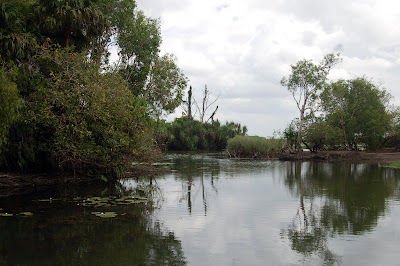
At Kakadu we cruised the Alligator river ...
... and saw eight crocodiles, including those in the video below ...
The entertainment included the sing-along below ...
... we also cruised Darwin Harbour ...
... and spent lots time eating and socialising ...
All of our children are doing well, in their lives and careers. In spite of the parlous state of the British economy, Philip has found an excellent job with Airbus. Sometimes he works in Madrid, and we hope to visit some of his Spanish friends next year. Beth continues to work with the Victorian Police Force in the payroll section, Recently she travelled to Perth to inform the WA police force of the work being done in Victoria. Christopher and Catherine have been promoted to a position where they are responsible for running programs for the Salvation Army youth in northern Melbourne.
That the years roll by quickly is attested to by the fact that next February four of our grand children will be in Secondary School, with Troy entering year seven, and thereby joining Joshua, Hayley and Cameron, in the second stage of education.
The Older Generation
There is, though, some very sad news. Recently Stephen’s mother, Edna, had a stroke. She is currently in the Royal Melbourne Hospital. Although we would love to report that her prognosis is good, her doctors can give no clear indication of her chances of recovery. As well, her brother, Bill, is a patient at the Western General Hospital suffering from bowel cancer. Finally Margaret’s mother is also un-well with a very bad tooth infection.
Weddings and New Additions
On a more cheerful note, there were a number of happy events in the family involving Stephen's three nieces - two weddings and two births:
I leant upon a coppice gate When Frost was spectre-gray, And Winter’s dregs made desolate The weakening eye of day. The tangled bine-stems scored the sky Like strings of broken lyres, And all mankind that haunted nigh Had sought their household fires.
The land’s sharp features seemed to be The Century’s corpse outleant, His crypt the cloudy canopy, The wind his death-lament. The ancient pulse of germ and birth Was shrunken hard and dry, And every spirit upon earth Seemed fervourless as I.
At once a voice arose among The bleak twigs overhead In a full-hearted evensong Of joy illimited; An aged thrush, frail, gaunt, and small, In blast-beruffled plume, Had chosen thus to fling his soul Upon the growing gloom.
So little cause for carolings Of such ecstatic sound Was written on terrestrial things Afar or nigh around, That I could think there trembled through His happy good-night air Some blessed Hope, whereof he knew And I was unaware
As noted in this analysis, "The most significant aspect of Thomas Hardy's brooding poem is the date and time of its composition". The poem is dated 31 December 1900, the last day of the 19th century. That the poem is referring to the end of the old century and the opening of the new one is indicated by the lines:
The land’s sharp features seemed to be The Century’s corpse outleant,
The first two stanzas are uniformly bleak, with Hardy leaning (wearily ?) on a gate leading to a dark forest, surveying the cold, frosty, spectre-gray, desolate surroundings, as the late afternoon leads to evening.
The last two stanzas describe the joyful singing (caroling)of an old thrush, (aged ... frail, gaunt, and small).
The last two stanzas could be interpreted as Hardy's optomistic hopes for the new century. If so the hope was to be dashed 14 years later as Owen's Dulce et Decorum Est makes amply clear.
A more likely interpretation is that the pessimism remains as Hardy wonders why a bird should be singing its heart out when there is nothing in sight but gloom and misery.
The title of the poem reminds me of two lines from Matthew Arnold's seminal poem Dover Beach
And we are hear as on a darkling plain Swept with confused alrams of struggle and flight
Another link to Arnold's poem is the likely source of Hardy's pessimism. Unlike the modern New Athiests, both Arnold and Hardy realised that the retreat from religious belief, no matter how necessary for intellectual reasons, entailed also a serious loss of certainty, security and hope.
As Arnold explained it:
The sea of faith Was once, too, at the full, and round earth's shore Lay like the folds of a bright girdle furled; But now I only hear Its melancholy, long, withdrawing roar ...