Loading...
Gadget by The Blog Doctor.

Friday, April 24, 2009

The Magic Flute

Yesterday I attended Australia Opera's presentation of Mozart's The Magic Flute. It is aptly named as it was a magical performance. Opera has a reputation in the wider community of being high brow and pretentious - a view that I don't accept. Certainly this show was very accessible, partly because it is in the form of a singspiel, "characterized by spoken dialogue, sometimes performed over music, interspersed with ensembles, popular songs, ballads and arias".


While Mozart wrote the music Emanuel Schikaneder wrote the libretto. He also took the role of Papageno at the premier. Schikaneder also may have given advice to Mozart concerning the musical setting of his libretto. The dramatist Ignaz Franz Castelli tells the following tale:

The late bass singer Sebastian Meyer told me that Mozart had originally written the duet where Papageno and Papagena first see each other quite differently from the way in which we now hear it. Both originally cried out "Papageno!", "Papagena!" a few times in amazement. But when Schikaneder heard this, he called down in to the orchestra, "Hey, Mozart! That's no good, the music must express greater astonishment. They must both stare dumbly at each other, then Papageno must begin to stammer: 'Pa-papapa-pa-pa'; Papagena must repeat that until both of them finally get the whole name out". Mozart followed the advice, and in this form the duet always had to be repeated.


An interesting story, though not necessarily true.

Mozart wrote the music with the initial cast in mind, as only two of them (The Queen of the Night and Sarastro) were professional singers. The other parts were taken by actors who could sing a bit. Most characters thus had string introductions so they could find their pitch. Mozart conducted the first two performances before falling ill

The opera premiered in Vienna on September 30, 1791.

This was just two years after the start of the French Revolution, before the revolution spun out of control, murdering its own during the Terror (led by Robespierre and Committee of Public Safety) .

Wordsworth later said of that time:
Bliss was it in that dawn to be alive,
But to be young was very Heaven!" (The Prelude, x, 690-4.)


Mozart, of cause was not a revolutionary, but he was a Freemason. Freemasonry, at that time - quite different to its current incarnation - was about brotherhood and the rights of man. The producer of the Opera Australia production was aware of the Masonic connection as the photo below, from a scene in the Melbourne production, shows Masonic imagery in the background.


Another innovation was that the Magic Flute was sung in German.

As Nicholas Yardley wrote in his review:

The audience didn’t stream out of the Melbourne Arts Centre in 2009 crying, “liberty, equality, fraternity,” or “How wonderful it was sung in German rather than Italian.” Think of fairy floss. It melts away to sweet, sticky nothingness in your mouth. That’s how The Magic Flute is to a modern audience. It’s fairy floss. It’s not about enlightenment. It’s like a Marx Brothers musical with Zeppo as Tamino singing love songs, upstaged by Harpo as Pappageno, who on this occasion sings, and sings very well. It mustn’t lecture – it’s a fantasy.

And that is why the Melbourne production works. The opera opens in an enchanted forest and stays enchanted. The difference between then and now is that the cast can sing, and not just a little bit. Director, David Freeman and conductor, Jari Hamalainen are at their best and Andrew Goodwin as Tamino, not only sounds good, but looks the part. The same can be said of Daniel Sumegi as Sarastro. He towers above the others and looks truly regal. Lorina Gore as the coloratura Queen of the Night is spectacularly suspended by wires high above the stage, sharing the space with a huge, golden crescent moon. Sarah Crane as a tearful Pamina and Andrew Moran, as a boastful Pappageno also perform well.


I particularly enjoyed Moran's performance - Pappangeno as an ocker.

The show was visually spectacular, as the photo below shows:


A great addition was the use of an physical theatre group - Legs on the Wall - to play the animals, which can be seen in the photograph.

Below is a slide show of photos from the production:


And, the music is of cause wonderful. Here is one of the famous arias (though not from the Australian performance) ...


Here is a synopsis of the plot:

Act 1

Scene 1

Tamino, a handsome prince who is lost in a distant land, is pursued by a serpent. He faints from fatigue and three ladies, attendants of the queen appear and kill the serpent. They all fall in love with the prince and each plans to be alone with him. After arguing, they decide that it is best that they all leave together.

Tamino recovers to see before him Papageno, arrayed entirely in the plumage of birds, who sings of his job as a birdcatcher and the fact that he is longing for a wife. (Aria: Der Vogelfänger bin ich ja) Papageno jokes with Tamino but says that he brings the birds that he catches to the Queen of the Night's servants, who give him food and drink in return. Papageno also claims that he has saved Tamino and strangled the serpent with his bare hands. At this moment, the three ladies appear and punish his lie by paying for his birds with a stone instead of food, water instead of wine and placing a padlock over his mouth. They tell Tamino that they were responsible for saving him. He deeply appreciates them and they show to the prince a miniature of a young maiden, Pamina, with whom he falls instantly in love. (Aria: Dies Bildnis ist bezaubernd schön / This image is enchantingly lovely, Like no eye has ever beheld!")
The arrival of the Queen of the Night. Stage set by Karl Friedrich Schinkel (1781–1841) for an 1815 production

The Queen of the Night now appears, demanding that Tamino free her daughter, the original of the picture, from the hands of Sarastro, promising that he can marry Pamina in return. (Recitative and aria: O zittre nicht, mein lieber Sohn / "Oh, tremble not, my dear son! You are innocent, wise, pious"). The ladies give Tamino a magic flute that can change men's hearts, remove the padlock from Papageno, and present him with a chime of bells to protect him. Papageno accompanies Tamino, and they set forth, guided by three boys. They escape all danger by the use of the magic instruments. (Quintet: Hm hm hm hm)

Scene 2: A room in Sarastro's palace

Pamina is dragged in by Sarastro's servant Monostatos, a Moor, who is persecuting her. (Trio: Du feines Täubchen, nun herein!) Papageno, sent ahead by Tamino to help find Pamina, arrives. Monostatos and Papageno are each terrified by the other's strange appearance and flee the stage. But Papageno soon returns and announces to Pamina that her mother has sent Tamino to her aid. Pamina rejoices to hear that Tamino is in love with her, and then offers sympathy and hope to Papageno, who longs for a Papagena to love. Together they sing an ode to love (Duet: Bei Männern welche Liebe fühlen), then depart.

Scene 3: Grove and entrance to the temples

The three boys lead in the prince. As Tamino reaches the temple, he is denied entrance at the Gates of Nature and Reason, by invisible voices singing "Go back!". But when he tries the Gate of Wisdom, a priest appears and gradually convinces him of the noble character of Sarastro. After the priest leaves him, Tamino plays his magic flute in hopes of summoning Pamina and Papageno. The tones of his magical instrument summon first a group of magically tamed beasts, then the sound of Papageno's pipes. Ecstatic at the thought of meeting Pamina, Tamino hurries off.

Papageno appears with Pamina, following the distant sound of Tamino's flute. The two are suddenly apprehended by Monostatos and his slaves. Papageno then works an enchantment on them with his magic bells, and they dance, blissfully and involuntarily, off the stage.

Papageno now hears the approach of Sarastro and his large retinue. He is frightened and asks Pamina what they should say. She replies, "The truth! The truth! Even if it were a crime," and with her words a triumphal march begins (Chorus: Es lebe Sarastro); Sarastro and his followers enter.

Sarastro conducts an impromptu judicial proceeding. Pamina falls at his feet and confesses that she was trying to escape because Monostatos had demanded her love. Sarastro receives her kindly and tells her that he will not force her inclinations, but cannot give her freedom.

Monostatos then enters with Tamino captive. The two lovers see one another for the first time and instantly embrace. The chorus sings "What is the meaning of this?" and they are separated. Monostatos tries to point the finger of blame at Tamino. Sarastro, however, does not believe Monostatos' dastardly trick. He punishes Monostatos for his insolence and leads Tamino and Papageno into the temple of Ordeal.

[edit] Act 2

Scene 4: A grove of palms

The council of priests, headed by Sarastro, enters to the sound of a solemn march. They determine that Tamino shall possess Pamina if he succeeds in passing through the ordeal, as they do not wish to return her to her mother, who has already infected the people with superstition. Sarastro, echoed by his fellow priests, then sings a prayer to the gods Isis and Osiris, asking them to protect Tamino and Pamina and to take them into their heavenly dwelling place should they meet death in the course of their trials. (O Isis und Osiris)

Scene 5: The courtyard of the temple of Ordeal

Tamino and Papageno are led into the temple. Tamino is cautioned that this is his last chance to turn back, but he states that he will undergo every trial to win his Pamina. Papageno is asked if he will also concede to every trial, but he says that he doesn't really want wisdom or to struggle to get it. The priest tells Papageno that Sarastro may have a woman for him if he undergoes the trials, and that she is called Papagena. Papageno says that he wouldn't mind a look at her to be sure, but the priest says that he must keep silent. Papageno finally agrees.

The first test is that Tamino and Papageno shall remain silent under the temptation of women. (Duet, Speaker and Priest) The three ladies appear, and tempt them to speak. (Quintet, Papageno, Tamino, Three Ladies) Tamino and Papageno remain firm, though Tamino must constantly tell Papageno, "Silent!"

Papageno confronts one of the priests and asks why he must undergo tests if Sarastro already has a woman that wants to be his wife. The priest says that it is the only way.

Scene 6: A garden, Pamina asleep

Monostatos approaches and gazes upon Pamina with rapture. (Aria: Alles fühlt der Liebe Freuden) When the Queen of the Night appears and gives Pamina a dagger with which to kill Sarastro (Aria: Der Hölle Rache kocht in meinem Herzen / "Hell's vengeance boileth in mine heart"), Monostatos retires and listens. He tries to force Pamina's love by using the secret, but is prevented by Sarastro, who allays Pamina's alarm. (Aria: In diesen heil'gen Hallen)

Scene 7: A hall in the temple of Ordeal

Tamino and Papageno must again suffer the test of silence. Papageno can no longer hold his tongue, but Tamino remains firm, even when Pamina speaks to him. Since Tamino refuses to answer, Pamina believes he loves her no longer. (Aria: Ach, ich fühl's, es ist verschwunden)

Scene 8: The pyramids

(Chorus) Sarastro parts Pamina and Tamino. (Trio, Sarastro, Pamina, Tamino) Papageno also desires to have his little wife, and sings of this with his magic bells. (Aria, Papageno: Ein Mädchen oder Weibchen). At the first ordeal, an old woman had appeared to him and declared herself his bride. She now again appears and changes herself into the young and pretty Papagena. However, the priests send her away with thunder and lightning. She vanishes, frightened, and Papageno is miserable.

Scene 9: An open country
Tamino and Pamina undergo their final trial; watercolor by Max Slevogt (1868–1932)

The three boys see Pamina attempting to commit suicide because she believes Tamino to be faithless. They prevent her from doing so, and take her to see him.

Scene 10: Rocks with water and a cavern of fire.

Two men in armor lead in Tamino, and in the musical form of a Baroque chorale prelude give him advice, then reassurance that Pamina lives. Sarastro appears and sends Pamina in. Pamina arrives and is overcome with joy to find Tamino, who is now allowed to speak to her. Both pass unscathed through the final ordeal of fire and water with the help of the magic flute, which Pamina tells him was carved by her father from an ancient oak tree. They emerge from their trials to the sound of an offstage chorus singing "Triumph!".

Papageno wishes to take his own life because he can't stop thinking about Papagena, but at the last minute the Three Boys appear and remind him that he should use his magic bells. The bells when played indeed summon Papagena, and the happy couple is united, stuttering at first ("pa … pa … pa") in astonishment. (Duet: Papageno! Papagena![10])

The traitorous Monostatos appears with the Queen of the Night and her ladies to destroy the temple (Nur stille, stille), but they are magically cast out into eternal night.

The scene now changes to the entrance of the chief temple, where Sarastro bids the young lovers welcome and unites them. The final chorus sings the praises of Tamino and Pamina in enduring their trials and gives thanks to the gods.

Thursday, April 9, 2009

Two Ferry Boats

Martin Gardner, in his book Hexaflexagons, Probability Paradoxes, and the Tower of Hanoi presents the following problem on page 123.

Two ferry boats start at the same instant from opposite sides of a river, travelling across the water on routes at right angles to the shores. They pass at a point 720 yards from the nearest shore. Both boats remain in their slips for 10 minutes before starting back. On the return they meet 400 yards from the other shore.

How wide is the river?


I have left the units in yards for two reasons: firstly, it is the unit that is quoted in the book, and secondly, it adds another interesting element to the final solution.

I puzzled over this for a few days. I had got about half way through the calculation ( I now realise from hindsight ) but couldn't see a way forward. It even kept me awake at night. A few nights ago, at 1:00 am, I hit on the strategy, got up and tried it out on paper; when I checked Gardner's answer I found that we agreed.

My solution is algebraic, and Gardner gives a very brief description of it, but it is also possible to solve this without maths, as Gardiner demonstrates in a long written paragraph.

Try to find the answer for yourself before you "Click to read the rest of the post" for my solution.


Define variables

Two time periods can be defined
T1 = interval between the two times that the boats pass
T2 = interval between when both boats "start at the same instant from opposite sides" and the second time that they pass

Five distances can be defined
Distances relating to T1
D1 = distance fast boat travels between the two passes
D2 = distance the slow boat travels between the two passes
Distances relating to T2
D3 = distance the fast boat travels from start to second pass
D4 = distance the slow boat travels from start to second pass

W = the width of the river

The two boat speeds
S1 = the speed of the fast boat
S2 = the speed of the slow boat

The diagram below presents the problem graphically.


Using the diagram above we can assign values to the distance variables.

D1 = 720 + W - 400 = W + 320
D2 = W - 720 + 400 = W - 320
D3 = 2W - 400
D4 = W + 400

The basic strategy for solving this problem can be outlined as follows:
As two time lengths can be found and distances the boats travel in these time frames can be calculated, the ratio of the boat speeds can be defined in two ways, using the distances.


Equate the two ratio equations and solve for width of river (W).

Note: as both boats spend an equal amount of time in the slips (10 minutes) that can be ignored as it doesn't effect the result of the calculation (it is a red herring).

__________________________________________________________________________________

Calculate the ratio of the boat speeds using distance information for T1
Note: time = distance / speed

T1 = D1 / S1 = (W + 320) / S1
T1 = D2 / S2 = (W - 320) / S2

As both equations = T1 they can be equated

(W + 320) / S1 = (W - 320) / S2


Cross multiply to express in terms of the ratio of the speeds

S1 / S2 = (W + 320) / (W - 320)    Equation 1

Calculate the ratio of the boat speeds using distance information for T2

T2 = D3 / S1 = (2W - 400) / S1
T2 = D4 / S2 = (W + 400) / S2

As both equations = T2 they can be equated

(2W - 400) / S1 = (W + 400) / S2

Cross multiply to express in terms of the ratio of the speeds

S1 / S2 = (2W - 400) / (W + 400)     Equation 2

We have now defined the ratio of the boat speeds in two ways: Equation 1 and Equation 2

All that remains is to equate Equation 1 and Equation 2 and solve for W (width of the river).

(W + 320) / (W - 320) = (2W - 400) / (W + 400)

Cross multiply to remove fractions.

(2W - 400)(W - 320) = (W + 320)(W + 400)

-> 2W2 - 640W - 400W + 128000 = W2 + 400W + 320W + 128000
-> 2W2 - 1040W + 128000 = W2 + 720W + 128000
-> 2W2 - W2 - 1040W - 720W + 128000 - 128000 = 0
-> W2 - 1760W = 0

Extract W

-> W(W - 1760) = 0

-> W = 0 which can be ignored as it is nonsensical in terms of the practical problem (as the function is a parabola it should have two solutions, one of which is at the origin)

or

W - 1760 = 0

W = 1760

Therefore the width of the river is 1760 yards

Can you see the second reason why I kept the problem in yards rather than change the units into the modern value of metres?

Any comments?

Thursday, April 2, 2009

The Manera

Our friends, and neighbours, David and Glenda Horne, own a boat. the Manera that is moored at Yaringa Marina on Westernport Bay.

Yesterday we travelled to join them on the boat.

This post is quite long, so if you just want to view the photos follow this link.

The map below shows the location of the Marina (the place mark at the top). The map can be operated like a normal Google Map, but it is probably better to click on the View Larger Map link at the bottom. If you choose the Satellite option and zoom in as far as possible the place mark is pointing at the Manera.


View Larger Map


We arrived after dark, boarded, and walked down the fore deck shown in the photo.


After a convivial supper in the Manera's spacious main cabin we retired for the night.


Thursday morning dawned bright and fine ...


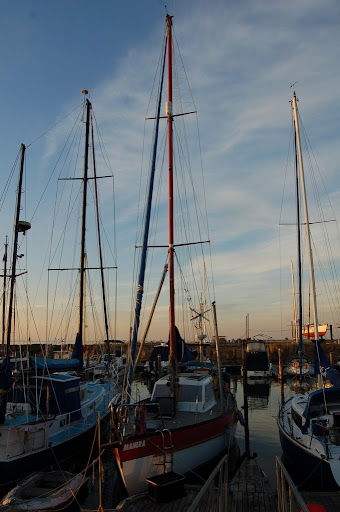
... giving us a clearer view of the boat.


Unfortunately, I didn't take many pictures of the interior, but the photos on this link clearly show that there is plenty of room down below, in a Swanson 42.


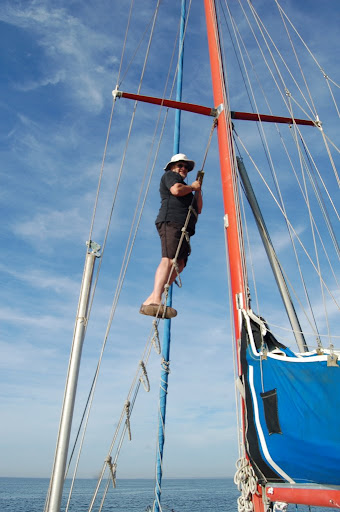
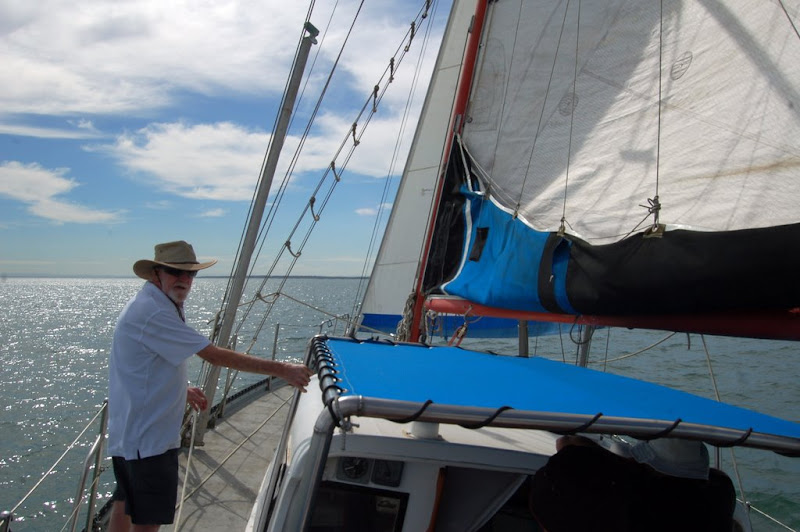
After checking over the boat, which included the rigging as can be seen in the photograph, David and Glenda manoeuvred the yacht from its tight berth into the main channel of the marina. This required some magic with ropes and at the helm.


Incidentally, that ladder that David is standing on, is called the ratlines, pronounced "ratlns".


According to Glenda, the sight of David on the ratlines is a rarity, as it is she who usually climbs the higher areas of the boat.


With Glenda at the helm we gently motored out of the marina. Westernport is very tidal, and we could only access the deeper water via channels. Sailing times are not determined by the whim of the captain, but by the requirements of the tide. We left at 9:20 am to ensure that our boat, with a draft of 1.8 metres could negotiate the two shallow places in the channel. David and Glenda discovered this once when sailing, getting firmly stuck on one of the shallow places. Although they spent a worrying couple of hours, they learned important information about the characteristics of the Manera on that occasion. The tide was still receding when they stuck fast, and after a while the boat rapidly tilted over to a 45 degree angle. Some boats do not recover well from such a predicament, but happily as the tide started rising, some hours later, the boat quickly righted itself.

When we finally cleared the channel, after about one nautical mile, David and his friend Jim, raised the sails. The Manera has a cutter rig, meaning that it has one mast, a mainsail, and can have two headsails set. We sailed with only the mainsail and one headsail.

I will try to use technical, nautical terms so the diagram below might be of help in deciphering my descriptions.


1 main sail


2 jib


3 spinnaker


4 hull


5 centre board


6 rudder


7 skeg


8 mast


9 spreader


10 shroud


11 main sheet


12 boom


13 mast


14 boom


15 backstay


16 forestay


17 vang


Another useful reference is this Wikipedia article.

The mainsail is raised using a rope called the main halyard.

The headsail is furled (wound) around the forestay, which is a piece of standing rigging which keeps a mast from falling backwards. It is attached to the top of the mast, at one end and to the bow of the boat at the other.

Before we left the marina, David had attached two ropes, called the headsail sheets, to the free corner of the headsail, the clew. These sheets were run through pulleys back to the cockpit, where the helm is located. David pulled the leeward sheet using a winch to set the headsail into position.

For a while the wind was too light for the sails to provide forward motion, though the water though the tide was moving us, slowly, in reference to the bottom of the bay. After a few minutes Glenda gave over the helm to Jim, a friend who lives on his boat at the marina. Jim is an experienced sailor, having participated in the >Sydney-Hobart race.

David and Glenda have also has experience in blue water sailing. They purchased the Manera in Brisbane and sailed the boat back to Victoria, with the help of Jim and a few other friends. They have also sailed her to from Western Port to Wilson's Promontory.

After Jim had sailed the boat for a while I took over the helm. This task is not quite as easy as it seems, as there are a range of issues to be considered.

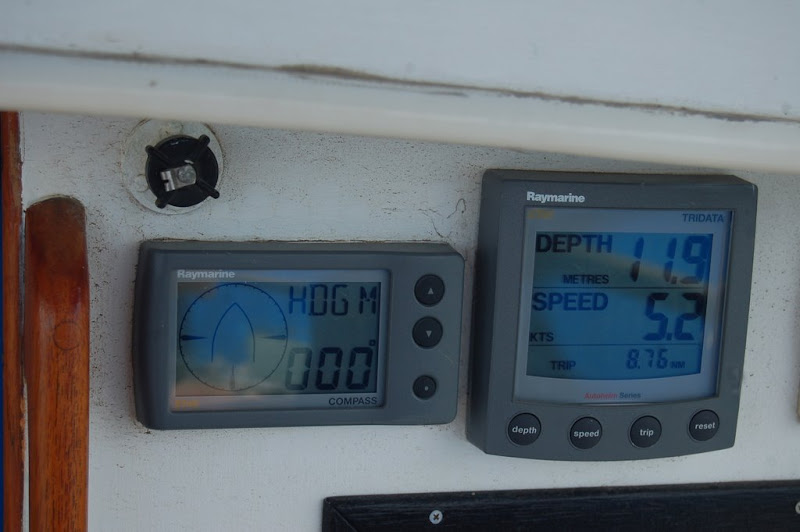
An appropriate heading has to be determined. It is not always possible to go directly to the destination - the wind might be blowing from an inappropriate quarter, and shallow water has to be avoided. One method of keeping on the chosen heading is to pick out a landmark in the right direction and sail towards it. There are also instruments available to assist in maintaining the heading. The Manera has three of them, the compass at the helm, and electronic compass as shown at left in the photo below ...


... and the chart plotter, below.


The chart plotter provides a great deal of information. The black oval shape near the bottom of the screen is the location of the boat. The heading can be seen (on the right) as 357 degrees (this photograph was taken while we were returning to the marina). The green line shows the heading graphically and the blue line with arrow is the direction of the tide. The boat's speed of 7.4 nautical miles is a combination of speed through water and the tide. The white areas signify deeper water, the shallow blue areas should be avoided.

The depth of the water can be monitored in two ways. The first is via the depth meter next to the electronic compass the second is by using the chart plotter.

The third issue to be monitored was brought home to me when Jim cautioned me to watch the wind direction which was heading around aft, and which could cause an unintentional gybe. The definition of a gybe (or jibe) below is taken from this site.

A jibe or gybe is a sailing maneuver where a sailing vessel turns its stern through the wind, such that the wind direction changes from one side of the boat to the other. ... In this maneuver the mainsail will cross the center of the boat while the jib (foresail) is pulled to the other side of the boat.


As a result of Jim's comment I adjusted the heading a little to port (the left). An instrument is available to determine the direction of the wind, relative to the boat. It is shown to the right of the clock in the photo below.


The photograph was taken on our return trip, when we were using the motor rather than the sails. At the time of the photograph, the wind was coming from about 15 degrees to starboard. When I took over the helm the ideal direction of the wind was 120 degrees on the port side. After Jim's warning I carefully watched the wind direction.

As well as heading, depth of water and wind direction, the person at the helm must regularly scan the water for other vessels.

About 10 or 15 minutes after I took over the helm we started to approach the shallower water (as indicated by the chart plotter) and a change of heading was required. As we were reaching, in fact close to a broad reach, the appropriate manoeuvre was a gybe (described above).

Jim adjusted the main sheet to make sure that the boom did not come across too fast. Then David loosened the starboard headsail sheet (from the winch) and after I turned the helm to starboard, Jim pulled in the port headsail sheet, until the sail was positioned and drawing air on the port side. While all of this was going on, the main automatically changed from starboard to port.

We sailed for a while toward Lysart's pier and then gybed back to port.

We then sailed on passing French Island to port and the Mornington Peninsula to starboard, with me at the helm ...


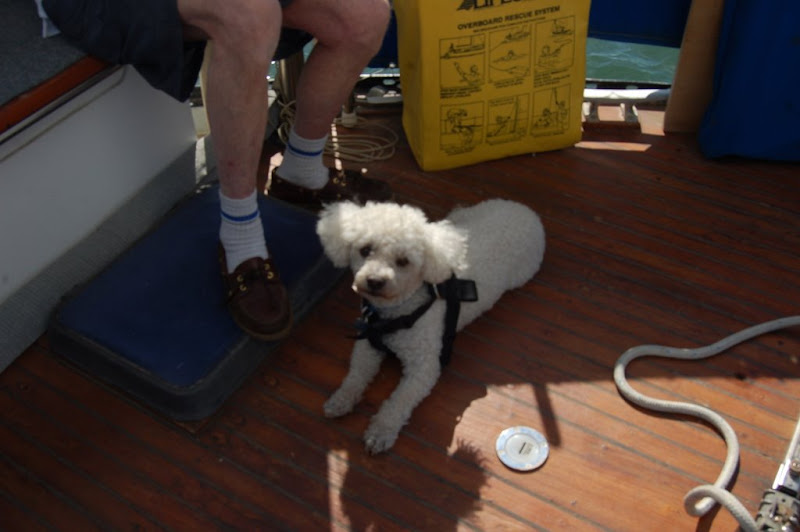
and, Frankie ...


... Glenda ...


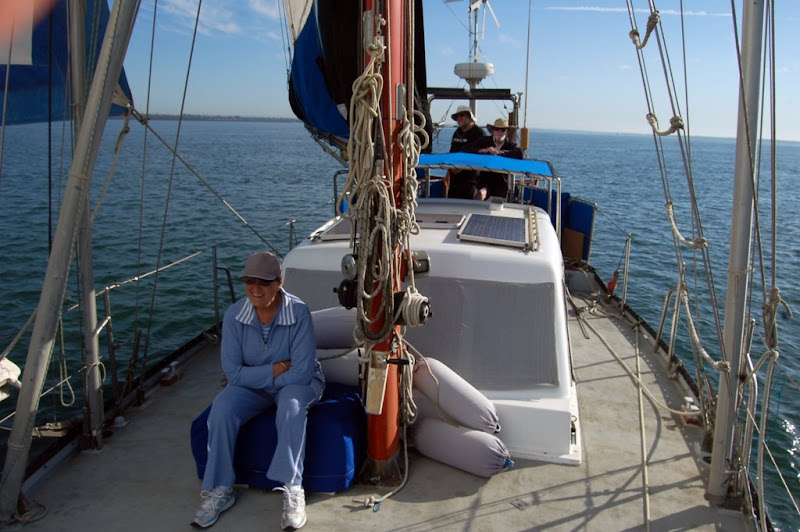
... Margaret ...


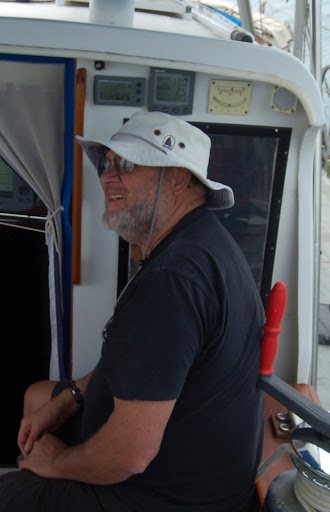
... Jim ...


... and David ...


... chilling.

A mile of so east of Cowes, on Philip Island, we noticed one of the Bass Straight oil platforms moored near the shore. A few hundred metres off Cowes we decided that we had travelled far enough to the south and decided to turn start our return to the marina. This time the appropriate turn was a tack. This involves turning the boat through the wind. It is important to have plenty of speed before performing a tack, as part of the way through the procedure, the boat looses power as it is pointing directly into the wind.

I turned the helm hard to starboard, and David and Jim started to move the headsail from port to starboard. Just after we had passed the half way point, they held the headsail in only part of the way across to get wind into it as quickly as possible so we could complete the turn as quickly. Then they secured the sail to its new position on the port side. Naturally the mainsail moved across automatically.

We took a heading reasonably close to the wind (close hauled), with the sails trimmed in fairly tightly. This was to avoid excessive rolling as Glenda was below preparing lunch - hot crossed buns and watermelon.

While we were sailing between Mornington Peninsula and French Island, we heard a radio communication with the ship Iron Monarch. Looking around we could see the ship a couple of miles aft. It was travelling much faster than we were and relatively soon it caught up to us and passed us. We kept out of its way, which was fairly easy as it had to stay in the channel.

Soon after we noticed that we were on a potential collision course with a trimaran. We watched the boat closely. We had the right of way as we were on starboard tack and he was on port tack, but not all sailors take notice of the rules. Happily the trimaran sailor did know the rules as he changed direction to pass aft of us.

The wind was coming from the direction we needed to go, so we were sailing close hauled, close to the wind, but not making much headway as the wind was dying. Consequently, we took down the sails and started motoring. There are not many landmarks in the northern section of Westernport, which would make for difficulties in finding the channel to the marina, if it were not for the fact that it was clearly marked on the chart plotter.

I was still at the helm, when David and Jim started a conversation about araldite. I suspected that it was about me, which was confirmed when they explained that someone who does not easily give up the helm is called Captain Alaldite. This has become my nickname according to David.

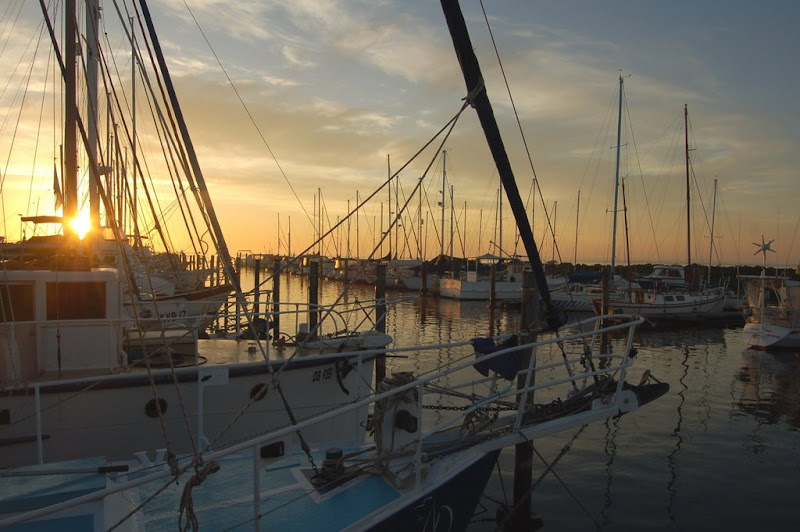
Six hours after leaving we arrived back at the marina. After a peaceful few hours on deck, a pleasant dinner, Margaret and I headed home into the sunset ...


... while Glenda and David stayed another couple of days on the yacht.