Loading...
Gadget by The Blog Doctor.

Sunday, August 17, 2008

Menopause the musical

We saw our last show at Wyndham Cultural Centre, yesterday.

The show was Menopause the musical.
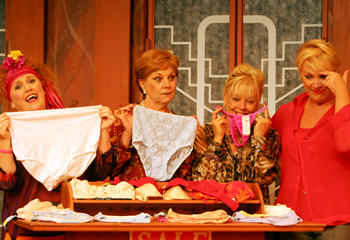


Four very different women are shopping at Myers and discover that they have one thing in common - Menopause.

From left to right in the photo above: Earth mother (Carolyn Waddell), emotionally limited Dubbo housewife (Donna Lee), a fading soapie star (Vivien Davies) and career woman (Caroline Gillmer) find sisterhood and solidarity in their common menopausal sufferings.

The play has very little plot, but is sustained by many '60s songs rewritten to describe issues of menopause.

For instance, The Lion Sleeps Tonight becomes In the Spare Room My Husband Sleeps Tonight, Chain of Fools becomes Change of Life, Stayin Alive becomes Stayin Awake and My Guy becomes My Thighs.

The actors perform and sing well, particularly Donna Lee, who keeps in character during the song and dance routines, performing them with a clumsy and uncertain style that is very entertaining.

This was Menopause the Musical not Menopause the Drama so it didn't have much to say that was profound, but it was a very entertaining night out.

Monday, August 11, 2008

The American Denial of Global Warming by Naomi Oreskes

Naomi Oreskes is a Professor of History and Science Studies at the University of California San Diego, who has written extensively on the history of the science of climate change.

The video is in two sections:
The first half of the video below emphasises the long history of climate research, that indicates the dangers of anthropogenic carbon dioxide. She makes a convincing case that there has been a great deal of research since John Tyndall published the evidence of the greenhouse properties of carbon dioxide in 1861, including:

  • Arrhenius at the turn of the 20th century

  • G.S. Callendar and W.O. Hulburt in the 1930s,

  • Suess and Revelle, in the 1950s

  • Keeling and U.S. National Academy of Sciences Panel on Weather and Climate Modification in the 1960s,

  • Robert M. White, Jule Charney and the JASON committee in the 1970.

  • And naturally the four IPCC reports from the late 1980s.


For a more detailed description see The Discovery of Global Warming by Spencer Weart

The second half deals with the denial industry that started in the early 1980s.
She describes in detail how the current strategies of the AWG denial industry developed from the following campaigns:

  • support for the Strategic Defense Initiative (Star Wars)

  • attacking the consensus that sulfur and nitrogen emissions cause acid rain

  • denying the consensus that CFCs cause the hole in the ozone layer

  • and in particular the tobacco industries attempts to deny the dangers of smoking


She demonstrates that some current deniers worked on those earlier campaigns of disinformation.

The stragegy that was developed in these campaigns involved claims that:

  • The Science is uncertain

  • The Concerns are exaggerated

  • Technology will solve the problem

  • There is no need for government interference


Sound familiar?


Sunday, August 10, 2008

Cat on a Hot Tin Roof

Yesterday we saw the MTC production of Cat on a Hot Tin Roof at the Playhouse. We had to change the booking so we were not in our usual row C seats, instead we watched the play from the Circle. This might explain why I enjoyed the play less than I expected to. A play loses some of its power and immediacy when watched from high up and to the back of the theatre.


It is of cause written by Tennessee Williams.
Born to Cornelius and Edwina Dakin Williams on March 26, 1911, in Columbus, Mississippi, Thomas Lanier "Tennessee" Williams was amply prepared for writing about society¹s outcasts. His mother was an aggressive woman, obsessed by her fantasies of genteel Southern living. His father, a traveling salesman for a large shoe manufacturer, was at turns distant and abusive. His older sister, Rose, was emotionally disturbed and destined to spend most of her life in mental institutions. He remained aloof from his younger brother, Dakin, whom his father repeatedly favored over both of the older children. Who could have fortold that this shy, sickly, confused young man would become one of America's most famous playwrights.
...
The conflicts between sexuality, society, and Christianity, so much a part of Williams's
drama, played themselves out in his life as well ... spent ... as
a wanderer - a sexual and religious outcast.

Source from this bio.

Many aspects of Williams' life homosexuality , mental instability, deception, a powerful and manipulating parent and alcoholism, are major themes in this play.

Williams is often placed in a genre of writing called Southern Gothic, which according to Williams captured "
an intuition, of an underlying dreadfulness in modern experience".
This style often involves using deeply flawed, disturbed, even grotesque characters to highlight unpleasant characteristics of Southern Society.

The patriarch of this wealthy (planter) family, Big Daddy has clawed his way to economic success at the expense of his family's emotional health. The youngest son Gooper and his wife Mae only attend the family party to scheme their way to Big Daddy's fortune. The eldest son, his father's favourite, is a former football star who has taken to the bottle in response to the death of his friend Skipper, for which Brick might be partly responsible. The family doctor is involved in a "soothing lie" about the extent of Big Daddy's illness, and the preacher is a fawning and spineless grotesque. Maggie, Brick's wife, was born into a poor family and married Brick only to find herself a relationship with a man who
doesn't love her and whom she loves; she is tries desperately to hold on
to him.

Brick's summary of the dramatic situation of the play is: "Mendacity ... a system that we live in. Liquor is one way out an death's the other."

There is some unresolved ambiguity in Brick's character. Was Brick's shocked reaction to Skipper's confession of love to him for the obvious conventional reasons or is Brick denying a suppressed homosexuality?

The play ends on an ambiguous note. Maggie takes Brick to bed and he might or might not be responding as the play ends. Knowing Williams the liklehood is that this will end in disaster, but the hopeful possibility is left open.

This is a Pullitzer Award winning play, and I have appreciated it more after thinking about the experience and feel more positively about it than when I left the theatre.


Essie Davis, who beautifully played Maggie, in the publicity photo