Loading...
Gadget by The Blog Doctor.

Wednesday, June 4, 2008

Europe 08 Heidelberg

The ship departed from Ruedesheim at 5:00 am and arrived in Mainz at 8:00 am.

We had a choice of destinations today. We could have stayed with the ship and toured Mainz, with the highlight the Gutenberg museum, then a cruise to Frankfurt and a tour of that town.

Instead we decided on the trip to Heidelberg. We made this choice a few days ago, on the basis that we would be on the ship for three weeks and it would be valuable to travel away from the rivers when possible.

The bus ride to Heidelberg took 90 minutes along an autobahn - which was similar to Australian freeways.
Heidelberg is not on the Rhine, its river is the Neckar. Like many of the cities and towns we visited, the history of the town goes back to Roman times, with a fort built in 40 AD. The city though is first mentioned in a document dated to 1196. This is considered the founding date for Heidelberg.

The most famous "sight" at Heidelberg is the Castle, or maybe the ruin of the castle. Victor Hugo summarised its history as follows:

In 1619, Frederick V, then a young man, took the crown of the kings of Bohemia, against the will of the emperor, and in 1687, the Philip William, Count Palatine, by then an old man, assumes the title of prince-elector, against the will of the king of France. This was to cause Heidelberg battles and never-ending tribuluations, the Thirty Years War, Gustav Adolfs Ruhmesblatt and finally the War of the Grand Alliance, the Turennes mission. All of these terrible events have blighted the castle. Three emperors, Louis the Bavarian, Adolf of Nassau, and Leopold of Austria, have laid siege to it; Pio II condemned it; Louis XIV wreaked havoc on it.

Source this site.

We toured the castle, as usual, high on a hill overlooking the city. As it is largely ruined we mainly inspected the exterior walls, some of which contained many statues. The cellar has survived and is the site of the large wine vat called the Heidelberg Tun. The vat is huge and has a capacity of approximately 220,00 litres.

It is a beautiful and picturesque city that was not bombed during the Second World War. It was probably spared as it was not an industrial city and did not have an important transport hub.

We toured the older portion of the town, seeing part of the famous University, founded in 1386. We walked the Haupstrasse, the main pedestrian walk and had lunch in a restaurant with a view to the castle. We ate a local specialty food called maultaschen. The linked article describes them accurately as:

a Swabian Baden-Württemberg specialty food, consisting of an outer layer of pasta minced meat spinach, bread crumbs and onions and flavoured with various spices. Their appearance is similar to Italian ravioli but larger, each Maultasche being about 8-12cm across.

Maultaschen are rumored to have been invented by monks of the Maulbronn monastery to conceal the fact that they were eating meat during lent. This is reflected in the semi-humorous alternative Swabian name "Herrgottsbscheißerle" (roughly: little ones who cheat the Lord).


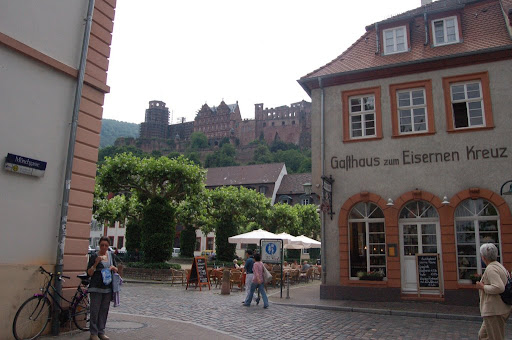
We quite enjoyed them. The photograph shows Margaret across the road from the restaurant, with the castle in the background.


We returned to the ship (which was now in Frankfurt) through the first rain of the trip. Although there was a little time to tour Frankfurt we stayed on the ship for four reasons: light rain was still falling, we were told that it was a modern city and not really interesting, we were tired from our trip to Heidelberg and it was pleasant to sit in the ships lounge comparing notes with other travelers.

Tuesday, June 3, 2008

Europe 08 Cochem to Rudesheim

As we started out today we did not realise what a long day it was to become.

We split up this morning. Margaret stayed with the ship and cruised to Koblenz while I took the excursion to the Cochem. I disembarked with the others going to Cochem at the village of Winningen. The bus trip took 45 minutes. We had passed the town during the night so we were retracing our night time travel. We passed many small picturesque towns. There were also a surprising numbr of camping / caravan parks along the river.

When we arrived in Cochem, we first went on a tour of the town, which was first mentioned in documents of 866. It received its town charter in 1332. Among the sights that we saw was the a Tower Gate dating from 1332.

We traveled to the castle through narrow, winding, steep streets. The castle was first mentioned in documents in 1051, but most of the current castle does not date from that time as it was destroyed by King Louis XIV's forces in 1689. This was during the War of the Palatinate Succession , sometimes called the Nine Years War. For more details on the history of the castle see this site. Many other castles in the Rhineland were destroyed by the French at this time. Like most of them, Cochem Castle was not rebuilt until the romantic era in the 19th century made old ruins attractive again. In 1868 a Berlin businessman, Mr Louis Ravene bought the castle and rebuilt it in the neo-gothic style. Some of the current building dates to the one that was destroyed. Since 1878 the castle has been owned by the town of Cochem.

The first floor rooms have been furnished so we toured them. They contained some beautiful and expensive pieces of furniture. One of the balconies gave a spectacular view over the town and the river valley. The link to the castle web site above contains a gallery of internal pictures.

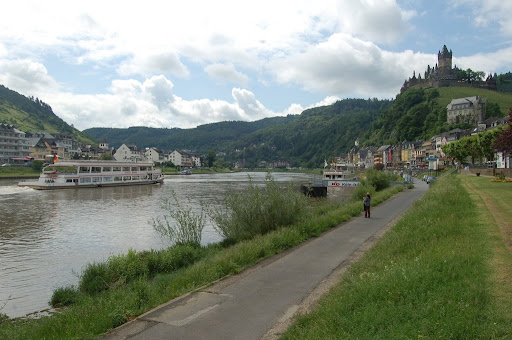
The photograph below shows the river, the town and the castle on the hill in the background.


We traveled back to join the Amadagio in Koblenz, at the confluence of the Moselle and Rhine rivers. The name means confluence. The town dates to Roman times and on her walking tour of Koblenz, Margaret saw a roman bridge dating from 49 AD. She saw many historic buildings and and learned some of the history of the town. She shopped for jewelry in the modern part of town, in a Schmuck jewelry shop.

After lunch the crew un-moored the ship and we sailed to the junction of the rivers and turned starboard into the Rhine. It was a beautiful, sunny and warm afternoon to cruise the famous Rhine Gorge, a 65 km stretch of the river between Koblenz and Bingen. The sides of the valley are often steep, reaching sometimes to 200 metres. The natural beauty is part of its charm, but it is most famous for the many castles that are generally perched high on the banks above the river.

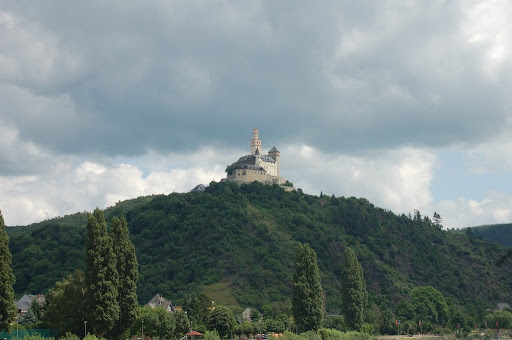
One of the most attractive was Marksburg castle, towering on a high crag above Braubach. Is the only fully preserved medieval fortress on the Rhine. It was owned successively by the Eppsteins, the Counts of Katzenelnbogen, and, from 1479, the Landgraves of Hesse, until it fell to the Prussians in 1866, along with Braubach. In 1899 Kaiser Wilhelm II presented the castle to the "Association for the Preservation of German Castles". This association has spared no effort or expense in looking after the building, and has repaired the heavy damage suffered under artillery fire during the last war. The tower, 130 ft. high.


As we cruised the gorge, Lilo, our cruise director, gave a commentary on the castles that we passed. Most of the castles had been destroyed during the Nine Years War, and had been restored during the 19th and 20th Centuries. Watching the beauty around us is was hardly a surprise that the Rhine Gorge had been declared a UNESCO world heritage site.

The Rhine is much wider that the Moselle. The sunny banks were covered with vines and we passed many attractive riverside towns. The valley is a major transport route. The river carries many ships, many of them barges carrying raw materials, and there is a road and railway on either side. Some of the entrances to the railway tunnels looked more like castles than modern constructions. This was done during the second world war, to protect them from allied bombing, as early on there was an agreement not to bomb monuments. That agreement clearly went by the board later in the war. We also passed Loreley Rock which is famous as geographically the narrowest section of the river and in German folklore as the location of a siren who lured sailors to their fates with her hypnotizing voice. Read more here and here . There is a German song about the rhine maiden's beguiling boatmen to their deaths. The words and music can be found here .


At 7:00 pm, during dinner, we arrived at the town of Rudesheim, the most visited of all Rhine villages. It is famous for a little street called the Drosselgasse . This street, less than 100 metres long and less than two metres wide, is jammed with restaurants totalling more than 2,500 seats.

After dinner we boarded a "toy train" similar to the one in Monmatre, and were taken to Siegfried's Musical Kabinett. There we were introduced to a wide range of mechanical musical instruments. One of the first instruments was an original cylindrical gramaphone. The guide played one of the cylinders, and some of you would be interested to know that it was clearly a Salvation Army band and songsters. We are all familiar with pianolas, but many of the music players were much more complex. One included six violins. A circular "bos" moved rotated constantly and the strings were pushed mechanically (outward) to be sounded by the bow! The building that housed the instruments was quite old. There were ceiling murals dating from 1559, which were in the process of rennovation. Naturally we exited through a shop. This is where Margaret bought Amanda's birthday present - a musical box.

We walked back to the boat via the Drosselgasse, and had a Rudesheim Coffee with two New Yorkers, Joe and Sarah. We had an interesting conversation about living in the big apple in a German restaurant. Rudesheim Coffee is a German version of Irish Cofee, replacing whisky with brandy.

The photograph below shows Margaret in the Drosselgasse.


As I said at the outset it was a long day, but very enjoyable.

Monday, June 2, 2008

Europe 08 Bernkastel and Zell

During the night we left Trier and cruised the Moselle River. As our cabin was at the back of the ship we could hear the engines, but as they kept a constant pitch we could "tune them out". We slept well on our first night on the boat.

At 6:00 am I went for a workout in the Gym, which happens to be next to our room. I felt much better after that.

After a typically too large breakfast we watched the crew mooring the ship at Bernkastel. The town is nestled in a bend in a spectacularly beautiful bend in the river.

We met our local guide near the boat. This was very well organised. The ship had a very effective audio system that we used. Passengers took a radio receiver (we had already been given our personal ear buds) and the guide had a microphone and transmitter. We could hear the guide more that 30 metres away. This was convenient as I sometimes moved away from the group to take a photograph. There were four local guides so the groups were fairly small.

Across the river towering above the town on a hill is the "Burgruine Landshut" (ruin of the Castle of Landshut), built in 1277. The guide told us that due to an accidental fire the building burnt down on January 8, 1692.


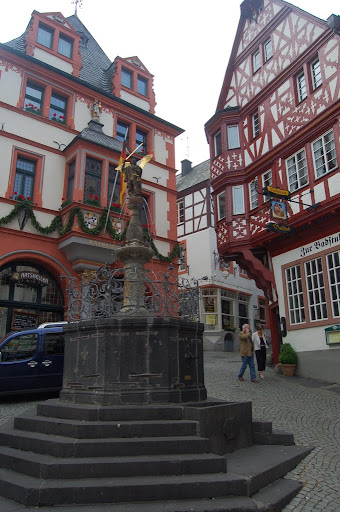
We crossed the bridge and inspected the late 14th century Church of St Michael. Its tower had been incorportate into the city wall and it looked more like a fortification than a church tower. We walked the narrow streets, to the market square, which was surrounded by many well preserved half-timered houses, including the city hall that was built in 1608. Most of the houses dated from the 17th Century. At the centre of the square stood the fountain of St Michael.


The photograph at right shows the fountain and the city hall


The guide told us of the history of the town. It became a municipality in 1291. There was probably a Roman settlement there in earlier times. Over the river stands the town of Kues. In 1905 Kues and Bernkastel were joined together as Bernkasgel-Kues. Kues is the birth place of Nicholas of Kues who is often referred to as Nicholas of Cusa (Cusa being the latinised version of Kues). Nicholas was born in 1401 and died in 1464. He was a noted theologian and for some of his time an emissary of the Pope. He also developed some progressive scientific ideas, anticipating Kepler's model of eliptical orbits of the planets. His scientific views were not developed in the usual way of observation of the natural world but from his personal numerological calculations and from his metaphysical musings. Nicholas also made noted contributions to the field of mathematics. Nicholas set up a building (St Nikolaus Hospital) to be used to house old people, which is still being used for that purpose. It contains a famous library with a collection of ancient books and the heart of the philosopher is buried in its chapel. When we returned to the other side of the river we attempted to visit the "hospital" but it was closed.
After we boarded the Amadagio, we cruised on down the Moselle. Lunch was served. A full lunch in the restaurant and a "light" lunch in the lounge. We ate in the lounge - soup, pasta, salads, cold meat and deserts.


Every available metre of the north bank of the river was covered with vines. These were in rows running up and down the hill, to make sure that the plants received as much sun as possible. The main agricultural produce of this area is white wine.


We were reminded of this fact when we arrived at our next town, Zell, late in the afternoon. We were greeted by the Mayor of the town and the Queen of Wine a young woman who spoke excellent English. Some local children performed a dance, dressed as black cats, in reference to a local wine. After another sumptuous dinner we went into town to sample the local product.


There was a brass band concert in the square near the Black Cat fountain and we had tickets for free wine. Margaret particularly liked the very sweet, Black Cat moselle, as you can see from the photo below. The band master had spent some time in New Zealand so he spoke excellent English. The band played a range of songs including favourites from the nationalities represented in his audience. Waltzing Matilda featured as the Australian contribution.


Sunday, June 1, 2008

Europe 08 Paris to Trier

An early start this morning. Our cases had to be out in the corridor by 6:30 am. Then our last breakfast in Paris. After breakfast I identified our luggage to Lilo, the cruise director. This is a process that ensures only tour member's luggage is taken on to the bus.

At about 8:10 our bus left the hotel for a five hour drive to Luxembourg.

It was a pleasant enough drive, but convinced up that we would not want to travel like that for the whole holiday.

We had a quick lunch in the a take away shop in the central square and then went on a walking tour with a local guide. During the tour we saw some of the sights of the town and were told of the history of the Grand Dutchy, which dates back to 963. Over many centuries Luxembourg has been buffeted by the large countries that surround it - France, Germany and Belgium.

For details of the history of Luxembourg see this link.

Luxembourg is a parliamentary democracy headed by a constitutional monarch, the Grand Duke. On our walk around the town we saw the building were the Grand Duke conducts his business. There was one soldier marching up and down outside it, and we made jokes about the location of the other two members of the Luxembourg army. (While researching when we arrived home I discovered that the Luxembourg army has about 800 members.

The guide told us that there are three official languages in Luxembourg - Luxembourgish, French and German. Luxembourgish is similar to the German dialect spoken in neighbouring parts of Germany.

We also saw parts of the old city walls.

Even though it is tiny, about 2,586 square kilometres, Luxembourg has an important role in Europe. It was one of the six founding members of the European Economic Community which became the European Union. It hosts some of the functions of the EU and the majority of the population are not native born Luxenbourgers.

After the tour we drive on to Trier, which is the oldest German history, boasting Roman ruins over 2000 years old. There are two sets of Roman baths, and Imperial Residence, Ampitheatre and part of the Roman wall, called the Black Gate.

We briefly drove around the town and passed a house where Karl Marx had once lived. Unfortunately we only had a brief bus tour of the town. At the time we were not particularly concerned about that because we were interested in getting to the ship.

Our ship, the Amadagio was docked at the port of Trier, which like many other docks was quite ugly. On embarkation we were given the keys to our room and settled in. After a while the crew brought our cases and we put our clothes away in the wardrobe and draws and pushed the cases under the bed not to be disturbed for three weeks.

The cabin was quite not as big as a hotel room, but was still quite comfortable. There was a double bed, desk with computer (which had free access to the Internet, music and films), a toilet, washbasin and shower room. It also had a large window which could be opened wide.

We all gathered in the lounge at the front of the boat to be introduced to the crew. The most memorable part of this was the entertaining safety talk given by the Captain. Although he was hilarious, the Captain conveyed the important safety information. The crew is from four main nations - German, Russian/Ucranian, German, Romanian and Bulgarian. All speak excellent English.

After the introduction of the crew, we adjourned to the restaurant. The meal was excellent. I had a very tender medium steak.

After dinner we were entertained by La Strada a group that consistd of two violinists and a guitarist. They played a range of popular light classics by Verdi, Chopin, Revel and some gypsy music.


We happily returned to our cabin and during the night the ship unmoored and headed to our next destination.


The diagrams below show the deck plans of the ship. Our cabin was 331, next to the Gym and aft lounge.