Loading...
Gadget by The Blog Doctor.

Wednesday, February 27, 2008

The Apology

On 13th February, 2008 an Australian Prime Minister finally apologised to the Stolen Generations and indigenous people generally for past mistreatment.

This was a great and long awaited day for Australia.


The text of the formal apology is as follows:

“Today we honour the Indigenous peoples of this land, the oldest continuing cultures in human history.
We reflect on their past mistreatment.
We reflect in particular on the mistreatment of those who were Stolen Generations – this blemished chapter in our nation’s history.
The time has now come for the nation to turn a new page in Australia’s history by righting the wrongs of the past and so moving forward with confidence to the future.
We apologise for the laws and policies of successive Parliaments and governments that have inflicted profound grief, suffering and loss on these our fellow Australians.
We apologise especially for the removal of Aboriginal and Torres Strait Islander children from their families, their communities and their country.
For the pain, suffering and hurt of these Stolen Generations, their descendants and for their families left behind, we say sorry.
To the mothers and the fathers, the brothers and the sisters, for the breaking up of families and communities, we say sorry.
And for the indignity and degradation thus inflicted on a proud people and a proud culture, we say sorry.
We the Parliament of Australia respectfully request that this apology be received in the spirit in which it is offered as part of the healing of the nation.
For the future we take heart; resolving that this new page in the history of our great continent can now be written.
We today take this first step by acknowledging the past and laying claim to a future that embraces all Australians.
A future where this Parliament resolves that the injustices of the past must never, never happen again.
A future where we harness the determination of all Australians, Indigenous and non-Indigenous, to close the gap that lies between us in life expectancy, educational achievement and economic opportunity.
A future where we embrace the possibility of new solutions to enduring problems where old approaches have failed.
A future based on mutual respect, mutual resolve and mutual responsibility.
A future where all Australians, whatever their origins, are truly equal partners, with equal opportunities and with an equal stake in shaping the next chapter in the history of this great country, Australia.”


When I sat down in front of the television set to watch the ABC presentation of the occasion, I was quite nervous. This was an event that had to work well in a number of ways. I was aware that there were two audiences for the apology.

The first was the indigenous people and non-indigenous supporters of the apology. For these people the apology had to be strong, clear, if possible lyrical but most importantly genuine and sincere. John Howard's "deep regret" non-apology speech of 1999, springs to mind as an example of how badly such an event could be handled. If you see a movie clip of Howard's speech just watch the body language and you will realise the insincerity of his effort.

The second group consisted of the large minority of people who doubted the necessity of an apology. Some of these were far right wing journalists and academics who could never be convinced to support and issue that requires decency, honesty or justice. Most opponents of the apology are conservatively oriented people who are not driven by an ideological agenda, who don't fully understand the issue, and therefore are amenable to persuasion.

The PM, Kevin Rudd, gave a fine speech, maybe even a great one. Within the first minute he had said sorry three times:


The time has now come for the nation to turn a new page in Australia's history by righting the wrongs of the past and so moving forward with confidence to the future.
We apologise for the laws and policies of successive parliaments and governments that have inflicted profound grief, suffering and loss on these our fellow Australians.
We apologise especially for the removal of Aboriginal and Torres Strait Islander children from their families, their communities and their country.
For the pain, suffering and hurt of these stolen generations, their descendants and for their families left behind, we say sorry.
To the mothers and the fathers, the brothers and the sisters, for the breaking up of families and communities, we say sorry.
And for the indignity and degradation thus inflicted on a proud people and a proud culture, we say sorry.
We the Parliament of Australia respectfully request that this apology be received in the spirit in which it is offered as part of the healing of the nation.
For the future we take heart; resolving that this new page in the history of our great continent can now be written.

Such sentiments are primary in an apology speech, but are not enough on their own. It was necessary for Rudd to address the huge problems that indigenous people face in their daily lives. Howard spoke of practical reconciliation probably as a means of avoiding an apology. Rudd set targets with deadlines to guide policy and practical measuers:

This new partnership on closing the gap will set concrete targets for the future: within a decade to halve the widening gap in literacy, numeracy and employment outcomes and opportunities for indigenous Australians, within a decade to halve the appalling gap in infant mortality rates between indigenous and non-indigenous children and, within a generation, to close the equally appalling 17-year life gap between indigenous and non-indigenous in overall life expectancy.


Rudd was clearly very aware of the second constituency that I described above - those who remain unconvinced of the necessity of an apology. He addressed these people with three arguments:


  1. A detailed description of the experience of one member of the stolen generation - Nanna Nungala Fejo - which can be found at this post .

  2. The claim that the basic intention of the laws and their administration was racist and possibly genocidal - though, of cause, he didn't use those terms

    But should there still be doubts as to why we must now act, let the Parliament reflect for a moment on the following facts: that, between 1910 and 1970, between 10 and 30% of indigenous children were forcibly taken from their mothers and fathers; that, as a result, up to 50,000 children were forcibly taken from their families; that this was the product
    of the deliberate, calculated policies of the state as reflected in the explicit powers given to them under statute; that this policy was taken to such extremes by some in administrative authority that the forced extractions of children of so-called mixed lineage were seen as part of a broader policy of dealing with the problem of the Aboriginal population.
    One of the most notorious examples of this approach was from the Northern Territory Protector of Natives, who stated: ''Generally by the fifth and invariably by the sixth generation, all native characteristics of the Australian Aborigine are eradicated. The problem of our half-castes'' - to quote the protector - ''will quickly be eliminated by the complete disappearance of the black race, and the swift submergence of their progeny in the white''.


  3. An appeal for empathy from non-indigenous Australians:

    I ask those non-indigenous Australians listening today who may not fully understand why what we are doing is so important to imagine for a moment that this had happened to you.
    I say to honourable members here present: imagine if this had happened to us. Imagine the crippling effect. Imagine how hard it would be to forgive.


Knowing where we come from - ie who our parents and other ancestors are or were is very important to us as human beings. I have written two posts on this issue, here and here.

Rudd made a strong point that indigenous policy should be bipartisan, in particular with the "war cabinet" idea.

I said before the election that the nation needed a kind of war cabinet on parts of indigenous policy, because the challenges are too great and the consequences are too great to allow it all to become a political football, as it has been so often in the past.
I therefore propose a joint policy commission, to be led by the Leader of the Opposition and me, with a mandate to develop and implement, to begin with, an effective housing strategy for remote communities over the next five years.

There is probably more than one motivation for this approach. On the positive side a large measure of agreement between government and opposition would make it more likely that appropriate policy would be developed and implemented and it would increase the liklehood that most non-indigenous Australians would support it. On the negative side, it is good politics, as tying the opposition into government policy would make it more likely that legislation would be passed.

What to make of the speech of the Opposition Leader, Brendan Nelson?

It certainly started very well, saying sorry in the second paragraph.

Mr Speaker, Members of this the 42nd Parliament of Australia, visitors and all Australians, in rising to speak strongly in support of this motion I recognise the Ngunnawal, first peoples of this Canberra land.
Today our nation crosses a threshold. We formally offer an apology. We say sorry to those Aboriginal people forcibly removed from their families through the first seven decades of the 20th century.


Like Rudd, Nelson gave some examples of the stealing of aboriginal children.

I was at the post office with my Mum and Auntie [and cousin]. They put us in the police ute and said they were taking us to Broome. They put the mums in there as well. But when we’d gone [about ten miles] they stopped, and threw the mothers out of the car. We jumped on our mothers’ backs, crying, trying not to be left behind. But the policemen pulled us off and threw us back in the car. They pushed the mothers away and drove off, while our mothers were chasing the car, running and crying after us. We were screaming in the back of that car. When we got to Broome they put me and my cousin in the Broome lockup. We were only ten years old. We were in the lockup for two days waiting for the boat to Perth.


Nelson also showed that he is aware of the damage caused by removing children from their families when he said:

It is reasonably argued that removal from squalor led to better lives: children fed, housed and educated for an adult world which they could not have imagined. However, from my life as a family doctor and knowing the impact of my own father’s removal from his unmarried, teenage mother, I know that not knowing who you are is the source of deep, scarring sorrows, the real meaning of which can be known only to those who have endured it.

My objection to that comment is that the intention was not to remove children from squalor, as children removed were largely light skinned "half casts".

After this promising beginning, Nelson strayed into territory that provoked spontaneous protest around the country.

He first discussed a compensation fund, an issue conspicuously absent from Rudd's speech.

There is no compensation fund for this—nor should there be. How can any sum of money replace a life deprived of knowing your family? Separation was then, and remains today, a painful but necessary part of public policy in the protection of children. Our restitution for this lies in our determination to address today’s injustices, learning from what was done and doing everything we can to heal those who suffered.

This is a position that is similar to that of the government. In the end I think a compensation fund is a moral requirement and might even be cheaper that civil law suits; but I understand the government's reluctance - which I think involves a fear that it would antagonise those who oppose the apology, which would make it more difficult to develop and implement appropriate policy.

Nelson then attempted to describe the intellectual, moral and political climate in the decades when the children were taken. There is nothing inherently reprehensible in this, I suspect the problems arose from Nelson's awkward phrasing of his argument. Discussion of the sufferings of war veterans was part of this attempt at filling in background to the times. At a stretch it might be justified on those grounds, but certainly when listening to the speech live seemed strange and unnecessary. In fact I expected him to follow up his comment that both indigenous and non-indigenous Australians were killed in the wars with by a comparison between the ways indigenous and non-indigenous veterans were treated when they returned from the wars. Non of that eventuated.

The section of Nelson's speech that provoked the most protest was his attempt to justify the Howard government's approach to indigenous policy and the following paragraph in particular:

The sexual abuse of Aboriginal children was found in every one of the 45 Northern Territory communities surveyed for the Little children are sacred report. It was the straw that broke the camel’s back, driving the Howard government’s decision to intervene with a suite of dramatically radical welfare, health and policing initiatives. I cannot imagine the strength upon which she drew, but the Alice Springs Crown Prosecutor, Nanette Rogers, with great courage, revealed to the nation in 2006 the case of a four-year-old girl drowned while being raped by a teenager who had been sniffing petrol. She told us of the two children, one a baby, sexually assaulted by two men while their mothers were drinking alcohol. Another baby was stabbed by a man trying to kill her mother. So too a 10-year-old girl was gang-raped in Aurukun, the offenders going free, barely punished. A boy was raped in another community by other children. Is this not an emergency, the most disturbing part of it being its endemic nature and Australia’s apparent desensitisation to it? Yet governments responsible for delivering services and security have resisted elements of a Northern Territory style intervention.


Some justification of the Howard legacy was inevitable and Rudd opened the door with the following claims:

... from the nation's Parliament there has been a stony, stubborn and deafening silence for more than a decade; a view that somehow we, the Parliament, should suspend our most basic instincts of what is right and what is wrong; a view that, instead, we should look for any pretext to push this great wrong to one side, to leave it languishing with thehistorians, the academics and the cultural warriors, as if the stolen generations are little more than an interesting sociological phenomenon.

All the same, Nelson's detailed descriptions of abuse in indigenous communities was seriously "over the top" and unnecessary.

Irrespective of the unfortunate middle of the speech, Nelson finished well, by referring to Neville Bonner, the first Aboriginal parliamentarian, and a Liberal.

Bonner was a

Yagara man abandoned by his non-Aboriginal father before his birth on Ukerebagh Island in the mouth of the Tweed River, Neville was born into a life of hardship known only to some who are here today as visitors. He grew up in a hollow that had been carved by his grandfather under lantana bushes. The year before his mother’s death when he was nine, she sent him to a school near Lismore. He lasted two days before the non-Aboriginal people forced his exclusion.

It was to his grandmother Ida he attributed his final success. Arguing that at 14 the boy must go to school, she had said to him: ‘Neville, if you learn to read and write, express yourself well and treat people with decency and courtesy, it will take you a long way,’ and it did. Through a life as a scrub clearer, a ringer, a stockman, a bridge carpenter and 11 years on Palm Island, it brought him to this parliament in 1971, as the events of this motion were nearing an end. He said in prophetic words to the Liberal Party members who selected him: ‘In my experience of this world, two qualities are always in greater need—human understanding and compassion.’

When he was asked by Robin Hughes in 1992 to reflect on his life, Neville observed that the unjust hardships he had endured ‘can only be changed when people of non-Aboriginal extraction are prepared to listen, to hear what Aboriginal people are saying, and then work with us to achieve those ends’. Asked to nominate his greatest achievement, he replied: ‘It is that I was there. They no longer spoke of boongs or blacks. They spoke instead of Aboriginal people.’

Today is about ‘being there’ as a nation and as individual Australians. It is about Neville Bonner’s understanding of one another and the compassion that shaped his life in literally reaching out to those whom he considered had suffered more than him. We honour those in our past who have suffered—many of whom are here today—and all who have made sacrifices for us by the way we live our lives and shape our nation. Today we recommit to do so—as one people. We are sorry.


Surprisingly, when reading the speech some weeks after it was delivered, there is less to abject to that appeared when Nelson was speaking.

The event was watched live around the country in homes and by groups of people on large screens in public places. Many of those watching turned their backs on the screens and some began slow hand clapping to drown out Nelson's words. I understand the reaction, I was dismayed, myself, by the middle section of the speech, and given the record of the Howard government, a Liberal leader would always be suspected by aboriginal people and their white activist supporters. All the same I was disappointed when I learned of the adverse public reaction. As I stated at the beginning, one of the two main objectives of the day was to convince as many as possible of the opponents of the apology that it was an appropriate and correct response. As I watched the television journalists avidly describe the reaction to Nelson, I felt that many opponents of the apology would latch onto that behaviour to justify their opposition. I understood the reaction but thought it was bad and thoughtless politics.

In the end one can excuse the "ordinary" people for reacting to Nelson, but that two or Rudd's senior staffers also joined in the protest was astounding. How someone who is very close to the centre of power, who have made politics their life could not see the obvious political danger in the protest is astounding.

Some of the poor imagery of the protesters was canceled by Rudd's strong emphasis on bipartisanship in the chamber, in particular his emphasis that he and Nelson hand the coolamon to the speaker together.

Not all conservatives could bring themselves to move on from the failed policies and attitudes of the past. Howard was the only former PM not to attend, and five conservative MPs boycotted the apology. The most notorious was iron bar Tuckey, who said to reporters:

"I'm there to say hallelujah. Tomorrow there will be no petrol sniffing. Tomorrow little girls can sleep in their beds without any concern. It's all fixed."

What an amazing lack of understanding of a basic human characteristic. As Malcolm Fraser noted that Tuckey and his like would "come to be marginalised and increasingly irrelevant".

It is important and fair to add that Tuckey does not represent the majority opinion in the Liberal party. This can be seen from Nick Minchin's comment:

If there was any failure on our part, it was in relation to recognising the significance of symbolism in helping Indigenous communities to move forward. We were unashamedly focused on practical outcomes but we can now acknowledge that that was at the expense of important symbolic acts… We do accept that the lack of a formal apology from the federal government has been an impediment to better relations between Indigenous and non-Indigenous Australians. The Coalition now recognise that this apology is very important to Indigenous Australians and that the parliament should adopt this motion in the interests of enhancing their hopes, their aspirations and their opportunities.


My concern that the controversy generated on the day would have adversely effected support for the apology has proved unfounded. Before the apology, 55% of the population supported an apology while 36% opposed it. In a survey taken the following weekend, those figures had changed to 68% support and 22% opposed.

The poll was commissioned by GetUp! and Brett Solomon the executive director said:

This is an unprecedented turnaround of opinion in such a short time

It shows that bold leadership on indigenous affairs will be rewarded, and that 'sorry' was indeed a healing moment for all Australians - the process of reconciliation has been breathed new life with this important first step.

The poll proved that saying "sorry" was a concrete step towards reconciliation.


One Stolen Generation Story

The following is just one of the Stolen Generation stories. It is taken from Kevin Rudd's Apology to the Stolen Generations speech in parliament on 13th Februaru, 2008.
Nanna Nungala Fejo,

an elegant, eloquent and wonderful woman in her 80s, full of life, full of funny stories, despite what has happened in her life's journey, a woman who has travelled a long way to be with us today, a member of the stolen generation who shared some of her story with me when
I called around to see her just a few days ago.
Nanna Nungala Fejo, as she prefers to be called, was born in the late 1920s.
She remembers her earliest childhood days living with her family and her community in a bush camp just outside Tennant Creek.
She remembers the love and the warmth and the kinship of those days long ago, including traditional dancing around the camp fire at night.
She loved the dancing. She remembers once getting into strife when, as a four-year-old girl, she insisted on dancing with the male tribal elders rather than just sitting and watching the men, as the girls were supposed to do.
But then, sometime around 1932, when she was about four, she remembers the coming of the welfare men.
Her family had feared that day and had dug holes in the creek bank where the children could run and hide.
What they had not expected was that the white welfare men did not come alone. They brought a truck, two white men and an Aboriginal stockman on horseback cracking his stockwhip.
The kids were found; they ran for their mothers, screaming, but they could not get away. They were herded and piled onto the back of the truck.
Tears flowing, her mum tried clinging to the sides of the truck as her children were taken away to the Bungalow in Alice, all in the name of protection.
A few years later, government policy changed. Now the children would be handed over to the missions to be cared for by the churches. But which church would care for them?
The kids were simply told to line up in three lines. Nanna Fejo and her sister stood in the middle line, her older brother and cousin on her left. Those on the left were told that they had become Catholics, those in the middle Methodists and those on the right Church of England.
That is how the complex questions of post-reformation theology were resolved in the Australian outback in the 1930s. It was as crude as that.
She and her sister were sent to a Methodist mission on Goulburn Island and then Croker Island. Her Catholic brother was sent to work at a cattle station and her cousin to a Catholic mission.
Nanna Fejo's family had been broken up for a second time. She stayed at the mission until after the war, when she was allowed to leave for a prearranged job as a domestic in Darwin. She was 16. Nanna Fejo never saw her mum again.
After she left the mission, her brother let her know that her mum had died years before, a broken woman fretting for the children that had literally been ripped away from her.
I asked Nanna Fejo what she would have me say today about her story. She thought for a few moments then said that what I should say today was that ''all mothers are important''.
And she added: ''Families - keeping them together is very important. It's a good thing that you are surrounded by love and that love is passed down the generations. That's what gives you happiness.''
As I left, later on, Nanna Fejo took one of my staff aside, wanting to make sure that I was not too hard on the Aboriginal stockman who had hunted those kids down all those years ago.
The stockman had found her again decades later, this time himself to say, sorry. And remarkably, extraordinarily, she had forgiven him.
Nanna Fejo's is just one story. There are thousands, tens of thousands of them: stories of forced separation of Aboriginal and Torres Strait Islander children from their mums and dads over the better part of a century.
Some of these stories are graphically told in Bringing Them Home, the report

Tuesday, February 19, 2008

Phillip Island Holiday

Ever since we bought into Timeshare we have taken our annual holiday during school vacation times, usually in January. When we booked our 2008 holiday in January 2007 we realised that both of us would be retired, so we booked the holiday for February 2008, when students and teachers had returned to the drudgery of school.

We chose the Phillip Island Resort, Island Breeze. It is many years since either Margaret or I have been to the Island. So on Friday, 8th February, we traveled to Philip Island. We took Joyce with us to give her a holiday as well.

Friday 8th February
We arrived at Cowes at lunchtime, and after eating lunch at the Bakery, visited Seabreeze Estate. Seabreeze is the sister Retirement Village to the one we are living in - Tarneit. For a description of our visit to Seabreeze see this post .

Naturally, I took plenty of photos. The slide show displays a selection of them.


To see all of the uploaded photos follow this link .

We booked into the resort. We had a two bedroom unit. As the manager admitted the next morning the whole place was in need of a "spruce up", which is planned. Like all of our timeshare units it was quite comfortable and pleasant to live in for the week.


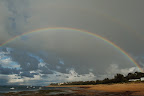
After tea we went for a walk along Cowes beach, which could be accessed via a track less than 100 metres from our flat. The sun was shining in the west, but there were intermittent showers moving across the island - perfect conditions for a rainbow - which can be seen at left.


Saturday 9th February
The managers run the usual meeting introducing the local area and the activities organised at the resort on Saturday morning. We attended this as we usually do. After that there was a Tips and Tricks of Timeshare meeting. The main emphasis in this talk was booking services at Holiday Concepts and RCI. I was not interested in RCI but The Hotel Saver on the Holiday Concepts site sounded interesting. Since returning home I have investigated Hotel Saver - it might be too limited. For instance only one hotel is Gipsland is listed. The manager also mentioned http://www.wotif.com/ which might be more useful.


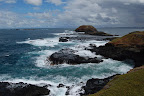
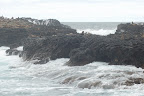
After lunch we visited the Nobbies. The new Centre has been completed and as always there are spectacular views of the south west coastline of the Island. The photo at right shows the Nobbies with Seal Rocks in the background, and the blow hole in the right foreground.


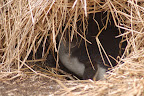
We decided during the week not to visit the Penguin Parade, largely because it would mean a late night. Margaret and I though were compensated by the fairly close up view of a penguin as can be seen in the photograph.


When we had finished at the Nobbies we visited the Vietnam Veterans Museum. Although I did not agree with some of the historical and political claims made the museum reinforced by hatred of old men who for their mere political advantage send young men off to war to be killed and injured. We have a contemporary example with the Iraq war and occupation.

Sunday 10th February
A craft market is held in Cowes every Sunday morning so naturally we visited it. There were four book stalls so I was kept occupied. I have quite a backlog of books to read so I have become quite choosy about the books I buy. The main books that I look for now are Patrick O'Brien's Master and Commander Series. I have read all twenty books - they were borrowed from friends - and I would like to have the whole series in my library. One one of the bookstalls I found Far Side of the World. I chatted to the proprietor as I bought the book and he said that he had acquired it in Canada. Margaret bought a twin set and a Linda Laplante book and Joyce bought my birthday present - I will find out what it was in September.

That morning we investigated the trip to Seal Rocks, and booked for Tuesday afternoon's trip. The rest of the day was for resting.

Monday 11th February
Monday morning was the pancake breakfast which is pretty much a fixture at Holiday Concepts resorts. Then we set off for Churchill Island.

Churchill Island is a small island just off the coast of Phillip Island near Newhaven.

The following is a potted history of the Island quoted from: the visitvictoria site

Phillip Island’s main historic attraction is Churchill Island – a tiny island of 57 hectares where there is an historic working farm with its original homestead that dates back to 1872. Explore the historical house and farm buildings, walk through the traditional gardens and orchard and see ranger demonstrations of traditional farming techniques.

Victoria's first European settlement
Churchill Island was discovered, along with Phillip Island, by George Bass and Matthew Flinders in 1798. Three years later Lieutenant James Grant constructed a simple cottage on Churchill Island and planted corn and wheat with seeds supplied by his friend John Churchill, after whom he named the Island. This was the first European settlement in Victoria.

From cottages to a homestead
In 1866 John Rogers took up residence on the island and built two small cottages. Six years later the island was purchased by Samuell Amess, who built a weatherboard homestead. These buildings are still standing and are the principle historic attractions on the island along with the fragrant herb and flower gardens.


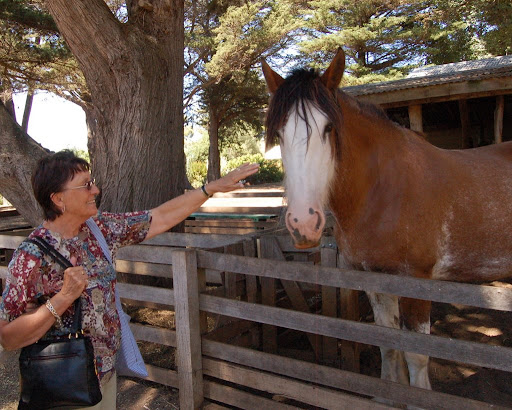
After lunch in the Cafe we toured the heritage farm. The animals included a goat, hens, cattle and horses, one of which can be seen with Margaret in the photo.

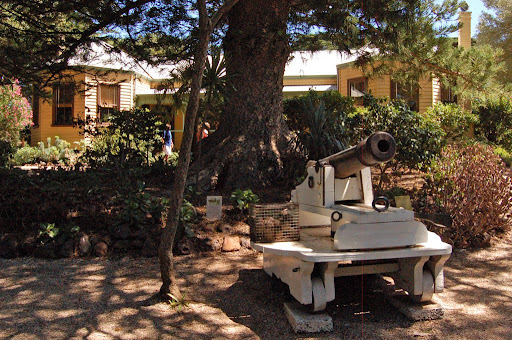
The most substantial building on the farm is Ames House. As shown in the photo, below, it is guarded at the front by a cannon.


While Samuel Ames was a member of the Melbourne City Council the city was visited by a fully rigged steam sloop, the Shenandoah, flying the Confederate flag. The city's high society, including Samuel, welcomed the ship's crew. Legend has it that the captain of the Shenandoah presented Amess with a small cannon which he bought to Churchill island.


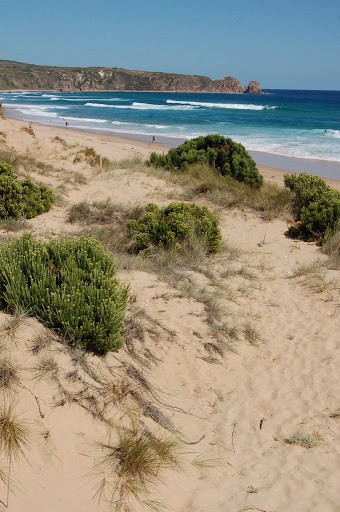
On the way back to Cowes we detoured to Woolamai surf beach. There were some substantial waves comming in but it was too late in the afternoon and a little too cool to swim. The photo shows the beach with Cape Woolamai in the background.


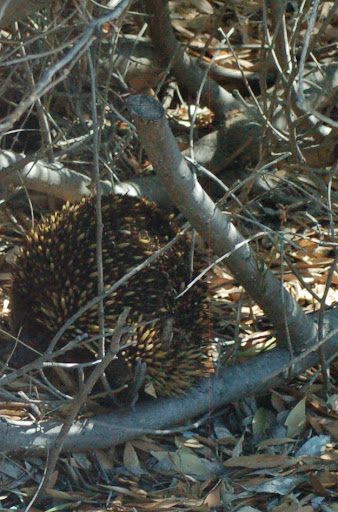
Look carefully at the photo and you will see an Echidna. As we were leaving it was walking across the road. The camera was in the back seat and while I was scrambling to retrieve it the animal headed off into the bush.


Tuesday 12th February


We had planned to have lunch at The foreshore hotel in Rhyll. On the way there we stopped off at Conservation Hill and I went on a walk to Rhyll Inlet. During the walk I saw a wallaby quietly grazing near the track as shown at right. Part of the way along I came across a bike rider who told me that it was worth continuing on to the end of the track and that it wasn't far away. I discovered that neither of these claims were true - the end was at least 1 km away and the view was hardly better than the ones I already had. To make matters worse the track ended in a car park which was accessed from a road - later I drove Margaret and Joyce to the car park to show them where I had been. When we arrived in Rhyll the hotel was closed on Tuesdays, so we returned home for lunch.


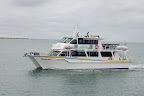
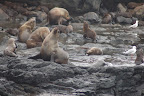
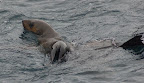
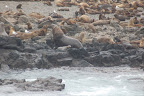
In the afternoon Margaret and I had the highlight of the week. We took a boat trip to Seal Rocks. We boarded the boat at Cowes Jetty and it took about 40 minutes to reach the Seal Rocks. It was an occasion for many senses. We could smell the seal colony long before we could see the seals. Although it was a relatively calm day I am susceptible to sea sickness and when we neared the seal colony I was feeling somewhat queezy. This was exacerbated by the necessity of focusing on the camera LCD screen rather on objects at a distance. Even so it was a great experience as can be sensed from the photos below.


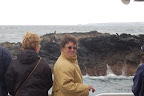
The video below shows Margaret with most of our fellow passengers viewing the seal colony.


Wednesday 13th February

This was a great day for Australia when the new PM Kevin Rudd led Federal Parliament in the apology to the stolen generations. We watched the full three hours of the ABC telecast. It is wonderful to feel proud of my country after 11 long and painful years!

My detailed response to the apology can be found at this post .

For lunch we returned to Rhyll to the Foreshore Hotel. We had a very pleasant lunch with an attractive view over the water to Churchill Island and the mainland.

Thursday 14th February

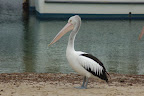
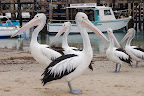
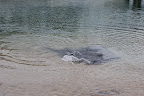
In the morning we visited San Remo. On previous visits to Phillip Island we had driven through San Remo in our haste to get to the Island. Our main interest was the feeding of the pelicans. This was done by the fish co-op at lunchtime. Feeding wild animals is not recommended, and consequently I had misgivings about the exercise, but it did afford an opportunity to see pelicans up close. As you will notice in the photos below pelicans were not the only creatures to realise that a free feed was available - about half a dozen sting rays appeared in the shallows.


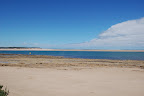
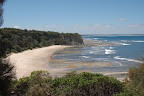
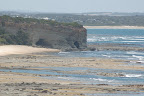
After lunch at the San Remo Hotel we drove to Inverloch via Wonthaggi. None of us had visited this part of the Gippsland coast and we were struck by its beauty. At Inverloch there is a large sandbar which provides a sheltered beach for the town. Waves can be seen and heard breaking on the seaward side of the bar three or four hundred metres away.


The photographs below display dome of the spectacular coastal scenery.


Fridayth February

The drive home.


Thursday, February 7, 2008

Yes We Can

Why do I hope that Obama will be the Democrat nominee for President?

Just listen the his speech on Super Tuesday. It covers the basic themes of his campaign, and although it is not quite as "spine tingling" as his Iowa speech, it soars; listening to it you can understand how Obama inspires many people, even Conservatives.


The Republican nomination has been sown up. McCain will be the Republican nominee. Compare this plodding effort delivered on the same night, to Obama's oratory.


Obama will make minced meat of that old goat come November.

The Republicans will unleash their attack dogs as they did with Kerry in 2004, but we saw that tactic fail here in the Australian election in 2007. The government attacks on Rudd did not succeed because people liked Rudd. People became offended by Howard's vitriol and gave even more support to Rudd. Rudd, though likable compared to his opponents, is still a fairly dull technocrat compared to the inspirational Obama. Any attempt to "swift boat" Obama I expect is likely to backfire on the Republicans.

As another example of the degree to which Obama inspires people look at the video below. It is claimed that this was produced without the assistance or knowledge of the Obama campaign.


Here are the lyrics

It was a creed written into the founding documents that declared the destiny of a nation.

Yes we can.

It was whispered by slaves and abolitionists as they blazed a trail toward freedom.

Yes we can.

It was sung by immigrants as they struck out from distant shores and pioneers who pushed westward against an unforgiving wilderness.

Yes we can.

It was the call of workers who organized; women who reached for the ballots; a President who chose the moon as our new frontier; and a King who took us to the mountaintop and pointed the way to the Promised Land.

Yes we can to justice and equality.

Yes we can to opportunity and prosperity.

Yes we can heal this nation.

Yes we can repair this world.

Yes we can.

We know the battle ahead will be long, but always remember that no matter what obstacles stand in our way, nothing can stand in the way of the power of millions of voices calling for change.

We have been told we cannot do this by a chorus of cynics...they will only grow louder and more dissonant ........... We've been asked to pause for a reality check. We've been warned against offering the people of this nation false hope.

But in the unlikely story that is America, there has never been anything false about hope.

Now the hopes of the little girl who goes to a crumbling school in Dillon are the same as the dreams of the boy who learns on the streets of LA; we will remember that there is something happening in America; that we are not as divided as our politics suggests; that we are one people; we are one nation; and together, we will begin the next great chapter in the American story with three words that will ring from coast to coast; from sea to shining sea --

Yes. We. Can.


Go Barack!


The Season at Sarsaparilla

On Wednesday 6th February we saw Patrick Whites play, The Season at Sarsaparilla at the Playhouse.

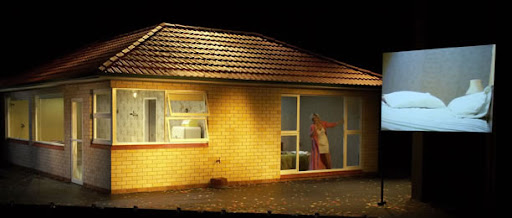
I knew beforehand that the play involved three families living in three houses in suburbia. I was surprised on entering the theatre to see on the sage one large house rather than the three small ones that I had expected. As well there were two large flat screens on either side of the stage. I briefly thought that the action in the other two houses would be shown on the screens.


As the play developed in the first few minutes the house became crammed with people, but it soon became clear that it did not contain a very large family, instead I realised that there was some theatrical artifice here. The three separate households physically occupy one generic house on stage, representing the three houses on quarter acre blocks. The photograph below shows Nola (Pamela Rabe) at the side window. The kitchen can be seen at the left. For most of the play the house was rotated by 90 degrees to show the kitchen, with its two picture windows and back door. The house is reminiscent of the suburban house paintings of Howard Arkley .


The play which was written by Patrick White, premiered in 1962, which was the same year that Edward Albee’s Who’s Afraid of Virginia Woolf? opened on Broadway. Albee’s play was a feature of the 2007 MTC season, and my review can be found at this post. The play was performed by members of the STC Actors Company, a full time actors ensemble.

The play has been summarised as follows:

Here is ordinary suburban Australia: three houses and three backyards, well-lawned and duly Hill’s-hoisted, full of the happy hubbub of family life. In this no-worries tract of battlers and good sorts, the Boyles, the Pogsons and the Knotts live out the Great Australian Dream of frugal comfort and conspicuous normality.

But look closer. These may be everyday Australians, but every day – every sunny, yellow, oven-baked day – is dunked in the pinky, bitter-sweet cuppa of human life. Seek love or lust or hatred; seek joy or disappointment, or the beauty that redeems, or the repulsiveness that clutches; seek head-back mirth or head-bowed sorrow; and you will surely find it contained within the three grassy spaces between the fence palings and the brick veneer during this long hot season at Sarsaparilla.


The Families:

The Pogsons - the respectable family

Clive - a business excutive who sells Holden cars. He is described in the stage directions as: "Round fifty. A rather thick-set business bull – a minor one, but he will probably never know that." Played by John Gaden.

Girlie - Clive's wife. She is the local busybody. According to White: "a small spruce woman in her forties. Not a hair out of place, and never will be. Everything must be nice, even if you pay the price. (She) wears all the marks of anxiety and a respectable social level." Girlie often mentions "Rosedale" which represents the lost paradise of her childhood. In Act Two she again says, “When we were girls at Rosedale, we were taught just how far a person may go, in conversation, or …life. We were educated to look at things ethically.” There is a feeling in the play that she has moved down the social class ladder to marry Clive. Ern, the night soil neighbour calls Girlie “that prissy old cow from next door,” to which Nola, his wife, adds, “She don’t need to come in. She was born with imagination. And a thousand ears.” Played by Peter Carroll, another male successfully playing a female character. For another example see my post on Priscilla.

Judy - the elder daughter of Clive and Girlie. She is studying the violin, has artistic notions about herself, according to White "she plays with a touch that is not exactly brilliant – yet studies at the Con – about 18. A tea-rose. Very pretty and sweet. Rather withdrawn and tentative." She is pursued by Ron and Roy. Played by Hayley McElhinney.

Pippy - Clive and Girlie’s inquisitive younger daughter, who is nearing puberty. She is very aware of the bitch in season that is being pursued by the local dogs the sounds of which can be heard throughout the play. Nola informs Pippy of the meaning of the dogs pursuing the bitch. Pippy loses interest in them as she matures during the second act. Played by Amber McMahon

Deedree Ingpen - described by the playwright as "Slightly younger than her friend Pippy, more innocent, easily put upon; Deedree is the eternal stooge." Pippy describes her as "bakcward" and "stupid". Played by Alan John another successful crossdressing role, John is an accomplished musician as well as actor. He wrote the music for the production and performed it on the Hammond organ.

The Boyles - the childless couple

Ernie - a night cart man, described as "he is in his forties, but very active. An obviously goodnatured, innocent and generous male, who respects and depends on ‘the
women folk..’ " Played by Brandon Burke.

Nola - Ernie’s wife, an earthy sexpot; described as "in her forties, she is often dressed in a chenille dressing-gown. Generous of figure. Tawny of head. A lioness.
Stretching and yawning… sounds hoarse, but comforting. Nola says “a
sanitary lady’s life is not all roses.” She tells Ern in Act Two, “The
terrible thing about a conscience is it don’t stay with you all the time. It walks
out, and lets you down. When you’re weak…. I’m weak. There are times
when the flesh lies too easy on your bones. When even the air tickles your
skin, in the places where it can get at you most.” As David Marrpoints out in Patrick White – A Life , “Girlie is initiating…. Pippy in the respectable lies that rule her existence. But the Pogson’s effoers…are undone by Nola Boyle, motherly, candid and sexually charged." Played by Pamela Rabe.

Rowley Masson (Digger) - A mate who fought with Ern in the Western Desert in WWII and now a truck driver who imposes on his mate to allow him to stay with him for a while. Described as : "a handsome man in his forties. A bit seedy, battered. Good features of the hatchet variety. He tells Nola: “My trouble is: I never had a woman I liked. But tried often." Ern is betrayed by his wife and his war buddy when they have an affair. The play makes clear that this is not the only instance when Nola has strayed. Played by Colin Moody.

The Knotts - the young happy family

Harry - a salesman in menswear he is described as: "a young man, probably younger than he looks, butresponsibilities have been thrust upon him early. He is wearing his business pants, well-pressed, and beautifully laundered white shirt. Arm-bands. There
is nothing distinctive about him." Played by Martin Blum.

Mavis - Harry's wife, very pregnant, described as: "a bit miserable and fretful, though normally she would be a placid, acceptant young woman. Neither pretty nor plain. The average, decent suburban wife." Nola comments of Mavis: "One of the lucky ones. She’ll settle down to ... (motherhood) like shelling peas." Played by Emily Dawe.

Roy Child - Mavis' brother, he is a teacher, on holidays during the play, and is a poet and discontented soul, who acts as the Chorus in the play; he lives with the Knotts and is Judy Pogson’s boyfriend for a time. He is restless and unhappy with his life deciding at the end to leave teaching to write. Played by Eden Falk.

Other characters

Ron Studdards - A post-office clerk he is described as: "a decent fellow. About 21. ….. He is a mixture of the diffident and the determined. He slowly but steadily pursues Judy. Played by Dan Spielman

Julia Sheen - not a member of one of the families something of an "outsider" she is describes as: "glorious. Perfectly dressed. Perfectly slim. Long legs, neck. A pencil parasol. Any position she takes will be the artificial pose of the model.": Roy who has a dalliance with her describes her as: “all show. But what a show!” She has an affair with Mr Erbage that ends in disaster. Played by Helen Thompson.

Mr Erbage - easily the most unattractive character described as: "middle fifties ... self-conscious and self-satisfied." A local businessman (with the feel of a corrupt realestate agent). Played by Alan John. I didn't realise that Deirdre and Erbage were played by the same actor until writing Erbage's description.

The Season at Sarsaparilla is an Australian classic brilliantly performed in this production.


The Slideshow below shows some of the characters and the setting.