The film deals with the struggle in England at the end of the 18th Century and the beginning of the 19th Century to bring an end to the slave trade.
The film centres on William Wilberforce the leader of the anti-slavery movement.
It seems reasonably historically accurate. While watching it I wondered whether Wilberforce was such the fine human being that the film made him out to be. In general the answer is probably that he was in the context of his times and his social class. It is important to remember that the action in the film occurred 200 years ago and that Wilberforce could easily made into a too modern man. Wilberforce was not the modern liberal that we might easily imagine. He was involved in the "Society for the Suppression of Vice" whose concerns included: profanation of the Lord's Day and profane swearing; publication of blasphemous, licentious and obscene books and prints; keeping of disorderly public houses, brothels and gaming houses; illegal lotteries and cruelty to animals. He also supported the suppression of Trade Unions and although he was rightly horrified by the treatment of slaves he was not particularly interested in the lives of poverty and degradation of working people in his own country.
Wilberforce was a fine man, but I don't think he was the saint this movie makes him out to be.
Although Wilberforce always had an interest in religion, this was dramatically quickened by a tour of Europe in 1784. He personally desired to devote his life to God, but was counselled by many people that he could do more good in politics. He eventually made the choice of a political career but fiercely maintained his evangelical beliefs.
The timing of some elements of the film were confusing. The scene in the gambling club is a great piece of film as it dramatically raises the central issues: Wilberforce's religiosity, slavery and the venality of his opponents. The problem that I have with it is that he didn't go to gambling houses after his spiritual awakening, and that it is unlikely that he would sing "Amazing Grace" at the time when he happily participated in the activities of the gambling clubs. The two just don't go together.
The other timing / pacing problem that I have with the film is Wilberforce's romance with Barbara Ann Spooner. The film gave me the impression that there was some time between their first meeting and marriage. In fact they were married less that six weeks after meeting. In the film the first meeting and the marriage are separated by fairly long political flashbacks which disrupts the the presentation of their romance.
Ioan Gruffudd plays the lead role. Although Wilberforce's addiction to Laudnum is detailed, Gruffudd seems too tall and robust to portray Wilberforce. As Boswell (Johnson's biographer) noted after watching a Wilberforce speech: "I saw what seemed a mere shrimp mount upon the table; but as I listened, he grew, and grew, until the shrimp became a whale."
The film raises some issues that have a contemporary resonance. Wilberforce's opponents don't dispute his description of the miseries and inhumanities of the slave trade, instead they claim that he is economically irresponsible as income from the slave trade is an important part of British prosperity. This of cause is always the response of Conservatives to liberal reforms - "we can't afford it". As well, during the war against revolutionary France, the conservatives attacked abolitionists as unpatriotic. Conservatives in all ages happily play the national security card when their own interests are at stake.
This is a generally well made movie about an important theme.
Rating: 31/2 stars.
Monday, August 27, 2007


Thursday, August 23, 2007
Measuring distance to the stars: Distance Modulus
The apparent magnitude (brightness) of a star can be easily measured, as it is just the brightness of the star as seen from Earth. The absolute magnitude is the brightness of the star as seen from 10 parsecs away. It is possible to determine the absolute magnitude of a star by determining its spectral type and then reading off the luminosity in a HR diagram. The luminosity can then be easily converted to absolute magnitude.
Once these two measures of brightness have been determined the distance to the star can be calculated by the formula:
d = 10(m-M+5)/5
where d = distance (in parsecs), m = apparent magnitude and M = absolute magnitude.
Here are some sample calculations:
Proxima Centauri
m = 11.01, M = 15.53
d= 10(11.01 -15.53 + 5) / 5
= 1.247 parsecs
The distance determined from parallax is 1.3 parsecs so the Distance Modulus calculation is fairly accurate.
The source for the parallax distance is Research Consortium on Nearby Stars (RECONS).
Parallax = 0.76887 therefore distance = 1 / 0.76887 = 1.3 parsecs
Sirius
m = -1.47, M = 1.48
d = 10(-1.47 - 1.48 + 5) /5
= 2.57
Paralax distance is 2.63 parsecs (1/0.38002) which is
also reasonably accurate.
This is all well and good, but how was the Distance Modulus formula determined?
The rest of the post attempts to answer this question.
Warning: the following is fairly mathematical!
Relating Flux to Distance
Flux is the energy (light) passing through an area in an amount of time
It is defined as:
F = L / (4πD2)
Note that 4πD2 is the surface area of a sphere.
The observed brightness of a light source is related to its distance by the inverse square law - a source twice as far away appears to be on quarter as bright. For a single object or two objects of the same luminosity:

The L terms cancel as do the 4π terms
Therefore F1 / F2 = (D2 / D1)2 - Equation 1
Converting Luminosity to Magnitude
It is important to realise that luminosity is linear while magnitude is logarithmic.
A difference of 5 magnitudes corresponds to a ratio of 100 in luminosity.
L1 / L2 = xΔM ΔM is a change in M
100 = x5 5 M difference = 100 L difference
2.5118875 = 100.0001132
It is conventional to abbreviate this to 2.55 which equals 97.66 .
Therefore:
L1 / L2 = 2.5ΔM - Equation 2
Relating Luminosity to Distance
We need to find the ratio of luminosity required to produce the same flux from different differences.
F = L / (4πD2)
L = F4πD2
L1 = F4πD12
L2 = F4πD22
Note: there is no F1 or F2 as we are looking for luminosity
required to produce the same flux from different differences, ie F = F
L1 / L2 = F4πD12 / F4πD22
= D12 / D22
= (D1 / D2) 2 - Equation 3
Note this is different to the flux / distance relationship.
Relating Magnitude to Distance
As:
L1 / L2 = 2.5ΔM
and
L1 / L2 = (D1 / D2) 2
therefore
2.5ΔM = (D1 / D2) 2
ΔM = 2.5log10(D1 / D2) 2
= 5log10(D1 / D2)
Note that ΔM = M2 - M1 therefore
M2 - M1 = 5log10(D1 / D2)
Note: absolute magnitude is defined as the apparent magnitude of an object when seen at a distance of 10 parsecs so the magnitude equation can be written as:
m - M = 5log10(D/10)
= 5(log10D - log1010)
= 5(log10D - 1)
= 5log10D -5
Solving for Distance
if m - M = 5log10D -5 then
m - M + 5 = 5log10D
(m - M + 5)/5 = log10D
Therefore D = 10(m - M + 5)/5
which is the relationship that we set out to prove!
Once these two measures of brightness have been determined the distance to the star can be calculated by the formula:
d = 10(m-M+5)/5
where d = distance (in parsecs), m = apparent magnitude and M = absolute magnitude.
Here are some sample calculations:
Proxima Centauri
m = 11.01, M = 15.53
d= 10(11.01 -15.53 + 5) / 5
= 1.247 parsecs
The distance determined from parallax is 1.3 parsecs so the Distance Modulus calculation is fairly accurate.
The source for the parallax distance is Research Consortium on Nearby Stars (RECONS).
Parallax = 0.76887 therefore distance = 1 / 0.76887 = 1.3 parsecs
Sirius
m = -1.47, M = 1.48
d = 10(-1.47 - 1.48 + 5) /5
= 2.57
Paralax distance is 2.63 parsecs (1/0.38002) which is
also reasonably accurate.
This is all well and good, but how was the Distance Modulus formula determined?
The rest of the post attempts to answer this question.
Warning: the following is fairly mathematical!
Relating Flux to Distance
Flux is the energy (light) passing through an area in an amount of time
It is defined as:
F = L / (4πD2)
Note that 4πD2 is the surface area of a sphere.
The observed brightness of a light source is related to its distance by the inverse square law - a source twice as far away appears to be on quarter as bright. For a single object or two objects of the same luminosity:

The L terms cancel as do the 4π terms
Therefore F1 / F2 = (D2 / D1)2 - Equation 1
Converting Luminosity to Magnitude
It is important to realise that luminosity is linear while magnitude is logarithmic.
A difference of 5 magnitudes corresponds to a ratio of 100 in luminosity.
L1 / L2 = xΔM ΔM is a change in M
100 = x5 5 M difference = 100 L difference
2.5118875 = 100.0001132
It is conventional to abbreviate this to 2.55 which equals 97.66 .
Therefore:
L1 / L2 = 2.5ΔM - Equation 2
Relating Luminosity to Distance
We need to find the ratio of luminosity required to produce the same flux from different differences.
F = L / (4πD2)
L = F4πD2
L1 = F4πD12
L2 = F4πD22
Note: there is no F1 or F2 as we are looking for luminosity
required to produce the same flux from different differences, ie F = F
L1 / L2 = F4πD12 / F4πD22
= D12 / D22
= (D1 / D2) 2 - Equation 3
Note this is different to the flux / distance relationship.
Relating Magnitude to Distance
As:
L1 / L2 = 2.5ΔM
and
L1 / L2 = (D1 / D2) 2
therefore
2.5ΔM = (D1 / D2) 2
ΔM = 2.5log10(D1 / D2) 2
= 5log10(D1 / D2)
Note that ΔM = M2 - M1 therefore
M2 - M1 = 5log10(D1 / D2)
Note: absolute magnitude is defined as the apparent magnitude of an object when seen at a distance of 10 parsecs so the magnitude equation can be written as:
m - M = 5log10(D/10)
= 5(log10D - log1010)
= 5(log10D - 1)
= 5log10D -5
Solving for Distance
if m - M = 5log10D -5 then
m - M + 5 = 5log10D
(m - M + 5)/5 = log10D
Therefore D = 10(m - M + 5)/5
which is the relationship that we set out to prove!
Tuesday, August 21, 2007
Measuring distance to the stars: Cepheid Variables
During the last decade of the 19th century and the first decade of the 20th century, Henrietta Levitt studied variable stars at Harvard College Observatory. When she compared variables in the Small Magellanic Cloud SMC(a satellite galaxy of the Milky Way) she noted that there seemed to be a relationship between the period of variability and the luminosity (bright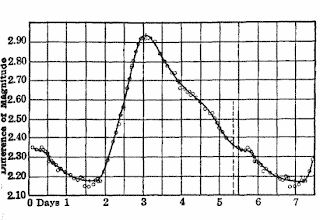 ness) of the stars. As all of the stars in the SMC were basically the same distance away from Earth, the variations in luminosity were proportional to the intrinsic brightness of the stars. Meaning that it was not necessary to determine the distance of the individual stars to demonstrate that there was relationship between period and luminosity - period / luminosity relation (PL relation). The stars that Levitt studied were Cepheid variables. The diagram above shows the light curve of one of the Cepheids that Levitt studied.
 ness) of the stars. As all of the stars in the SMC were basically the same distance away from Earth, the variations in luminosity were proportional to the intrinsic brightness of the stars. Meaning that it was not necessary to determine the distance of the individual stars to demonstrate that there was relationship between period and luminosity - period / luminosity relation (PL relation). The stars that Levitt studied were Cepheid variables. The diagram above shows the light curve of one of the Cepheids that Levitt studied.
This discovery indicated a method of measuring astronomical distances. Once the PL relation for Cepheids was established it would be possible to determine the absolute luminosity of a Cephid and by comparing absolute and apparent magnitudes to determine the distance to the star. Hubble used Cephids to show that there were many galaxies beyond our own and that the galaxies were moving away from each other ie that the universe was expanding. Eventually the Space Telescope that bears his name was able to determine the distances of galaxies as far away as 20 million light years using Cepheid variable stars.
There were many difficulties in calibrating the PL relation for Cepheids, and it was many decades before a reasonably accurate determination was made.
The rest of the post covers in some technical and mathematical detail the processes involved in determining a value for the PL relation, which enabled the modern measuring of distances in the millions of light year range.
The PL relation is usually written as: M = a + blog10P, where P is the period, M is the intrinsic magnitude (luminosity), a is a constant (the zero point) and b is the gradient of the relation.
The problem facing astronomers was to determine the values of the zero point and the gradient. One of the problems with the initial calibration attempts was that there are more than one variable star. The early calibrations included RR Lyrae stars, W Virginis stars as well as Cepheids. It took more that 20 years to clear up this confusion.
There were also difficulties with some of the techniques available. During Levitt's time and for many decades afterwards, photographic plates were used to measure the variations in the intensity of the stars. This was problematic for two reasons: 1) photographic plates are non linear and therefore produced incorrect measures of magnitude variation (fluxes), and 2) most of the light registered on photographic plates was from the blue wavelengths which is strongly absorbed by inter-stellar dust.
Measuring absolute distances to even close Cepheid variables was very difficult at they were too far away for accurate parallax measurements for much of the 20th Century.
In recent decades improved techniques (such as charged coupled devices) have improved the measurement of fluxes. The Hipparcos satellite has allowed improved measurement of distances to Cepheids. These technical developments have made possible the reasonably accurate determination of the PL relation. The modern value is:
Movie Review: Fracture
On Sunday (19th August) Margaret and I saw a film called "Fracture" It is a courtroom thriller, staring Ryan Gosling as an ambitious District Attorney and Anthony Hopkins as the accused murderer. The plot is well written with the DA realising too late that this apparently "open and shut" case will be much more difficult than he initially realised.
The performance by Gosling has been universally acclaimed, but there is debate on the quality of Hopkins acting. Some (eg David Strattan) claim that Hopkins' performance is "lazy, hitting all the right buttons". Others (such as Margaret Pomeranz) argue that Hopkins also gives a fine performance. I suspect that the source of these differences relates to the two different characters. Gosling is given a more meaty role, with a wide range of circumstances and emotions to portray. Hopkins' character is set up as controlling from the beginning. He decisively points out the source of a plane crash to his engineers in one of the opening scenes, and creates intricate machines with races for balls to roll along. As well the Hopkins character is confidently in control of events through most of the film. It is my view that Hopkins gives an excellent, understated performance of this controlling and manipulative character.
The weakest element of the film is Rosamund Pike's character who is to be the DA's new boss when he moves to private practice. Her character's role in the film seems only as a love interest for Gosling's character. Their relationship does not go anywhere.
Although the film is well plotted, there seems to me to be one unexplained hole. The murderer, (Hopkins character) requires a particular policeman to arrest him at his house for his plan to work. The film does not adequately explain why that cop was the one to arrest him.
Otherwise the resolution of the conundrum running through most of the film - the whereabouts of missing evidence - is handled cleverly.
If the hallmark of a successful movie is satisfaction as you leave the cinema and material for discussion later, then this movie
succeeds.
My rating: four stars.
The performance by Gosling has been universally acclaimed, but there is debate on the quality of Hopkins acting. Some (eg David Strattan) claim that Hopkins' performance is "lazy, hitting all the right buttons". Others (such as Margaret Pomeranz) argue that Hopkins also gives a fine performance. I suspect that the source of these differences relates to the two different characters. Gosling is given a more meaty role, with a wide range of circumstances and emotions to portray. Hopkins' character is set up as controlling from the beginning. He decisively points out the source of a plane crash to his engineers in one of the opening scenes, and creates intricate machines with races for balls to roll along. As well the Hopkins character is confidently in control of events through most of the film. It is my view that Hopkins gives an excellent, understated performance of this controlling and manipulative character.
The weakest element of the film is Rosamund Pike's character who is to be the DA's new boss when he moves to private practice. Her character's role in the film seems only as a love interest for Gosling's character. Their relationship does not go anywhere.
Although the film is well plotted, there seems to me to be one unexplained hole. The murderer, (Hopkins character) requires a particular policeman to arrest him at his house for his plan to work. The film does not adequately explain why that cop was the one to arrest him.
Otherwise the resolution of the conundrum running through most of the film - the whereabouts of missing evidence - is handled cleverly.
If the hallmark of a successful movie is satisfaction as you leave the cinema and material for discussion later, then this movie
succeeds.
My rating: four stars.
Monday, August 20, 2007
Weekend of 18th to 19th August
Another busy weekend.
Saturday morning I attended my usual Pilates session at Windy Hill Fitness Centre.
In the afternoon we attended Emma Kleins' "Princess Fiona" birthday party at her home on the outskirts of Kilmore.
In the evening we attended a 50th birthday party in Laverton. The most interesting thing about the restaurant was the decore. There were some kitsch landscapes but one very impressive photograph of tigers. The most interesting picture was a take off of Titian's School of Athens painting. Instead of venerable philosophers the painting contained entertainers of the 20th century. The central figures in the original were Plato (pointing up to indicate the importance of ideal forms) and Aristotle is pointing towards the earth. In the entertainers version Plato is replaced by Marilyn Monroe and Aristotle by James Dean. The painter was not attempting to make a correspondence between Plato and Monroe on one hand and Aristotle and Dean on the other. Such a concept would be ridiculous. A less "platonic" personality then Monroe would be difficult to find. The correspondence is between philosophical "stars" and entertainment "stars". The most interestin g juxtaposition in the painting is between Lisa Minelli and Batman. Lisa is dressed as "Sally Bowles" from Cabaret and has her hand on Batman's shoulder. Sally is the symbol of liberated femininity and Batman is the symbol of repressed masculinity.
Another interesting print on the walls is Gotfried Helnwein's "Boulevard of Broken Dreams" (see painting on left). It is based on Ed Hopper's 1942 painting "Nighthawks" (see painting on right). They both have a sense of loneliness and alienation. The street outside is dark, vacant and bleak, and while the cafe is brightly lit this only adds to the sense of danger and threat. Note also that there is not door visible to the cafe, giving a sense that the people inside were caged. Was Helnwein making a point about the isolation of fame or was he just having fun parodying a famous picture?
On Sunday morning, I dropped Margaret off at DFO for some shopping and I trained at Windy Hill - Treadclimber, 10 minutes, Bike, 10 Minutes, Stepper, 20 minutes, and treadmill, 10 minutes.
In the afternoon we went to the movies and watched "Fracture" a powerful thrilller. Se my review here. Then we visited my niece Narelle in hospital. Her newborn son, Elijah, was only a few days old. Both Narelle and Elijah were well and happy, as are all members the families involved.
Saturday morning I attended my usual Pilates session at Windy Hill Fitness Centre.
In the afternoon we attended Emma Kleins' "Princess Fiona" birthday party at her home on the outskirts of Kilmore.
In the evening we attended a 50th birthday party in Laverton. The most interesting thing about the restaurant was the decore. There were some kitsch landscapes but one very impressive photograph of tigers. The most interesting picture was a take off of Titian's School of Athens painting. Instead of venerable philosophers the painting contained entertainers of the 20th century. The central figures in the original were Plato (pointing up to indicate the importance of ideal forms) and Aristotle is pointing towards the earth. In the entertainers version Plato is replaced by Marilyn Monroe and Aristotle by James Dean. The painter was not attempting to make a correspondence between Plato and Monroe on one hand and Aristotle and Dean on the other. Such a concept would be ridiculous. A less "platonic" personality then Monroe would be difficult to find. The correspondence is between philosophical "stars" and entertainment "stars". The most interestin
 g juxtaposition in the painting is between Lisa Minelli and Batman. Lisa is dressed as "Sally Bowles" from Cabaret and has her hand on Batman's shoulder. Sally is the symbol of liberated femininity and Batman is the symbol of repressed masculinity.
Another interesting print on the walls is Gotfried Helnwein's "Boulevard of Broken Dreams" (see painting on left).
 It is based on Ed Hopper's 1942 painting "Nighthawks" (see painting on right). They both have a sense of loneliness and alienation. The street outside is dark, vacant and bleak, and while the cafe is brightly lit this only adds to the sense of danger and threat. Note also that there is not door visible to the cafe, giving a sense that the people inside were caged. Was Helnwein making a point about the isolation of fame or was he just having fun parodying a famous picture?
On Sunday morning, I dropped Margaret off at DFO for some shopping and I trained at Windy Hill - Treadclimber, 10 minutes, Bike, 10 Minutes, Stepper, 20 minutes, and treadmill, 10 minutes.
In the afternoon we went to the movies and watched "Fracture" a powerful thrilller. Se my review here. Then we visited my niece Narelle in hospital. Her newborn son, Elijah, was only a few days old. Both Narelle and Elijah were well and happy, as are all members the families involved.
Thursday, August 16, 2007
Measuring distances to the stars: Spectroscopic Parallax
The next step for distances beyond trigonometric parallax is to use the brightness of start to determine their distance. There are enormous variations in the brightness of start so it is not possible to use brightness on its own to determine stellar distances. The light that we see is made op of "all of the colors of the rainbow" from dark blue to red. Taking the light of a star and breaking it up into its constituent colors is called taking the star's spectrum. Astronomers can determine the luminosity (brightness) of a star from the spectrum. If they know how bright a star is, astronomers can compare its brightness as seen from Earth and then determine how distant is is.
That simple description raises a number of questions. If you are interested in exploring these issues further click on the "Read the rest of the post" link.
1. How do astronomers determine the luminosity of a star from its spectrum?
The first step is to determine the surface temperature. This can be done from the spectrum. A simplified version of a spectrum for a star like the sun is displayed below.

Note the colors range from dark blue to dark red. There are dark lines in the spectrum. Each line is caused by the absorption of light at that particular frequency by an element in the star's atmosphere. The electrons in the atoms of the elements have to be at particular energy levels to absorb the light. The energy levels of atoms are determined by temperature, so the temperature of the star can be determined.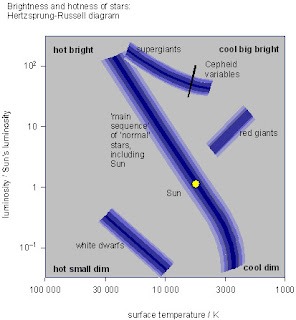
The next step is to use a Hertzsprung - Russell diagram (illustrated at right) to determine the luminosity of the star. The horizontal axis is the surface temperature and the vertical axis is the star's luminosity as a ratio of the luminosity of the sun. The calibration of the diagram has been improved by the large number of stars that have been studied by the Hipparcos satelite.
Most stars are on the "main sequence" so to determine the luminosity from star temperature take a line up from the appropriate location on the horizontal axis to the main sequence and then read off the luminosity from the vertical axis.
2. How is distance determined from absolute luminosity?
We can use the formula:
D = 10(m-M+5)/5
where D = distance, m = apparent magnitude and M = absolute magnitude.
Magnitude measure is an issue that I will not discuss in this post.
I will use Spica as an example:
Apparent magnitude: m = 0.98
Spectral type is B1
From HR diagram this indicates an absolute magnitude, M, in the range: -3.2 to -5.0
For M = -3.2, D = 10(0.98 - (-3.2) + 5) / 5 = 68.54 parsecs (pc)
For M = -5.0, D = 10(0.98 - (-5.0) + 5) /5
The Hipparcos measurements give D = 80.38 .
Spectroscopic Parallax provides a distance measurement to stars but is not particularly accurate.
That simple description raises a number of questions. If you are interested in exploring these issues further click on the "Read the rest of the post" link.
1. How do astronomers determine the luminosity of a star from its spectrum?
The first step is to determine the surface temperature. This can be done from the spectrum. A simplified version of a spectrum for a star like the sun is displayed below.

Note the colors range from dark blue to dark red. There are dark lines in the spectrum. Each line is caused by the absorption of light at that particular frequency by an element in the star's atmosphere. The electrons in the atoms of the elements have to be at particular energy levels to absorb the light. The energy levels of atoms are determined by temperature, so the temperature of the star can be determined.

The next step is to use a Hertzsprung - Russell diagram (illustrated at right) to determine the luminosity of the star. The horizontal axis is the surface temperature and the vertical axis is the star's luminosity as a ratio of the luminosity of the sun. The calibration of the diagram has been improved by the large number of stars that have been studied by the Hipparcos satelite.
Most stars are on the "main sequence" so to determine the luminosity from star temperature take a line up from the appropriate location on the horizontal axis to the main sequence and then read off the luminosity from the vertical axis.
2. How is distance determined from absolute luminosity?
We can use the formula:
D = 10(m-M+5)/5
where D = distance, m = apparent magnitude and M = absolute magnitude.
Magnitude measure is an issue that I will not discuss in this post.
I will use Spica as an example:
Apparent magnitude: m = 0.98
Spectral type is B1
From HR diagram this indicates an absolute magnitude, M, in the range: -3.2 to -5.0
For M = -3.2, D = 10(0.98 - (-3.2) + 5) / 5 = 68.54 parsecs (pc)
For M = -5.0, D = 10(0.98 - (-5.0) + 5) /5
The Hipparcos measurements give D = 80.38 .
Spectroscopic Parallax provides a distance measurement to stars but is not particularly accurate.
Tuesday, August 14, 2007
Measuring distances to the stars: Parallax
In my post on Galaxies I noted the distance to the two galaxies concerned.
This raises the issue of measuring astronomical distances. The first step is
measuring distances to near by stars. This post considers how these
measurements are done.
It is possible to directly measure distances to stars that are relatively close to us by using trigonometry which is probably familiar from secondary school maths - eg COS, SIN, TAN, PI, radians and the like.
Nearby stars appear to move with respect to more distant background stars due to the motion of the Earth around the Sun. This apparent motion (it is not "true" motion) is called Stellar Parallax. (Stellar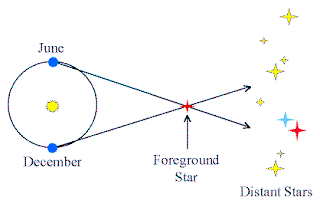 means star).
In the diagram at right , the line of sight to the star in December is different than that in June, when the Earth is on the other side of its orbit. As seen from the Earth, the nearby star appears to sweep through the angle shown. Half of this angle, is the parallax, p.
As even the closest stars are very far away the measured parallaxes are very small. Even the largest is less than an arcsecond.
If you are wondering what an arcsecond is, here is an explanation. A degree is 1/360 of a circle. An arcminute is 1/60 of a degree. An arcsecond is 1/60 of an arcminute. If you do the maths an arcsecond is 1/1296000 of a circle. For those with some maths background that is (π/648000) radians, which is approximately 1/206265 radian.
The closest star to the solar system, Proxima Centauri, has a parallax of 0.772-arcsec, which is the largest ever measured. (The closer a star is the larger its parallax). Incidentally the first parallax was measured in 1837 by Friedrich Bessel for the star 61 Cygni. We use photography and digital imaging techniques to measure parallaxes today. Increasingly, we measure parallaxes from space to avoid blurring due to the Earth's atmosphere.
The parallax relationship to distance can be expressed in a simple formula:
d = 1/p , where p is the parallax measured in arcseconds and d is the distance measured in parscecs. So what is a parsec.
This raises the issue of measuring astronomical distances. The first step is
measuring distances to near by stars. This post considers how these
measurements are done.
It is possible to directly measure distances to stars that are relatively close to us by using trigonometry which is probably familiar from secondary school maths - eg COS, SIN, TAN, PI, radians and the like.
Nearby stars appear to move with respect to more distant background stars due to the motion of the Earth around the Sun. This apparent motion (it is not "true" motion) is called Stellar Parallax. (Stellar
 means star).
In the diagram at right , the line of sight to the star in December is different than that in June, when the Earth is on the other side of its orbit. As seen from the Earth, the nearby star appears to sweep through the angle shown. Half of this angle, is the parallax, p.
As even the closest stars are very far away the measured parallaxes are very small. Even the largest is less than an arcsecond.
If you are wondering what an arcsecond is, here is an explanation. A degree is 1/360 of a circle. An arcminute is 1/60 of a degree. An arcsecond is 1/60 of an arcminute. If you do the maths an arcsecond is 1/1296000 of a circle. For those with some maths background that is (π/648000) radians, which is approximately 1/206265 radian.
The closest star to the solar system, Proxima Centauri, has a parallax of 0.772-arcsec, which is the largest ever measured. (The closer a star is the larger its parallax). Incidentally the first parallax was measured in 1837 by Friedrich Bessel for the star 61 Cygni. We use photography and digital imaging techniques to measure parallaxes today. Increasingly, we measure parallaxes from space to avoid blurring due to the Earth's atmosphere.
The parallax relationship to distance can be expressed in a simple formula:
d = 1/p , where p is the parallax measured in arcseconds and d is the distance measured in parscecs. So what is a parsec.
- "A star with a parallax of 1 arcsecond has a distance of 1 Parsec."
1 parsec (pc) is equivalent to:
* 206,265 AU (and AU is the distance between the Earth and the Sun about 149,598,000 Kms)
* 3.26 Light Years
* 3.086x10¹³ km
It can be argued that the parsec measure of distance is probably more "natural" than the light year as the latter is dependent on the length of one year (revolution of the Earth around the Sun) where as a parsec relates to a fraction of a circle. On the other hand the fraction of a circle used to define a parsec is pretty unusual, and relates to the realatively arbitrary decision to define degrees as 1/360 of a circle, and arcminute as 1/60 of a degree and arcsecond as 1/60 of an arcminute. Parsec as a "natural" measure is not in the same class as radian measure.
Here is an example of the calculation of parallax distances:
Alpha Centauri has a parallax of p=0.742-arcsec.
d = 1/p = 1/0.742 = 1.35 parsecs (pc)
There are serious limitations to this method:
If the stars are too far away, the parallax can be too small to measure accurately. In general, the greater the distance, the smaller the parallax, and so the less precise the distance measurement will be. The smallest parallax measurable from the ground is about 0.01-arcsec. This means that from the ground, the method of Trigonometric Parallaxes has the following limitations:
* good out to 100 pc
* only get 10% distances out to a few parsecs.
* only a few hundred stars are this close
The blurring of stars caused by the atmosphere makes it difficult to measure parallaxes to high precisions. Consequently the Hipparcos satellite was launched by the European Space Agency in 1989 with the aim of more precisely measuring stellar parallaxes. It can measure parallaxes to an accuracy of about 0.001-arcsec.
*Hiparcos has measured parallaxes for about 100,000 stars
*It can get a 10% accuracy for distances out to about 100 pc
*It can measure good distances for bright stars out to 1000 pc
Hiparcos represented a great leap in our knowledge of the distances (and motions) of nearby stars. For more information on Hiparcos visit the web site.
Monday, August 13, 2007
Bricklayer's Accident
I know we've seen it before but................
Possibly the funniest story in a long while. This is
a bricklayer's accident report, which was printed
in the newsletter of Workers' Compensation board.
This is a true story.
Had this guy died, he'd have received a Darwin
Award for sure.......
Dear Sir,
I am writing in response to your request for additional
information in Block 3 of the accident report form.
I put " poor planning " as the cause of my accident.
You asked for a fuller explanation and I trust the
following details will be sufficient.
I am a bricklayer by trade. On the day of the accident,
I was working alone on the roof of a new six-story building.
When I completed my work, I found that I had some bricks
left over which, when weighed later were found to be slightly
in excess of 500lbs.
Rather than carry the bricks down by hand I decided to
lower them in a barrel by using a pulley, which was attached
to the side of the building on the sixth floor. Securing
the rope at ground level, I went up to the roof,
swung the barrel out and loaded the bricks into it.
Then I went down and untied the rope, holding it tightly
to ensure a slow descent of the bricks.
You will note in Block 11 of the accident report form that
I weigh 135lbs.
Due to my surprise at being jerked off the ground so suddenly,
I lost my presence of mind and forgot to let go of the rope.
Needless to say, I proceeded at a rapid rate up the side of
the building. In the vicinity of the third floor, I met
the barrel, which was now proceeding downward at an equally
impressive speed. This explained the fractured skull, minor
abrasions and the broken collar bone, as listed in section 3
of the accident report form.
Slowed only slightly, I continued my rapid ascent, not
stopping until the fingers of my right hand were two
knuckles deep into the pulley.
Fortunately by this time I had regained my presence of mind
and was able to hold tightly to the rope, in spite of
beginning to experience pain.
At approximately the same time, however, the barrel of bricks
hit the ground and the bottom fell out of the barrel. Now
devoid of the weight of the bricks, that barrel weighed
approximately 50 lbs.
I refer you again to my weight. As you can imagine, I began a
rapid descent, down the side of the building. In the vicinity
of the third floor, I met the barrel coming up. This accounts
for the two fractured ankles, broken tooth and several
lacerations of my legs and lower body.
Here my luck began to change slightly. The encounter with
the barrel seemed to slow me enough to lessen my injuries
when I fell into the pile of bricks and fortunately only three
vertebrae were cracked. I am sorry to report, however, as I
lay there on the pile of bricks, in pain, unable to move, I
again lost my composure and presence of mind and let go of
the rope and I lay there watching the empty barrel begin
its journey back down onto me. This explains the two broken
legs.
I hope this answers your inquiry.
UPDATE:
Since writing this I have seen a Mythbusters episode that attempts to emulate this "accident". It took a great deal of effort and manipulation to get all of the elements of the incident to happen. In particular, it was very difficult to get the barrel to break even after significantly weakening it.
True Australian Ghost Story
This story happened a while ago in Sydney,
and even though it sounds like an Alfred Hitchcock tale, it's true.

John Bradford, a Sydney University student, was on the side
of the road hitch hiking on a very dark night and in the
midst of a storm. The night was rolling on and no car went by.
The storm was so strong he could hardly see a few feet ahead
of him. Suddenly he saw a car slowly coming towardshim and
stopped. John, desperate for shelter and without thinking
about it, got in the car and closed the door, just to realise
there was nobody behind the wheel and the engine wasn't on!
The car started moving slowly. John looked at the road and saw
a curve approaching.

Scared, he started to pray, begging for his life.  Then, just
before he hit the curve, a hand appeared through the window
and turned the wheel. John, paralysed with terror, watched
how the hand repeatedly came through the
window but never harmed him.

Shortly thereafter John saw the lights of a pub down the
road so, gathering strength, jumped out of the car and ran
to it. Wet and out of breath, he rushed inside and started
telling everybody about the horrible experience
he had just experienced.

A silence enveloped the pub when everybody realised he
was crying and ?... wasn't drunk.

Suddenly two other people walked into the same pub.
They, like John,  were also wet and out of breath.  Looking
around and seeing John Bradford sobbing at the bar,
one said to the other, "Look, Bruce ?? there's that  f*cking
idiot that got in the car while we were pushing it."
Galaxies
I was browsing through the Hubble Space Telescope site today and came across many beautiful images of astronomical objects taken with the space telescope.
Among them were the two galaxies displayed in this post.
The one at rightis M 101. It is a spiral galaxy that is about 25 Million Light Years away.
 It is nicknamed the "Pinwheel Galaxy" for obvious reasons. It was first discovered by Pierre Mechain in 1871 and was included by Charles Messier in his catalog. It is relatively large with a diameter of 170.000 light years. Our galaxy, the Milky Way has a diameter of about 100,000 light years. The Pinwheel is quite asymetrical (compare left and right sides in the picture). This asymetry is thought to have been caused by a close encounter with another galaxy in the relatively recent past. Galactic collisions are not particularly rare, photographs have been taken of galactic collisions. Our galaxy would look something like M 101 from the outside. We see it as a band across the sky as we are inside the Milky Way Galaxy.
 The galaxy at left is also a spiral but with quite a different appearance. Its designation is NGC 1300. It type is called a "Barred Spiral" as the spiral arms are connected by a large bar rather than spiral in to the centre as in M 101. It is approximately 70 million light years away and about 100,00 light years across. It was discovered by John Herschel in 1835. His father was the more famous William Herschel.
A light year is the distance that light travels in one year, so the pictures show the galaxies as they were 25 and 70 million years ago respectively. The distance of a light year can be easily calculated by multiplying seconds in a minute X minutes in a hour X hours in a day X days in a year X distance light travels in one second. As light travels very close to 300,000 Kms in a second the calculation becomes 60 X 60 X 24 X 365 X 300,000. The answer is 9,460,000,000,000 Kms.
That means that M 101 is 236,000,000,000,000,000,000 Kms away and NGC 1300, 66,20,00,000,000,000,000,000 Kms away. These are large distances in anyone's estimation - except maybe for astronomers. Compared to the most distant galaxies known M 101 and NGC 1300 are just in our back yard. The most distant galaxies are of the order of 13 billion light years distant from us. I won't even bother with the kilometer distance which would be meaningless and silly. Galaxies much older than 13 billion years old are unlikely to be found as the universe is about 13.7 billion years old.
This post raises many questions, in particular, how are astronomical distances measured and how do we know that the universe is about 13.7 billion years old? They are obvious topics for later posts.
Sunday, August 12, 2007
Weekend 11th to 12th August
We had a busy weekend.
We saw all of our grandchildren who live in Australia over the weekend.
On Saturday we looked after Spencer, while Cath and Chris attended a conference on Church planting.
Between 11:00 and 11:30 we had our first "open house" for the selling of our home. It was successful with 13 groups inspecting the house, and with at least three of them interested in being "kept in the loop". As is usual with inspections we had to leave the house, so Spencer and I observed proceedings from my car, parked up the street.
_________________________________________________________________

On Saturday night we had a party for Joyce's 88th birthday at the First and Last Hotel. We chose it as that venue as it has an excellent children's playground. The food was quite presentable for a local pub. Those who attended were, Joyce (of cause), Margaret, Edna, Jim and Janice, Adrian and Shannyn, Graeme and Ryan, Beth, Mark, Joshua, and Troy, Michelle, David, Jonathan, Mandy and lastly me.
_________________________________________________________________

On Sunday morning we attended Troy's enrollment as a Junior Soldier at Moreland Salvation Army. Joshua and Cameron renewed their pledge. After the service we had lunch at Moreland. The lunch was very tasty, being organised very effectively by Beth.
_________________________________________________________________
In the afternoon Margaret and I attended our second theatre performance in three days, this time at the Clock Tower in Moonee Ponds. The show was called Lalaluna.
To read my review of this wonderful show go to this post.
Theatre Revue: LaLaLuna
The premise of the show is:
"What if, one evening, the light in the moon went out … and you were the one responsible for finding a replacement light bulb?
In LALALUNA, the stage fills with illusion, lunacy and a touch of circus as Bob – the lunar caretaker – attempts to correct this astronomical malady. In his quest to put the light back in the darkened night, Bob encounters body-engulfing balloons, tangles with a tango-dancing music stand, brings a movie to life beyond the confines of its screen and invites his audience to participate in ways they’d never dreamed of before." http://www.clocktowercentre.com.au/
Occasionally we have gone to a show not knowing what it is about and finding that we are watching something very special, that you will remember for many years to come. Lalaluna was one of those performances.
You can't a lways believe the publicity for all entertainments as it is in the interests of the publicist to claim that the show is "wonderful, marvellous, the best ever". The following excerpt from the show's publicity website (which I checked after seeing the show) gives just a sense of the quality and originality of the show:
"Lalaluna flies you to the moon and back on a winged unicycle to a symphony of whoopee cushions and ukulele. It plumbs the collective consciousness with a toilet plunger; enbosoms the collective imagination in a giant balloon; animates musical sketches and further charms with and interactive clothes line film".
This was a very different type of show to "The Glass Soldier" that we saw on Friday night, but equally as memorable.
If you get a chance to see this show don't pass it up!
"What if, one evening, the light in the moon went out … and you were the one responsible for finding a
 replacement light bulb?
In LALALUNA, the stage fills with illusion, lunacy and a touch of circus as Bob – the lunar caretaker – attempts to correct this astronomical malady. In his quest to put the light back in the darkened night, Bob encounters body-engulfing balloons, tangles with a tango-dancing music stand, brings a movie to life beyond the confines of its screen and invites his audience to participate in ways they’d never dreamed of before." http://www.clocktowercentre.com.au/
Occasionally we have gone to a show not knowing what it is about and finding that we are watching something very special, that you will remember for many years to come. Lalaluna was one of those performances.
You can't a
 lways believe the publicity for all entertainments as it is in the interests of the publicist to claim that the show is "wonderful, marvellous, the best ever". The following excerpt from the show's publicity website (which I checked after seeing the show) gives just a sense of the quality and originality of the show:
"Lalaluna flies you to the moon and back on a winged unicycle to a symphony of whoopee cushions and ukulele. It plumbs the collective consciousness with a toilet plunger; enbosoms the collective imagination in a giant balloon; animates musical sketches and further charms with and interactive clothes line film".
This was a very different type of show to "The Glass Soldier" that we saw on Friday night, but equally as memorable.
If you get a chance to see this show don't pass it up!
Anthropic Principal
The following post appeared at Cosmic Variance
Unusual Features of Our Place In the Universe That Have Obvious Anthropic ExplanationsSean at 5:02 pm, August 7th, 2007
The “sensible anthropic principle” says that certain apparently unusual features of our environment might be explained by selection effects governing the viability of life within a plethora of diverse possibilities, rather than being derived uniquely from simple dynamical principles. Here are some examples of that principle at work.
- Most of the planetary mass in the Solar System is in the form of gas giants. And yet, we live on a rocky planet.
- Most of the total mass in the Solar System is in the Sun. And yet, we live on a planet.
- Most of the volume in the Solar System is in interplanetary space. And yet, we live in an atmosphere.
- Most of the volume in the universe is in intergalactic space. And yet, we live in a galaxy.
- Most of the ordinary matter in the universe (by mass) consists of hydrogen and helium. And yet, we are made mostly of heavier elements.
- Most of the particles of ordinary matter in the universe are photons. And yet, we are made of baryons and electrons.
- Most of the matter in the universe (by mass) is dark matter. And yet, we are made of ordinary matter.
- Most of the energy in the universe is dark energy. And yet, we are made of matter.
- The post-Big-Bang lifespan of the universe is very plausibly infinite. And yet, we find ourselves living within the first few tens of billions of years (a finite interval) after the Bang.
That last one deserves more attention, I think.
If you go to the post (by clicking on the link at the top) you will find many erudite comments and it would be impossible to summarise the debate, but my favourites are short:
From Allyson: "This is one of posts that is awesome to read to stoned people"
From Neil B.: "How did life start? From atom and eV".
This issue relates to the "Fine Tuned Universe" which is described at this wikipedia article:
http://en.wikipedia.org/wiki/Fine-tuned_universe
and in the books:Just Six Numbers by Martin J. Rees
and
The Goldilocks Enigma by Paul Davies
I am planning a future post on these issues.
Saturday, August 11, 2007
Theatre Review: The Glass Soldier
We are theatre subscribers at the MTC. Last night we attended a performance of "The Glass Soldier" at the Playhouse. The play is by Hannie Rayson.
It tells the story of Nelson Ferguson, who was a soldier in the First World War, who when in London he fell in love with Madeline. The first act largely is set on the Western Front depicting the horrors that were inflicted on the soldiers in the trenches as well as some scenes set in London, sometimes with the soldiers at the front and denizens of London Society overlapping. The London scenes not only establish the love between Nelson and Madelaine but also that Nelson is a painter. Madelaine imagines their life together after the war with Nelson as a famous painter. She asked him to promise not to die, which reluctantly he did. Ofcause not all soldiers die but all are damaged in some way.
The climactic scene of the first act occurs in a church, near Villers-Bretonneux. Nelson, the artist, is admiring the beauty of the stained glass windows, when the Church and surrounding village was bombed. As the playwright herself says: "One of Nelson's last images before he was gassed was in a church in France with a stained-glass window. The church was bombed and the window was shattered. I use it as a metaphor: over the century there have been moments of peace shattered by war. This is kind of about the quest to pick up the pieces of fractured, fragmented lives to let in the light."
Nelson loses most of his sight in the gas attack and the rest of the play is largely about the consequences of this affliction.
Nelson returns to Australia and thinks that Madelaine has deserted him. In reality she has lost track of him after the gas attack and took some time to find him. She arrives in Melbourne where Nelson initially rejects her, but when he learns of her struggle to find him they are reconciled and marry. Amazingly, Nelson who is almost blind, finds a job at an art teacher.
Nelson and his family and friends struggle through the Great Depression, and then World War 2 arrives on the scene. While I was watching the early WW2 scenes I wondered if people at that time thought "Oh no, it is happening again." Soon after Kerry Armstrong, playing the older Madelaine voiced the same thought. (I wonder if this was a common response to WW2, and will try to research it.) A new generation of young men are now going off to war again. Although Nelson and Madelaine's son is spared during the fighting, Nelson's friend Wolfie's son is killed.
Throughout the play there is a tension between family life - the wife and children - and the war buddies who share an amazing bond having suffered together in the trenches. Although Nelson is mainly damaged physically, he is still haunted by the war. As Madelaine says at one stage, "I sleep with him and when Nelson has a night in the trenches, so do I." His friend Wolfie is not physically damaged but is emotionally crippled by the war. Although Madelaine attempts to support Wolfie she feels left out of a relationship that is bonded in experiences that she has never had.
The last scenes are set during the Vietnam War, just before the first Moratorium. By now Nelson and his son have started a stained glass business and are making a success of it. This makes a connection with the incident that originally took Nelson's eyesight.
The play finishes on a upbeat note. Nelson's sight is restored by a corneal transplant. The wife of the rapacious landlord who they struggled against during the Depression arrives with a commission for a stained glass window memorialising her husband, who was a pillar of the church. And although they have misgivings, the family accepts the commission - they need the money. Finally, Wolfie has at last come to terms with his war experiences and with the loss of his son.
Although the finish seems a little too cheerful the play is based on a true story. Nelson did work as a teacher - he was a better teacher than a painter. The family did set up a stained glass company, which is still operating in Melbourne.
This play had some resonances for me. Nelson was gassed near Villers-Bretonneux on 17th April 1918. My grandfather was shot near Villers-Bretonneux less that two weeks later, on 30 April 1918.
The Glass Soldier reinforces the point that I made in my post Valuing Old Folks, which coincidentally I wrote just hours earlier than seeing the play.
Friday, August 10, 2007
Valuing Old Folks
The second half of the 20th Century was the era when youth was celebrated. This has meant that older people have been devalued, as doddery and uninteresting. The first two decades of life are very formative. For instance my basic attitudes to life were largely formed by the time I was 20 and I expect this is true of most people.
Those born in the 1920s lived through a period of very spectacular world history in their first two decades. I will give some examples of a 79 year old that I know quite well, my father who was born in January 1928.
He was born into the long shadow of the Great War (WW1). Dad was constantly reminded of the reality of that devastating conflict as his father had been wounded towards the end of the war, and never fully recovered his health . Dad reminds me that the prosperity of the "Jazz Age" was really an American phenomenon and that times were tough when he was young. This was compounded by the Great Depression, which might be dated from 1929 to 1933, but in his experience persisted throughout the 1930s. But, the thirties weren't all "doom and gloom" in his recollection. He has always been interested in Science and Technology and as a boy was fascinated by the new technologies that were developing. fROM THE 1920S His father had built radios (Dad still calls them wirelesses). Changing the station on the radio required changing coils, which were separate and had to be inserted into the "wireless". Dad was also interested in the new "talkie" movies, and would hang around the hall where they were shown watching the projectionist set up for a show.
Much entertainment in the 1930s, though, was still of the old fashioned type. Community singing was very popular. It was also quite organised. Entertainers would tour the country side organising and leading community singing sessions. My father attended elocution lessons (somewhat under sufferance) and so was asked to recite a poem at a community sing. He remembers being gently mocked by the compare after his presentation.
In recollecting the Second World War he says: "For many people the declaration of War in 1939 is the stuff of books and films. For me it is a memory of a particular Sunday evening. One of our major entertainments was listening to radio plays. On Sunday nights the show was Lux Radio Theatre. On the night of 3rd September 1939 the show was interrupted by a 'grave announcement', from Prime Minister Robert Menzies's that Australia had declared war on Germany". Socially Australia was a very different country than today. Ethnically it was largely Anglo-Celt, and consequently very homogeneous. In those days it was usual to speak proudly of Britain and the Empire, though by 1942 that was starting to change as Britain could not help Australia with resist the Japanese and the new PM, Curtin, appealed to the Americans for help. Dad remembers that the American soldiers were quite unpopular during the war: "over paid, over sexed and over here." Empire loyalty died slowly.
He lived in a country town that was at the junction of two major railway lines, Seymour. Dad describes the concern that the Japanese might bomb the town to damage the communications infrastructure. Zig zag slit trenches were dug in the school grounds and were used for "air raid practices". He also remembers that his father started to build an air raid shelter in the back yard of their house.
Although there were many changes in the first five decades of the 20th Century some remained largely unchanged from the 19th century. My father joined the State Savings Bank in the mid 1940s. He remembers banking chambers being similar to the offices described by Charles Dickens. All writing was done by hand (there were not typewriters), figures were added manually, and the only bank employees visible to the public were the tellers, the rest worked behind a large partition. He describes on of his tasks as follows: "... filling the ink wells and checking that the pen nibs were working and scraping the nibs clean, in the public area. Biros had not yet been invented and most writing was done with pens that were dipped in ink wells".
I was born , in 1950, at the beginning of the economic "golden age". My formative experiences were very different to those of "old" people born in the 1920s of 1930s and their recollections are very interesting. Although like all men of my age I was threatened with conscription into the Army, Australia has never been threatened by invasion during my lifetime. The "old people's" generation did face invasion as a serious possibility in the early years of the war and such an experience would change your outlook on the world permanently. Although the business cycle has had some "down periods" during my lifetime, my generation has not had to face economic conditions as devastating as the Great Depression.
Whenever you have the opportunity to talk to an "old" person about their life experiences, do not pass up the opportunity, for sadly there is only limited time to do it.
Those born in the 1920s lived through a period of very spectacular world history in their first two decades. I will give some examples of a 79 year old that I know quite well, my father who was born in January 1928.
He was born into the long shadow of the Great War (WW1). Dad was constantly reminded of the reality of that devastating conflict as his father had been wounded towards the end of the war, and never fully recovered his health . Dad reminds me that the prosperity of the "Jazz Age" was really an American phenomenon and that times were tough when he was young. This was compounded by the Great Depression, which might be dated from 1929 to 1933, but in his experience persisted throughout the 1930s. But, the thirties weren't all "doom and gloom" in his recollection. He has always been interested in Science and Technology and as a boy was fascinated by the new technologies that were developing. fROM THE 1920S His father had built radios (Dad still calls them wirelesses). Changing the station on the radio required changing coils, which were separate and had to be inserted into the "wireless". Dad was also interested in the new "talkie" movies, and would hang around the hall where they were shown watching the projectionist set up for a show.
Much entertainment in the 1930s, though, was still of the old fashioned type. Community singing was very popular. It was also quite organised. Entertainers would tour the country side organising and leading community singing sessions. My father attended elocution lessons (somewhat under sufferance) and so was asked to recite a poem at a community sing. He remembers being gently mocked by the compare after his presentation.
In recollecting the Second World War he says: "For many people the declaration of War in 1939 is the stuff of books and films. For me it is a memory of a particular Sunday evening. One of our major entertainments was listening to radio plays. On Sunday nights the show was Lux Radio Theatre. On the night of 3rd September 1939 the show was interrupted by a 'grave announcement', from Prime Minister Robert Menzies's that Australia had declared war on Germany". Socially Australia was a very different country than today. Ethnically it was largely Anglo-Celt, and consequently very homogeneous. In those days it was usual to speak proudly of Britain and the Empire, though by 1942 that was starting to change as Britain could not help Australia with resist the Japanese and the new PM, Curtin, appealed to the Americans for help. Dad remembers that the American soldiers were quite unpopular during the war: "over paid, over sexed and over here." Empire loyalty died slowly.
He lived in a country town that was at the junction of two major railway lines, Seymour. Dad describes the concern that the Japanese might bomb the town to damage the communications infrastructure. Zig zag slit trenches were dug in the school grounds and were used for "air raid practices". He also remembers that his father started to build an air raid shelter in the back yard of their house.
Although there were many changes in the first five decades of the 20th Century some remained largely unchanged from the 19th century. My father joined the State Savings Bank in the mid 1940s. He remembers banking chambers being similar to the offices described by Charles Dickens. All writing was done by hand (there were not typewriters), figures were added manually, and the only bank employees visible to the public were the tellers, the rest worked behind a large partition. He describes on of his tasks as follows: "... filling the ink wells and checking that the pen nibs were working and scraping the nibs clean, in the public area. Biros had not yet been invented and most writing was done with pens that were dipped in ink wells".
I was born , in 1950, at the beginning of the economic "golden age". My formative experiences were very different to those of "old" people born in the 1920s of 1930s and their recollections are very interesting. Although like all men of my age I was threatened with conscription into the Army, Australia has never been threatened by invasion during my lifetime. The "old people's" generation did face invasion as a serious possibility in the early years of the war and such an experience would change your outlook on the world permanently. Although the business cycle has had some "down periods" during my lifetime, my generation has not had to face economic conditions as devastating as the Great Depression.
Whenever you have the opportunity to talk to an "old" person about their life experiences, do not pass up the opportunity, for sadly there is only limited time to do it.
Thursday, August 9, 2007
Travel Plans
We have booked three separate holidays for 2008.
The first is in February, where we will spend a week at Philip Island, at one of our timeshare resorts.
UPDATE:
Here is the post on Philip Island.
In late May we will head to Europe for a 30 day tour. It will start in Paris and end in Istanbul. We will have four nights in Paris (where we hope to meet Philip) before heading by coach to Trier. There we will board a river cruise ship illustrated below. We wi ll travel down the Moselle, Rhine, Main and Danube rivers. Cities we will visit include: Heidelberg, Frankfurt, Wurzburg, Munich, Nurembrug, Salzburg, Passau, Vienna, Budapest, Belgrade, Bucharest and Istanbul. The travel company is APT. We can't wait.
In late August we will fly to New Zealand, for an 18 day Coach and Rail tour. The trip will finish in Christchurch just in time for Probus Rendezvous 2008. If you don't know what Rendezvous is then see the posts on Rendezvous 2007 on the Gold Coast which we visited this year.
The first is in February, where we will spend a week at Philip Island, at one of our timeshare resorts.
UPDATE:
Here is the post on Philip Island.
In late May we will head to Europe for a 30 day tour. It will start in Paris and end in Istanbul. We will have four nights in Paris (where we hope to meet Philip) before heading by coach to Trier. There we will board a river cruise ship illustrated below. We wi
 ll travel down the Moselle, Rhine, Main and Danube rivers. Cities we will visit include: Heidelberg, Frankfurt, Wurzburg, Munich, Nurembrug, Salzburg, Passau, Vienna, Budapest, Belgrade, Bucharest and Istanbul. The travel company is APT. We can't wait.
In late August we will fly to New Zealand, for an 18 day Coach and Rail tour. The trip will finish in Christchurch just in time for Probus Rendezvous 2008. If you don't know what Rendezvous is then see the posts on Rendezvous 2007 on the Gold Coast which we visited this year.
My Book List
When I began my semi-retirement, in 2006, I started reading many more books and have kept track of the books that I have read. Here they are:
Literature
Madame Bovary by Flaubert
Life of Pi by Yann Martel
In Cold Blood by Truman Capote
Breakfast at Tiffanys by Truman Capote
Portrait of the Artist as a Young Man by James Joyce
An Equal Music by Vikram Seth
Fight Club by Chuck Palahniuk
Tokyo Station by Martin Cruz Smith
Wolves Eat Dogs by Martin Cruz Smith
The Removalists by David Williamson
Girl With A Pearl Earring by Tracy Chevalier
The Art of the Engine Driver by Steven Carroll
Napoleon by Max Gallo
The Curious Incident of the Dog in the Night-Time by Mark Haddon
Biography and Autobiography
Long Walk to Freedom by Nelson Mandella
Truman Capote by George Plimpton
iCon: Steve Jobs by Jeffrey S. Young and William L. Simon
My Desert Kingdom by Jill Koolmees
Two Lives by Vikram Seth
History
The Dust of Empire by Karl Meyer
The Navigators by Klaus Toft
The Age of Empire by Eric Hobsbaum
Munich to Vietnam by Carl Bridge
A History of the Middle East by Peter Mansfield
The Rise and Fall of the House of Medici by Christopher Hibbert
The Ern Malley Affair by Michael Heyward
History of Ideas and Essays
A Terrible Beauty by Peter Watson
Love, Poverty and War by Christopher Hitchens
Poll Dancing: The Story of the 2007 Election by Mungo MacCallum
Literature
Madame Bovary by Flaubert
Life of Pi by Yann Martel
In Cold Blood by Truman Capote
Breakfast at Tiffanys by Truman Capote
Portrait of the Artist as a Young Man by James Joyce
An Equal Music by Vikram Seth
Fight Club by Chuck Palahniuk
Tokyo Station by Martin Cruz Smith
Wolves Eat Dogs by Martin Cruz Smith
The Removalists by David Williamson
Girl With A Pearl Earring by Tracy Chevalier
The Art of the Engine Driver by Steven Carroll
Napoleon by Max Gallo
The Curious Incident of the Dog in the Night-Time by Mark Haddon
Literary Criticism
How Novels Work by John Mullan
Detective and Courtroom Fiction
The Black Book by Ian Rankin
The Falls by Ian Rankin
Tooth and Nail by Ian Rankin
Master's Mates by Peter Corris
Saving Billie by Peter Corris
Hornet's Nest by Patricia Cornwall
Gallows View by Peter Robinson
A Dedicated Man by Peter Robinson
The Big Sleep by Raymond Chandler
Rumpole Rests His Case by John Mortimer
The Broken Shore by Peter Temple
Fleshmarket Close by Ian Rankin
Science Fiction
The Foundation Trilogy by Isaac Asimov
The Lion of Comarre and Against the Fall of Night by Arthur C. Clarke
Fantasy
Harry Potter and the Philosopher's Stone by J.K Rowling
Harry Potter and the Chamber of Secrets
Biography and Autobiography
Long Walk to Freedom by Nelson Mandella
Truman Capote by George Plimpton
iCon: Steve Jobs by Jeffrey S. Young and William L. Simon
My Desert Kingdom by Jill Koolmees
Two Lives by Vikram Seth
History
The Dust of Empire by Karl Meyer
The Navigators by Klaus Toft
The Age of Empire by Eric Hobsbaum
Munich to Vietnam by Carl Bridge
A History of the Middle East by Peter Mansfield
The Rise and Fall of the House of Medici by Christopher Hibbert
The Ern Malley Affair by Michael Heyward
History of Ideas and Essays
A Terrible Beauty by Peter Watson
Love, Poverty and War by Christopher Hitchens
Poll Dancing: The Story of the 2007 Election by Mungo MacCallum
Environment
We Are The Weather Makers by Tim Flannery
Field Notes From A Catastrophe by Elizabeth Kolbert
Biology
Climbing Mont Improbable by Richard Dawkins
Mathematics
Imagining Numbers by Barry Mazur
The Mathematical Universe by William Dunham
Tuesday, August 7, 2007
Andrew O'Hagen on Literature
I found this quote from Andrew O'Hagen on Pavlov's Cat. It is part of a speech that O'Hagen gave at the Sydney Writers Festival earlier this year.
Literature may be entertaining and it may be diverting but its role in a civilised world is neither for distraction nor diversion, but for engagement: every day is Sorry Day in the world of literature and every day is Humanity Day and Contemplation Day and Tolerance Day and Get Your Finger Out of Your Arse Day. Let the word go out. Literature is not Lifestyle – it is Life. It is the news that stays news.
His latest book (I think) is "Be Near Me" which I might investigate.
Literature may be entertaining and it may be diverting but its role in a civilised world is neither for distraction nor diversion, but for engagement: every day is Sorry Day in the world of literature and every day is Humanity Day and Contemplation Day and Tolerance Day and Get Your Finger Out of Your Arse Day. Let the word go out. Literature is not Lifestyle – it is Life. It is the news that stays news.
His latest book (I think) is "Be Near Me" which I might investigate.
Subscribe to:
Posts (Atom)